Most SaaS companies invest in content marketing, expecting it to drive conversions and grow their organic acquisition channel. They hire writers, fill the blog with posts, and promote them once across their channels. A few months later, the numbers tell the true story. The blog is getting traffic, but trial signups haven’t improved.
The problem isn’t effort. It’s approach.
Content marketing for SaaS goes beyond just publishing blog posts. It’s the strategy that determines who you’re writing for, what stage of the buying process they’re in, and whether each piece actually drives signups or just traffic. When that strategy is missing, even a busy content team ends up producing work that doesn’t convert to leads.
This article walks through the 9 most common SaaS content marketing mistakes we see, and shows you how to fix each one.
If your traffic has plateaued, conversions feel weak, or the sales team keeps asking for better leads, there is a strong chance several of these mistakes are already in play.
Ready to find out which mistakes are costing you signups? Get a free content analysis where we identify exactly what’s broken and show you the specific fixes that will move the revenue needle.
Table of Contents
The 9 SaaS Content Marketing Mistakes Most B2B SaaS Companies Make
Mistake #1: No Documented Content Strategy
How To Fix The Content Strategy Mistake
Mistake #2: Writing for Everyone Instead of Your Ideal Customer Profile (ICP)
How To Fix The ICP Targeting Mistake
Mistake #3: Ignoring Bottom-of-Funnel Content
How To Fix The Bottom-of-Funnel Content Mistake
Mistake #4: Publishing Without a Distribution Plan
How To Fix The Distribution Mistake
Mistake #5: Tracking Vanity Metrics Instead of Business Impact
How To Fix The Vanity Metrics Mistake
Mistake #6: Creating Content Without Understanding Search Intent
How To Fix The Search Intent Mistake
Mistake #7: Lack of Collaboration Between Marketing, Sales, Support, and Product Teams
How To Fix The Cross-Team Collaboration Mistake
Mistake #8: Ignoring Answer Engine Optimization
How To Fix The Answer Engine Optimization Mistake
Mistake #9: Hiring the Wrong Writers
How To Fix The Writer Hiring Mistake
How Your Content Mart Helps SaaS Companies Avoid These Mistakes
The 9 SaaS Content Marketing Mistakes Most B2B SaaS Companies Make
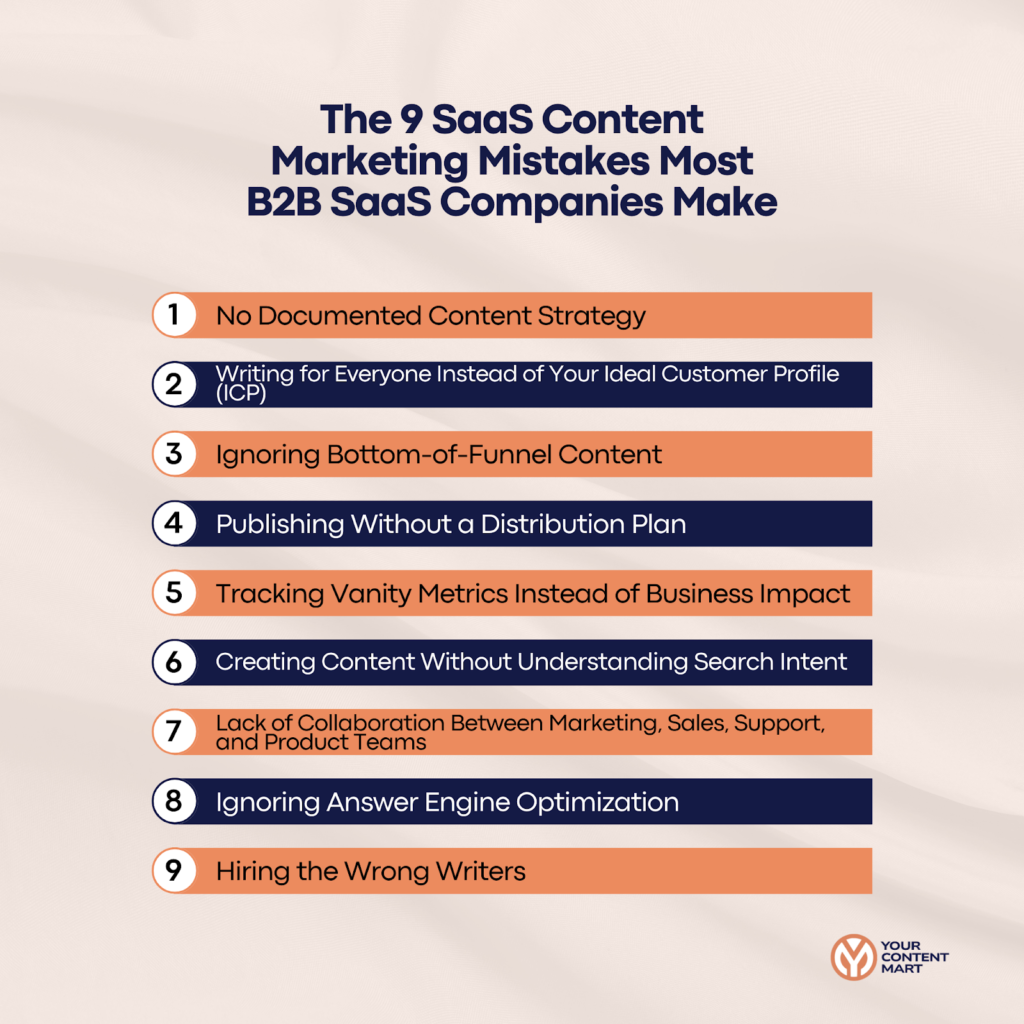
In this section, we’ll walk through the most common mistakes we see SaaS companies make with their content marketing, from publishing without a clear strategy and writing for the wrong audience to ignoring high-intent content and tracking metrics that don’t matter. For each mistake, we’ll explain why it happens, what it costs you, and how to fix it.
Mistake #1: No Documented Content Strategy
A content strategy isn’t a list of blog post topics in a spreadsheet. It’s a document that tells your team who you’re writing for, what stage of the buying journey each piece targets, and how you measure whether it worked.
Without that document, content marketing turns into guesswork. One week, the team publishes an industry trends piece; the next week, it’s a feature announcement. Then a generic how-to guide. At the end of the day, nothing connects to anything else. There’s no buyer journey mapping, no cohesion, and no purpose beyond filling the content calendar.
Your team is spending hours publishing content that doesn’t move the business forward. You’re missing chances to answer buyer objections when prospects are actively comparing options. And because no one agreed on what “success” even means, it’s hard to tell what’s working.
When Copysmith came to us, their blog was filled with generic posts that weren’t helping anyone make a buying decision. Random informational content that wasn’t ranking for anything meaningful. Meanwhile, they were burning cash on paid ads, and only 30% of their signups came from organic sources. Most of those were branded searches from people who already knew them.
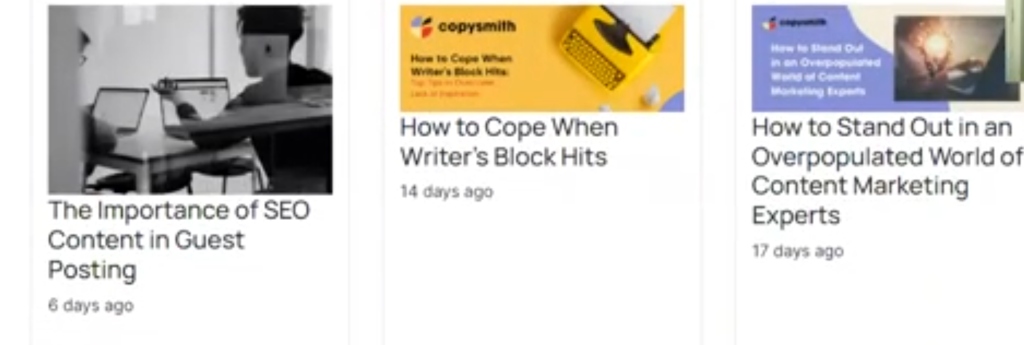
What the Copysmith blog looked like before working with us
How To Fix The Content Strategy Mistake
Start by defining what you want the content to achieve. More trial signups? Shorter sales cycles? Lower acquisition costs?
Then build a documented strategy that covers these three things:
Who are you writing for? Define your ICP (Ideal Customer Profile) in detail. Rather than say “SaaS marketers”, be more specific: “Head of Marketing at Series A SaaS companies with 20-50 employees who currently rely on paid ads and want to build an organic channel.”
What content will you create and why? Map content to your buyer’s journey. Someone learning about a problem needs different content than someone comparing two tools. Prioritise content that targets buyers closer to a purchasing decision.
Also, remember that B2B SaaS buyers typically take months to make decisions, often involving multiple stakeholders, which means your content needs to serve technical evaluators researching solutions, champions building internal business cases, and decision-makers comparing final options.
How you’ll measure success. Track signups and pipeline influence, not just traffic. A blog post that drives 200 visitors and 15 trial signups is worth more than one that drives 10,000 visitors and 0 signups.
This was exactly what we did for Copysmith. We built a documented strategy focused on buyer-intent keywords and conversion-focused content. Instead of “what is AI copywriting” articles, we targeted commercial keywords like “Copy AI alternatives” and created product comparisons that helped prospects make buying decisions. Monthly signups grew from 529 to 3,457 in 8 months, a 553% increase, and organic became their #1 acquisition channel.
Mistake #2: Writing for Everyone Instead of Your Ideal Customer Profile (ICP)
“We don’t want to narrow our audience” is the most expensive lie SaaS marketers tell themselves, because generic content converts nobody.
When you try to speak to enterprise CTOs, mid-market product managers, and solo founders in the same article, you end up with watered-down fluff that resonates with none of them.
Say you sell a CRM tool and you publish a blog post titled “How to Build Better Customer Relationships with [Your Product].” An enterprise CTO reading that wants to know about how your tool can help with API integrations, data migration from Salesforce, and compliance with SOC 2. A mid-market product manager wants to see how it fits into their existing workflow alongside Jira and Slack. A solo founder just wants to know if it’s cheaper than HubSpot and whether they can set it up in an afternoon.
One article can’t serve all three. So it serves none of them well. The CTO leaves because it’s too basic, the founder leaves because it’s too vague, and the product manager leaves because it doesn’t address their stack.
Generic content competes with everyone and resonates with no one. ICP-specific content competes with almost no one and is more likely to resonate with readers and address their pain points.
How To Fix The ICP Targeting Mistake
Go deeper than company size and industry. What tools does your ICP use today? What problems keep them up at night? How do they search for solutions? The more specific you get, the better your content performs.
Then write content that speaks directly to that profile.
For example, if your ICP is engineering managers at Series A startups, instead of writing “How to Improve Team Productivity,” write “How Engineering Teams Under 20 People Can Cut Sprint Planning Time in Half.” Use their vocabulary. Reference their stack and address their constraints, like a limited budget and no dedicated project manager.
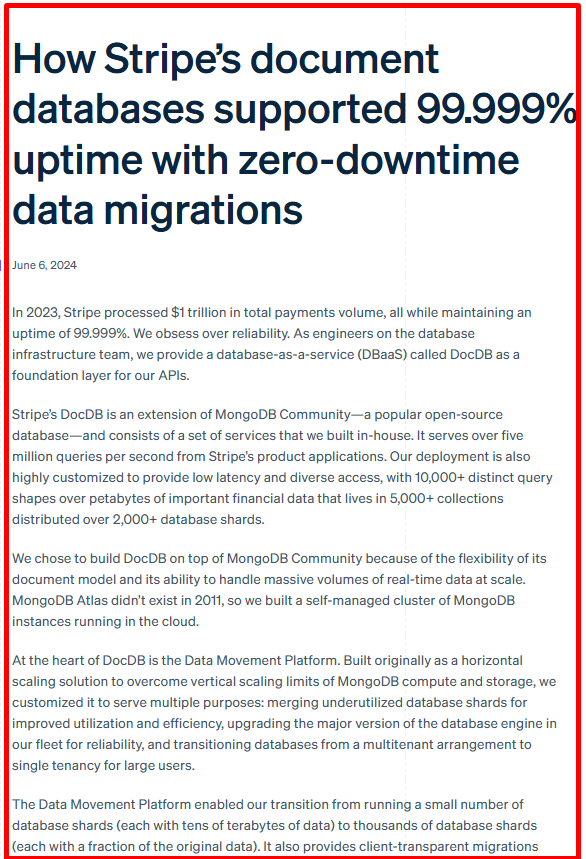
Companies that do this well make it obvious who their content is for. Stripe’s blog reads like it was written by developers, for developers. For example, this blog post, “How Stripe’s document databases supported 99.999% uptime with zero-downtime data migrations,” dives into MongoDB internals, database sharding, and data migration. It wastes no time trying to explain the engineering terms used throughout the article. They assume their reader already knows, and that specificity is what makes Stripe’s content among the most-shared technical writing on the internet.
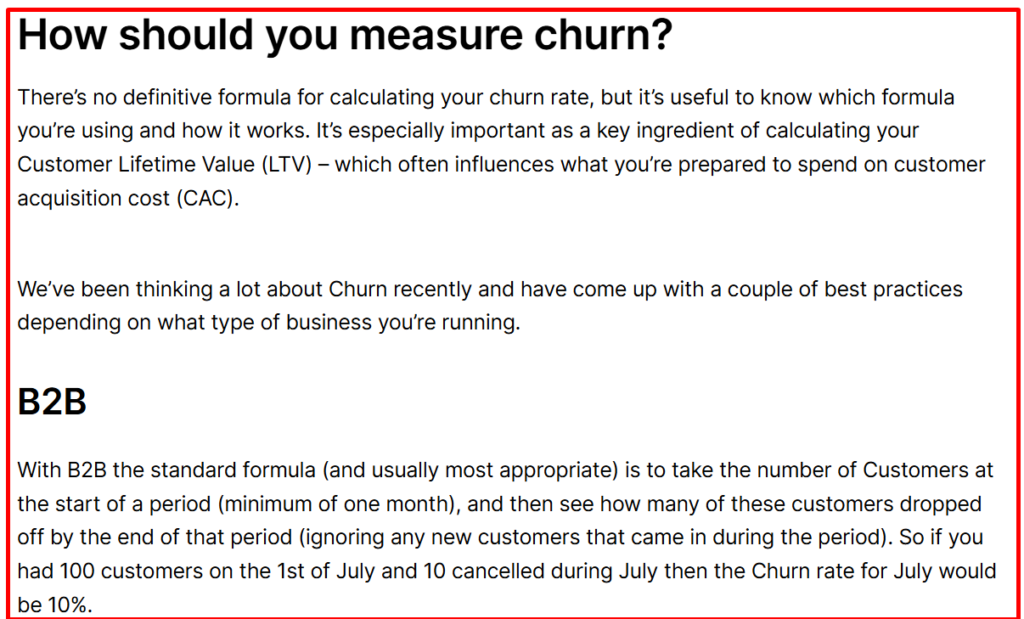
Another example of an article that writes with a clear ICP in mind is this piece from ChartMogul, a subscription analytics platform built for SaaS founders and finance operators. In their post, “How should you measure churn?”, they begin by discussing customer lifetime value, CAC ratios, and how mixing annual and monthly plans can distort churn reporting. They don’t waste time defining churn because they assume the reader already understands the metrics and language SaaS teams use every day.
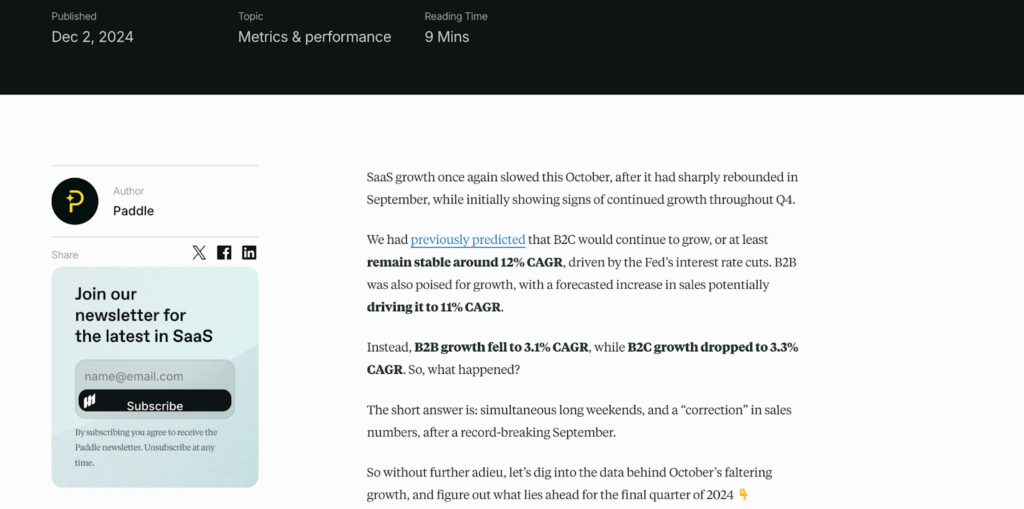
One other example of content that zooms in on its target audience is Paddle’s SaaS market report.
Paddle is a SaaS billing platform, and they know that anyone reading a subscription metrics report is already deep in this world. So they don’t waste time defining terms. The post opens with “B2B growth fell to 3.1% CAGR” in the first sentence and moves straight into MRR indices, expansion revenue, and churn breakdowns. Anyone unfamiliar with SaaS finance terminology will get lost in the second paragraph. But for Paddle’s target audience, it reads like a language they already speak.
The counterintuitive truth is that narrowing your focus actually expands your reach: when content deeply resonates with your ICP, they share it, link to it, and become advocates, whereas generic content is ignored because no one feels it was written specifically for them.
Mistake #3: Ignoring Bottom-of-Funnel Content
Most SaaS companies fill their blog with top-of-funnel content and wonder why traffic doesn’t convert.
They publish articles such as “What is CRM Software?” and “10 Tips for Better Email Marketing.” That content might rank, but it attracts people who are not ready to make a purchase. Someone searching “what is CRM software” is learning. Someone searching “HubSpot vs Salesforce for startups” is evaluating the options. The second person is closer to pulling out their credit card.
Bottom-of-funnel (BOFU) content targets buyers who are actively comparing, evaluating, or ready to switch. These are the searches that drive signups. Yet, most content calendars are stuffed with awareness content. Posts like “The Ultimate Guide to Time Management” or “How to Be More Productive at Work.” Those might rank and drive traffic, but they attract people who are farther away from buying anything.
At Your Content Mart, we always recommend targeting keywords with higher purchase intent, regardless of search volume.
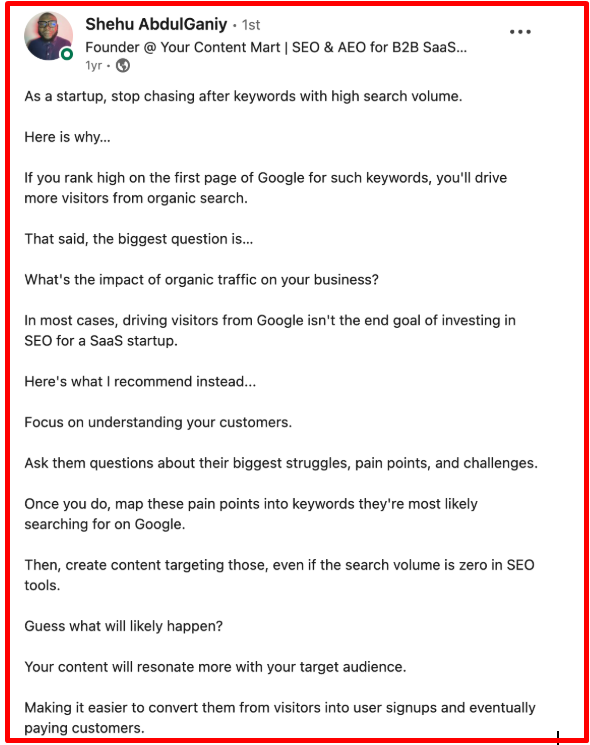
Think about it. When someone searches “Salesforce alternative for bootstrapped startups” or “Slack vs Teams for remote engineering teams,” they’re not casually browsing. They have a specific problem and are actively seeking a solution. The search volume for these hyper-specific searches is always low, but the people making them are most likely already in buying mode.
How To Fix The Bottom-of-Funnel Content Mistake
Create content for buyers who are ready to make a decision. Some categories of BOFU content to consider are:
Alternative pages: “[Competitor] alternatives” listicles that position your product alongside others. These types of articles capture buyers actively searching beyond well-known brands. For example:
- “Calendly alternatives for small teams”
- “Mailchimp alternatives with better automation”
- “Zendesk alternatives for SaaS startups”
- “Asana alternatives for engineering teams”
Comparison pages: “Your Product vs [Competitor]” head-to-head positioning with feature tables, pricing breakdowns, and honest acknowledgment of where competitors might be stronger (which builds trust). Be direct about your unique advantages without sounding defensive. Examples of comparison pages include:
- “HubSpot vs Salesforce: Which CRM is better for startups?”
- “Notion vs Confluence for technical documentation”
- “Slack vs Microsoft Teams for remote engineering teams”
- “Mixpanel vs Amplitude: Which analytics tool should you choose?
Product-led content: Feature announcements, integration guides, use case walkthroughs showing your product solving real problems. This isn’t promotional fluff; it’s educational content that also demonstrates product value. Examples of this type of content include:
- “How to Sync Your Outlook and Google Calendar in 3 Steps” (for a calendar tool)
- “How to Automate Client Onboarding with [Your Product] + Zapier.”
- “5 Ways Marketing Teams Use [Your Product] to Cut Reporting Time.”
- “How [Your Product]’s New API Integration Works with Salesforce”
- “5 ways to use [Your Tool]’s API to customise your dashboard.”
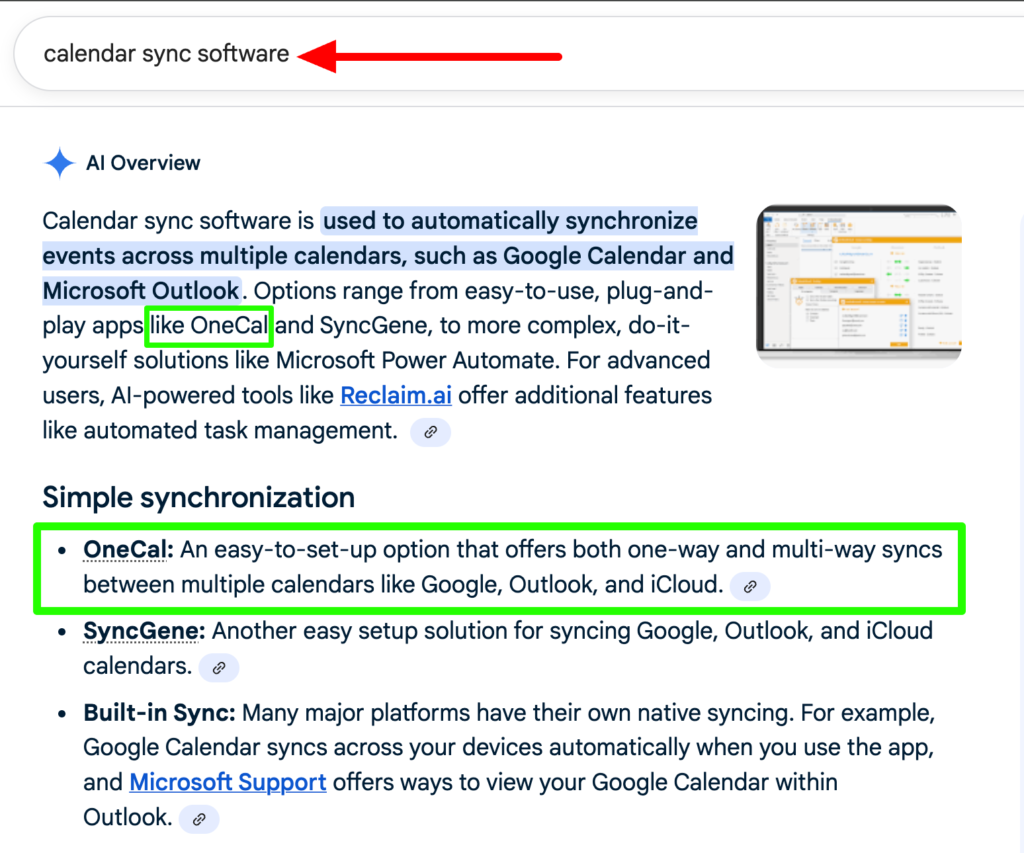
This is the approach we used with OneCal. We created comparison and alternative content that their competitors ignored, which helped them rank on page one and reach #1 in Google AI Overviews for “calendar sync software.” In five months, their traffic grew by 291%, and it continued to grow even after our engagement ended.
Awareness content fills the top of the funnel, but BOFU content is what helps you close deals.
Mistake #4: Publishing Without a Distribution Plan
Many SaaS teams put all their energy into writing the post, then treat promotion as a quick afterthought.
They’ll spend days researching, pulling insights from customer calls, and polishing the draft. Then they publish it, share it once on LinkedIn, maybe drop it in a Slack channel, and move on.
And that’s usually the end of it.
Weeks later, the post is sitting there with barely any traction. Not because it’s bad, but because it never reached the people it was written for. At that point, it doesn’t matter how good the article is. If nobody sees it, it may as well not exist.
This is also where teams start getting frustrated and content becomes harder to defend, even if the work itself is solid.
As Joe Pulizzi, co-founder of the Content Marketing Institute, said in his book Get Content Get Customers: “Before you create any more ‘great content,’ figure out how you are going to market it first.”
How To Fix The Distribution Mistake
Build a systematic distribution plan that promotes every piece across multiple channels. Ann Handley, Chief Content Officer at MarketingProfs, has been saying for years: “we’re past the age where if you build it, they will come.” Promotion needs to be built into your content strategy from day one.
Here’s what a practical distribution checklist looks like for a single piece. Say you published an article: “HubSpot Alternatives for Early-Stage Startups.”
Owned channels:
- Send a dedicated email to your list highlighting the key takeaways.
- Share on LinkedIn and other social media pages with a personal anecdote about why early-stage teams might need a HubSpot alternative.
- Add it as a resource in your product’s onboarding emails for new trial users
- Give your sales team a summary they can drop into outreach emails when prospects mention HubSpot
Earned channels:
- Post a condensed version in relevant Slack communities.
- Find Reddit threads where founders ask “what CRM should I use instead of HubSpot?” and share a genuinely helpful response linking to the article.
Paid channels:
- Run a LinkedIn ad targeting marketing managers at companies with 10-50 employees.
- Set up retargeting ads for people who visited your pricing page but didn’t convert.
Organic search (SEO):
- Optimise for “HubSpot alternatives” and related long-tail keywords
- Structure the article for featured snippets
- Build internal links from your existing content to this new piece
One of the easiest ways to make a post perform even better is by squeezing more value out of the content you already published. A single article like “HubSpot Alternatives for Early-Stage Startups” can be repurposed into multiple formats, so it reaches different audiences across different platforms.
Here are a few smart ways to repurpose it and keep promoting it:
- LinkedIn carousel: “7 HubSpot alternatives ranked by use case”
- Short YouTube video: “Why startups stop using HubSpot.”
- Newsletter edition: “HubSpot is not built for early-stage startups”
- Twitter/X thread: “HubSpot alternatives in 2026”
- One-page PDF comparison sheet (lead magnet)
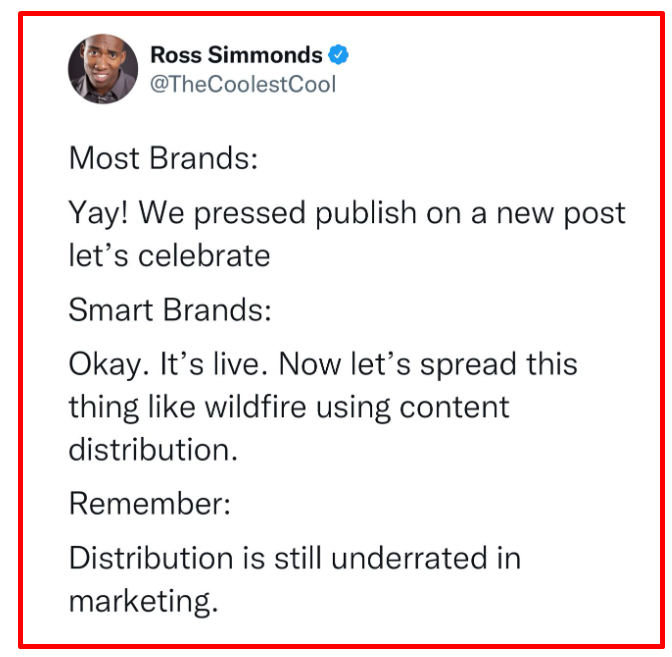
Follow the mantra of Ross Simmonds, the founder and CEO of Foundation Marketing: “Create Once and Distribute Forever.”
Mistake #5: Tracking Vanity Metrics Instead of Business Impact
“Our blog got 50,000 visitors this month!” sounds impressive until someone asks how many signed up for trials, how many became paying customers, and what the pipeline influence looks like, questions that are usually met with silence.
Traffic can be a vanity metric that feels good but doesn’t pay salaries, and optimizing for page views instead of business outcomes is how you end up with a content program that looks busy in dashboards but fails to justify its budget during quarterly reviews.
How To Fix The Vanity Metrics Mistake
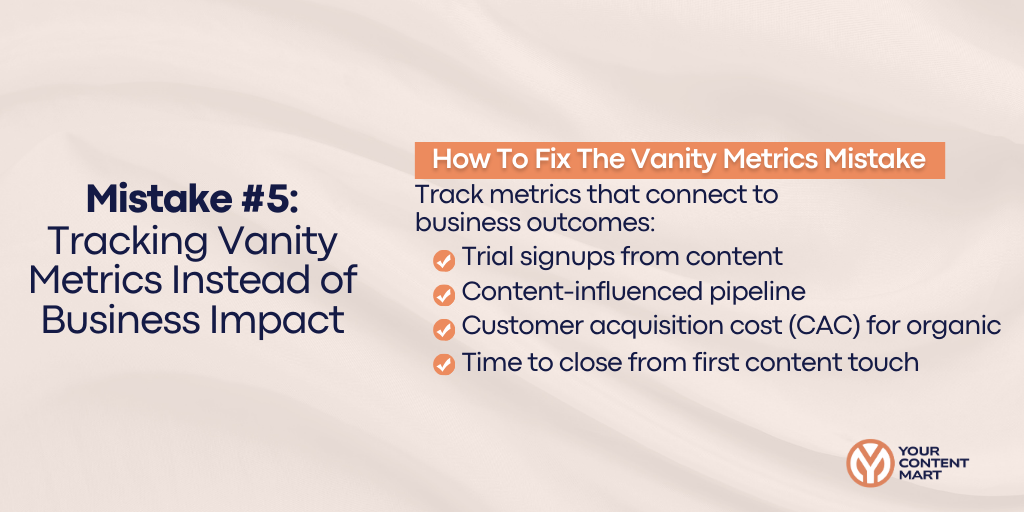
Track metrics that connect to business outcomes:
Trial signups from content – Use UTM parameters and proper attribution to track which content pieces drive actual signups, not just visits. A blog post with 500 visits driving 20 trials beats one with 10,000 visits driving 5 trials every single time.
Content-influenced pipeline – Which content did prospects consume before becoming SQL? Marketing automation platforms like HubSpot track content touchpoints throughout the buyer journey. This shows which content actually influences deals.
Customer acquisition cost (CAC) for organic – Calculate your content program cost divided by customers acquired through organic channels. Compare this to paid acquisition CAC. Content marketing costs 62% less than traditional marketing while generating better leads.
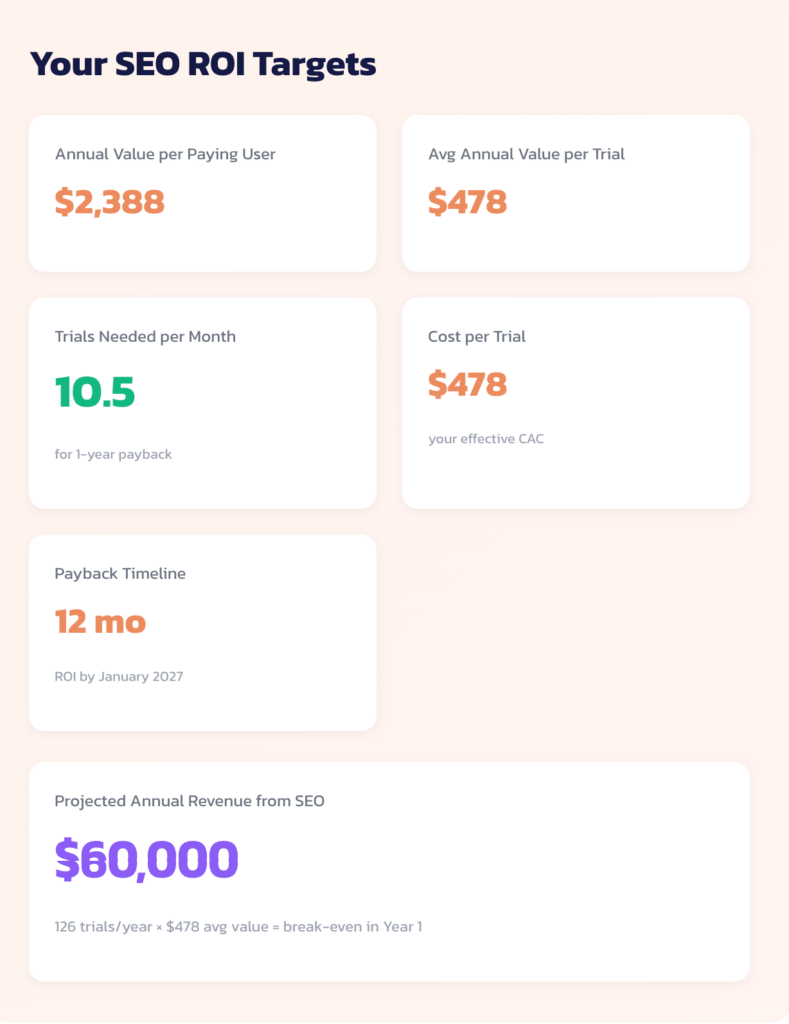
Not sure if your SEO investment makes financial sense? Use Your Content Mart’s free SaaS SEO ROI Calculator to understand exactly how many trial signups you need to justify your content spend and see when you’ll break even.
Time to close from first content touch – Content that educates buyers typically shortens sales cycles. Track how quickly deals close when prospects engage with your content vs cold outreach.
According to Andy Crestodina, CMO at Orbit Media, “Some keyphrases are question marks, other keyphrases are dollar signs.” Focus on the dollar signs.
Mistake #6: Creating Content Without Understanding Search Intent
Search intent is the reason behind a search query. It tells you what the searcher is trying to accomplish when they search on Google.
This is important because two keywords can look similar on the surface but carry completely different intent. Someone searching “what is email marketing software” wants to learn. Someone searching “Mailchimp vs ConvertKit pricing” wants to compare options before buying. If you create an educational guide for the second keyword, you’ll miss the mark completely. The searcher wanted a comparison, not a lesson.
When your content doesn’t match what the searcher is looking for, Google notices. Your page might rank briefly, but if users bounce because they didn’t find what they expected, your rankings will drop quickly. Search intent mismatch kills conversion rates faster than almost any other content marketing mistake.
How To Fix The Search Intent Mistake
Before creating any content, search for your target keyword and review what Google already ranks. The results tell you exactly what type of content to create.
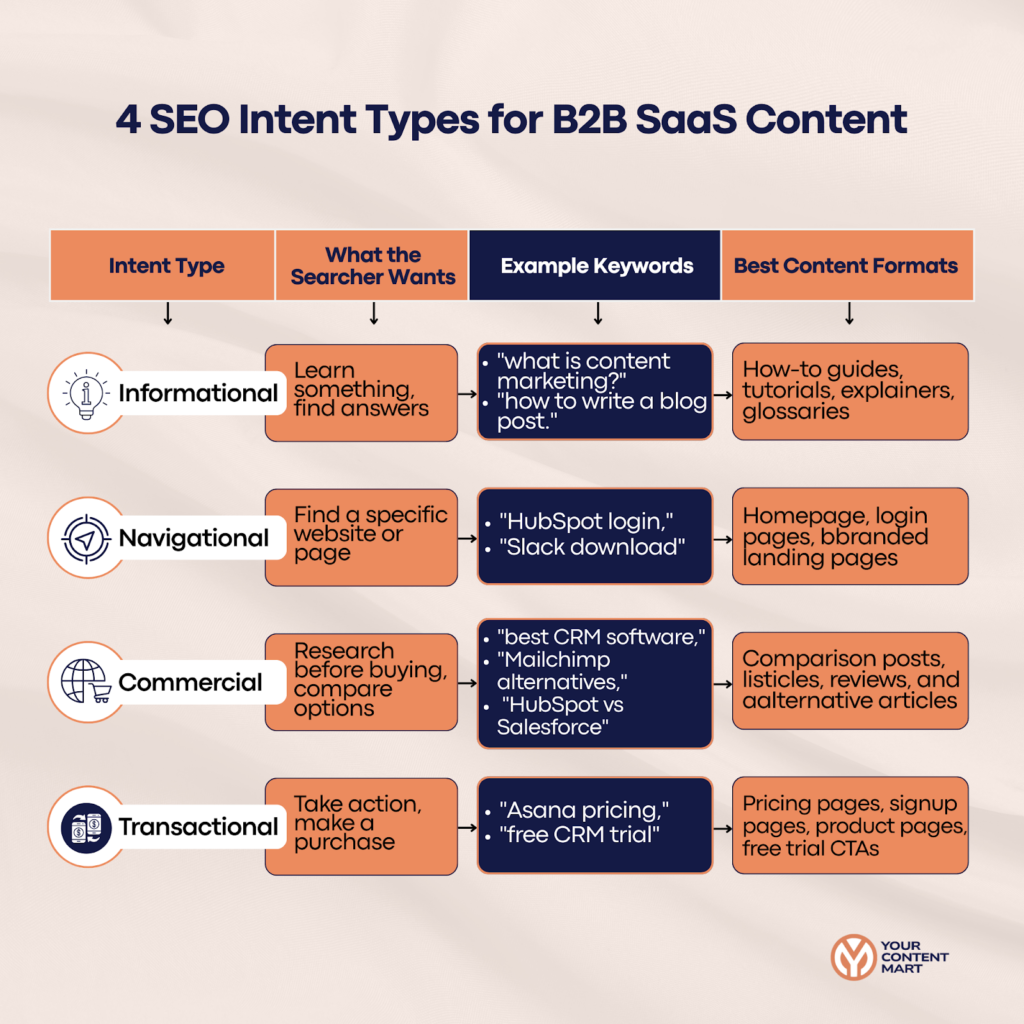
If the top results are guides, definitions, and explainers, you’re looking at informational intent, which means searchers want to learn something. Your content needs to educate first, and hard sells won’t rank here because that’s not what people are looking for.
If Google shows comparisons, reviews, and “best X for Y” lists, that’s commercial intent. Searchers are evaluating their options and trying to figure out which solution fits their needs. This is where conversion-focused content belongs because readers are already in buying mode and just need help making a decision.
If the results are product pages, pricing pages, and signup flows, you’re looking at transactional intent. Searchers already know what they want, and they’re ready to buy. A blog post won’t serve them here because they don’t necessarily need more information; they need a place to convert.
And if someone searches “Slack login” or “HubSpot pricing,” they want to go directly to that specific company’s website. That’s navigational intent, and there’s no point creating content for branded searches that belong to another company.
Let’s say you’re targeting “project management software.” Before creating content, search that term and analyze what’s ranking:
- If the top results are listicles (“10 Best Project Management Tools”), you need a listicle
- If they’re comparison pages, you need comparison content
- If they’re in-depth guides, you need comprehensive coverage
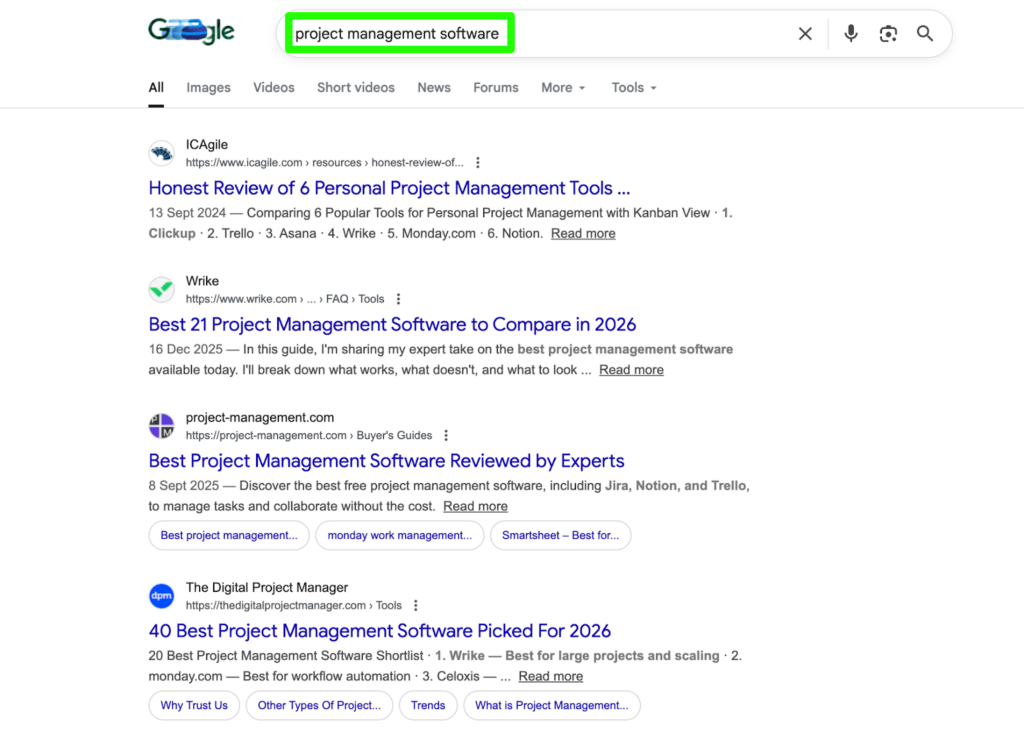
As you can see, the top results for this keyword are listicles. Creating comparison content or an in-depth guide for a keyword where Google ranks listicles is a mismatch. Your content might be excellent, but it just won’t rank because it doesn’t serve what searchers actually want.
Look at the top 10 results for your target keyword. What format dominates? Listicles? Comparison tables? How-to guides? Deep technical documentation? Match that format because Google has already determined what satisfies search intent.
Mistake #7: Lack of Collaboration Between Marketing, Sales, Support, and Product Teams
Your sales team hears objections daily. Support sees recurring questions. Product knows which features customers request most.
Yet most content teams create in isolation, relying on keyword tools instead of these goldmines of buyer intelligence.
52.2% of salespeople say companies lose revenue when sales and marketing don’t align. Content created without sales input misses the objections that kill deals. Content without support input ignores the questions that create support tickets.
How To Fix The Cross-Team Collaboration Mistake
Create dedicated collaboration channels so insights flow continuously, not just during scheduled meetings.
For teams that prefer structure, a bi-weekly or monthly sync can supplement the async channel. Use it to identify patterns and prioritize which insights become content.
Here’s what to ask each team:
Sales team – What objections come up repeatedly? Which competitors do prospects evaluate you against? What questions delay deals? Where do prospects get stuck in the buying process?
Support team – What questions fill your ticket queue? Which features confuse new users? What documentation gaps create frustration? Where do users struggle most?
Product team – Which features drive the most value? What’s on the roadmap that solves major customer pain points? Which integrations do customers request most? What use cases weren’t originally anticipated?
These conversations surface content opportunities that no keyword tool reveals. When we interviewed Copysmith’s team, we understood that their ideal customers were not looking for guest-posting tips but were looking for alternatives to similar tools like Copy.ai. We created comparison content targeting their search intent. This resulted in high-intent traffic that converted better than the informational content they previously focused on.
Create a shared Slack channel or regular sync meeting and make it easy for these teams to flag content opportunities when they spot patterns. The best content ideas come from people who talk to customers daily, not marketers staring at Semrush dashboards.
Mistake #8: Ignoring Answer Engine Optimization
Google search is evolving. ChatGPT, Claude, Perplexity, Gemini, and other AI tools are changing how buyers research solutions.
When someone asks ChatGPT, “What’s the best project management tool for engineering teams,” your blog post might not surface, unless you’ve optimized for AI-powered answer engines alongside traditional search.
We helped OneCal earn the #1 spot in Google AI Overviews for “calendar sync software” above well-funded competitors, and that wasn’t by accident; it was strategic Answer Engine Optimization.
How To Fix The Answer Engine Optimization Mistake
AEO isn’t separate from SEO. It’s an extension. Content optimized for helpful, accurate answers performs well in both traditional search and AI tools.
Structure content for AI citation:
- Clear, direct answers to specific questions
- Well-organized information with descriptive headers
- Factual statements with supporting evidence
- Comprehensive coverage of subtopics
- Natural language that reads conversationally
Instead of stuffing keywords, focus on building genuine expertise in your content. AI tools pick up on depth and specificity. When we create comparison content, we include detailed feature breakdowns, actual pricing, real user scenarios, and honest assessments of when competitors might be a better fit. AI tools reward that kind of thoroughness because it gives them confident, citable information.
The goal isn’t to trick AI models. It’s creating content so genuinely helpful that AI tools confidently cite it as authoritative. Andy Crestodina, co‑founder and CMO of Orbit Media Studios, recently explained in a talk on AI visibility that the path to being recommended by AI starts with helping people first. That means making your content genuinely helpful and easy for both humans and AI systems to understand, so your brand shows up in the contexts that matter.
Things are changing fast, but the basics haven’t. Make content that’s complete, accurate, and genuinely useful for people. That’s what works for Google, ChatGPT, Claude, or any other AI.
Mistake #9: Hiring the Wrong Writers
Cheap writers create cheap content. Generalists create generic content. SaaS content demands writers who understand technical products, long sales cycles, and buyer-intent keywords.
You get what you pay for. $50 blog posts usually deliver $50 results. And even AI-generated content, without proper human oversight, delivers the same generic advice already flooding every SERP.
How To Fix The Writer Hiring Mistake
When evaluating writers, look for:
SaaS writing experience – Have they written for technical B2B audiences before? Do they understand software buying cycles? Can they explain complex features clearly?
Research capability – Can they conduct customer interviews? Do they ask clarifying questions about product positioning? Will they talk to your sales and support teams?
SEO understanding – Do they know the difference between informational and commercial keywords? Can they structure content for featured snippets? Do they understand search intent?
Technical depth – Can they write for engineering audiences without oversimplifying? Will they take time to understand your product thoroughly?
This is exactly why we built Your Content Mart as a specialized SaaS content marketing and SEO agency. Our entire operation is built around one methodology: the Signup Engine Framework. While most agencies optimise for traffic, we reverse-engineer the signup process and create content that consistently feeds it.
And to make that work, we have an in-house team of writers with deep B2B and SaaS experience. People who understand buyer psychology, technical products, and the kind of content that drives signups. So instead of cycling through freelancers who need weeks of onboarding (and still miss the mark), our clients get content that converts from day one.
See how we’ve helped SaaS companies like Copysmith and OneCal drive real results →
How Your Content Mart Helps SaaS Companies Avoid These Mistakes
Every mistake in this article stems from the same root issue: a gap between content output and content strategy. Fixing that gap is what we do at Your Content Mart.
We’re a specialised SEO and content marketing agency built exclusively for B2B SaaS companies. Our Signup Engine Framework is designed to turn organic search traffic from Google and AI tools into trial signups and paying customers. Here’s how it works:
We start with your product, not a keyword tool. Our writers create accounts, test features, run through onboarding flows, and document what works and what causes friction. When we write about your product, we’re drawing on direct experience with it.
We interview your customers. Before we touch a content calendar, we talk to your buyers, your sales team, and your support team. This reveals the searches your competitors miss and buyer-intent keywords that don’t appear in Semrush or Ahrefs.
We prioritise content that drives signups. Every piece maps to your buyer journey. We start with BOFU content first, alternative pages, comparison articles, and use case pieces, because these target people actively looking to buy.
We optimise for Google and AI answer engines. Buyers now also search on ChatGPT, Perplexity, and Google AI Overviews. We structure content to rank well in traditional search and get cited in AI-powered tools.
We track signups, not just traffic. Our reporting focuses on trial signups and revenue attribution. Traffic is a means to an end, not the end itself.
If your content is generating traffic but not signups, that’s a strategy problem. And it’s fixable.
Ready to ditch these content marketing mistakes? Get a free content analysis where we identify exactly what’s broken in your current content program and show you the specific fixes that will move the revenue needle.

Shehu AbdulGaniy is the Founder of Your Content Mart. He helps B2B SaaS companies drive paying customers from SEO and AI search.