

7 Best SEO Agencies for SaaS Companies with No Organic Traffic
When a SaaS product is new, growth usually leans on channels that deliver results fast. Paid acquisition is often the starting point because it gives immediate feedback. You can test positioning, validate demand, and start generating signups without waiting months.
That works, but it gets expensive over time. As competition increases, customer acquisition costs rise, margins tighten, and growth becomes tied to how much you’re willing to spend each month. The moment you pull back, the pipeline slows down.
At some point, the conversation shifts to organic search. That’s when founders and marketing leads start typing queries like “best SEO agencies for SaaS companies with no organic traffic,” looking for a way to build a channel that compounds instead of resetting every month
The challenge is that building organic traction from scratch is a different job from improving an existing blog or ranking a few pages higher. It requires a strategy designed for zero or low organic visibility, not one that assumes you already have momentum. After reviewing 15+ agencies, a few stand out for helping SaaS companies grow from little to no organic visibility.
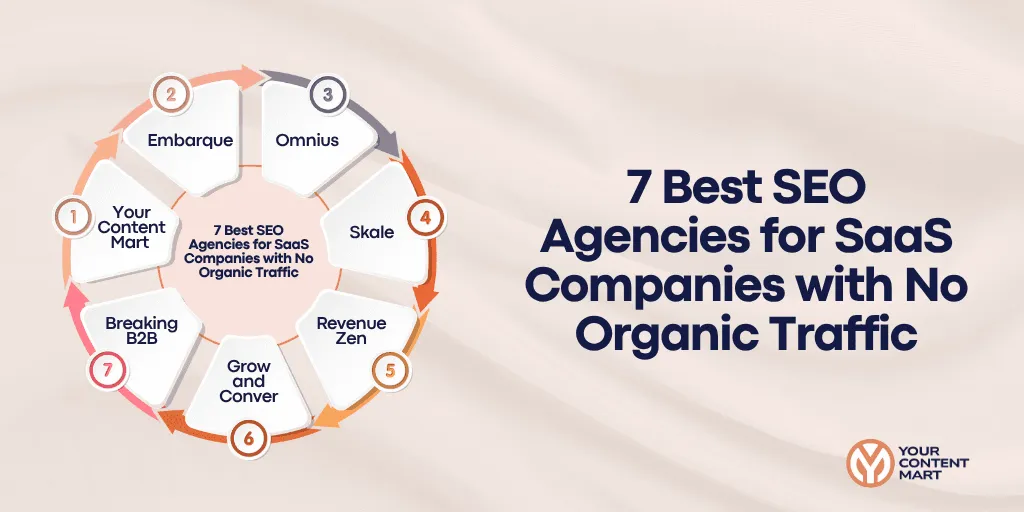
7 SEO Agencies for SaaS Companies with No Organic Traffic
Here is a list of 7 SEO agencies for SaaS companies with no organic traffic:
| Agency | Starting Price | Best For | Core Specialty | Notable Clients |
| Your Content Mart | $4,250/month (6-month plan) | B2B SaaS building signups from search and AI assistants | Signup Engine Framework with signup tracking and a revenue guarantee | Copysmith, OneCal, SweetProcess |
| Embarque | Full SEO service plans range from $1,699/month to $4,900/month | Early-stage bootstrapped SaaS | Product-led content with flexible contracts | BlueTally, Stagetimer, Instatus, VEED |
| Omnius | Custom Pricing | Series A+ funded SaaS | AI search optimization with their AtomicAGI tool | Zencoder, Meniga, Anna Money |
| Skale | ~$5K+/mo | Series A+ PLG SaaS | Sign up and revenue metrics focus | Holded, Rezi, Maze, Typeform |
| RevenueZen | $2,500/mo | Mid-market B2B SaaS | Pipeline attribution with CRM integration | Incfile, Smartsheet, Dooly. |
| Grow and Convert | $10,000/mo | Funded SaaS with PMF | Pain Point SEO with interview-based content | Circuit, Leadfeeder, Smartlook |
| Breaking B2B | $4,000/mo | Growth-stage B2B tech ($2M-50M ARR) | tech ($2M-50M ARR)Bottom-funnel content strategy | ClickHouse, Payara, Wildsparq |
1. Your Content Mart

Your Content Mart is a done-for-you SEO and AI search agency for B2B SaaS companies, working with SaaS companies since 2016 and led by our founder, Shehu AbdulGaniy. While most agencies report rankings and traffic, we focus on conversions as our primary metric, meaning every piece of SaaS content we create is measured by how many trial signups and paying customers it brings in.
Our methodology is built around one framework designed specifically for companies with no organic traffic who need to build sustainable signup engines.
How the Signup Engine Framework Works

Stage 1: Product-First Research
Most agencies start by opening Ahrefs and targeting the same keywords everyone else is fighting over, which means you’re competing against companies with years of domain authority and millions in SEO content budgets. We start by understanding your product and interviewing your actual customers to understand how they currently solve the problem your product addresses, which reveals “current solution” search queries that competitors haven’t discovered yet.
These are the searches happening before buyers know your product category exists, like “how to sync Google Calendar with Outlook without Zapier” instead of “best calendar sync tools.” For SaaS companies starting from zero, this creates an immediate advantage because you’re ranking for buyer-intent keywords with little competition while your competitors are fighting over saturated terms.
Stage 2: Signup-Intent Strategy
We target keywords that signal someone is ready to switch tools, compare options, or make a purchase decision. These aren’t informational queries that bring curious visitors who bounce after reading one paragraph; these are commercial-intent searches from people actively evaluating solutions.
Every month we publish 4 new product-tested pages (2 in month one), focused on types that tend to convert better than top-of-funnel content:
- Alternative pages that position your product in “[Competitor] alternatives” listicles alongside established brands, which lets you intercept buyers who’ve already decided to switch
- Comparison pages with head-to-head “[Your Product] vs [Competitor]” breakdowns, including feature tables and honest assessments of when each tool is the better choice
- Best-of pages that put your product in “best [category] tools” lists that buyers read when they are choosing between options
- Use case content showing your product in action for specific industries or roles, like “email warm-up for cold outreach agencies” instead of “what is email warm-up.”
Stage 3: Conversion-Focused Content
Every piece includes CTAs designed specifically for where the reader is in their decision-making process, so someone reading an alternative page sees completely different CTAs than someone reading a how-to guide. We structure our content creation to answer buyer questions thoroughly while guiding them toward the next logical step, whether that’s trying a specific feature, comparing pricing, or starting a trial.
Stage 4: Revenue Attribution
As your SEO growth partner, we set up signup tracking in month one, and every monthly report shows the signup count, so you see which pages bring in trials. We measure ROI by what those signups are worth: in month one we set a target from your own signup-to-paid rate and first-year revenue per customer, which means you know whether your SEO investment is generating revenue.
Stage 5: AI Search Optimization
Your buyers aren’t just Googling anymore because they’re asking ChatGPT for tool recommendations, using Perplexity to research solutions, and trusting Claude to compare options. When someone asks an AI “What’s the best calendar sync app?” or “Show me Calendly alternatives,” your product needs to appear in that answer, or you’re invisible to a growing percentage of your market.
We optimize content to rank in both traditional Google results and AI-generated recommendations, and every month we check 25 buyer questions across ChatGPT, Perplexity, Gemini, and Google’s AI Overviews to see whether your product shows up. This matters more for zero-traffic companies than established brands because AI search creates new ranking opportunities where domain authority matters less than content structure and relevance signals.
Results We’ve Driven for SaaS Companies
Copysmith came to us with 529 monthly sign-ups and a heavy reliance on paid ads, which were driving up their customer acquisition cost every quarter.

Copysmith’s traffic and conversion rates before working with Your Content Mart
Eight months into working together, they hit 3,457 monthly signups, which represents 553% growth from baseline. Their organic signup conversion rate jumped from 13.2% to 23.7%, meaning they were getting nearly twice as many signups with the same amount of traffic.

Copysmith’s traffic and conversion rates after working with Your Content Mart
OneCal was competing against VC-backed calendar sync tools with millions in funding and years of content headstart. We grew their organic traffic from 8,000 to 31,300 monthly clicks (291% increase) and helped them earn the #1 recommendation spot in Google’s AI Overview for “calendar sync” searches, ahead of those VC-backed competitors.
SweetProcess got over 1,000 signups a month from organic search between October 2024 and April 2026.
Pricing
We sell one plan, the Signup Engine: done-for-you SEO and AI search for B2B SaaS. It costs $5,000 a month, month to month, and you can stop with 30 days’ notice. It is $4,500 a month on a 3-month plan, or $4,250 a month on a 6-month plan. The work and the guarantee are the same on every plan.
Every month, you get:
- 4 new product-tested pages (2 in month one): alternatives, comparison, best-of, and use-case pages, written by people who have used your product
- 2 refreshes of existing pages
- On-page and technical work: internal links, titles, meta, and schema
- AI search checks on 25 buyer questions across ChatGPT, Perplexity, Gemini, and Google’s AI Overviews
- Disclosed Reddit and community answers
- Outreach for links
- Signup tracking set up in month one, and a monthly report with the signup count
- A monthly strategy call and weekly written updates
- One linkable asset a quarter (an original stats page or data study)
Work starts in week one, with no month-long strategy phase. Refreshes go live in week 2, and the first 2 new pages go live in weeks 3 and 4. Shehu AbdulGaniy, our founder, leads every account, and there is no account manager. Paid ads, social media, and website design or development are not included.
The guarantee: by month six, the signups our pages bring from Google and AI assistants will be worth at least $5,000 a month. We set that number in month one from your own signup-to-paid rate and first-year revenue per customer. If we miss it, we keep working for free for up to three months. We only offer the guarantee when our forecast is at least twice that number. You can also get your first month’s fee back if you are not happy (ask within 30 days). See our refund policy for the full terms and our pricing page for every plan.
2. Embarque

Source: Embarque
Embarque is an SEO agency that works primarily with early-stage SaaS companies and centres its approach on product-led content. Instead of relying on generic research-based articles, the team builds content around actual product usage, which helps make the output more aligned with how users experience the tool.
According to their published case studies, this approach has produced notable results. BlueTally reportedly grew from 52 monthly visitors to 7,663 over the course of a two-year engagement. In another example, Instatus is said to have experienced 1,500% traffic growth alongside an 833% increase in monthly recurring revenue during their time working together.
Pricing: Full SEO service plans range from $1,699/month to $4,900/month, depending on scope and hours included.
3. Omnius

Source: Omnius
Omnius is a London-based B2B SEO agency that focuses heavily on AI search optimisation for SaaS, fintech, and AI companies. A key part of their positioning is AtomicAGI, a proprietary tool designed to track brand visibility across platforms like ChatGPT, Perplexity, Gemini, and Claude.
Their strategy leans on what they describe as a reversed funnel approach, where bottom-of-funnel content targeting sales-qualified leads is prioritised before expanding into broader awareness topics.
Based on their published results, the agency claims to have taken one Speedinvest-backed AI SaaS company from zero to 2.73 million organic clicks in 13 months. In another case, they report scaling an Entrepreneur First-backed startup to 60,000 monthly visits within seven months.
Pricing: They offer custom pricing based on the engagement scope.
4. Skale

Source: Skale
Skale is an organic growth agency that works mainly with funded B2B SaaS companies, particularly those operating product-led growth models. Unlike agencies that emphasise traffic volume, Skale claims to position itself around signups and revenue as primary success metrics.
Their case studies also reflect that focus. Holded, a business management SaaS, reportedly saw a 1,370% increase in organic signups alongside a 279% increase in revenue over a 12-month period. In another example, Rezi reportedly achieved a 243% increase in signups and a 176% increase in revenue within four months.
They use what they call an “SEO Revenue Engine Framework” that models expected MRR impact before work begins and employs “topic stacking,” building content in tight sequential clusters to rapidly establish topical authority in specific areas.
Pricing: Custom pricing based on engagement scope.
5. RevenueZen

Source: RevenueZen
RevenueZen is a B2B SEO agency that works mainly with SaaS and technology companies. The firm focuses on connecting SEO efforts to business outcomes such as pipeline and revenue rather than treating traffic growth as the primary success metric.
Their strategy emphasizes high-intent pages that target buyers closer to the purchasing stage. Founder Alex Boyd has often argued that most B2B SEO should prioritize “money pages” tied to product features or use cases, where conversions and sales opportunities are more likely to originate.
According to their case studies, this approach has delivered significant outcomes. Their work with Incfile, now part of Bizee, reportedly led to a 400% increase in organic traffic and a 300% increase in revenue within the first year. Over a longer engagement, the company is said to have scaled to 3,000% traffic growth and an 800% increase in revenue from organic search.
Pricing: Retainers start at $2,500/month with month-to-month, 6-month, and 12-month contract options available
6. Grow and Convert

Source: Grow and Convert
Grow and Convert is a B2B content marketing agency that pioneered “Pain Point SEO” in 2018 and built its entire service model around conversion-focused keyword targeting. Their approach inverts traditional SEO by prioritizing conversion intent over search volume, which means they target keywords that drive trials and customers rather than just traffic.
Their Circuit Route Planner case study highlights this approach. According to their published data, the company grew from 920 to 14,577 monthly organic sessions within six months, while trial signups increased from 59 to 244 per month, representing a 313% increase.
Their methodology centers on three-tier keyword prioritization, starting with the highest buying intent: category keywords (direct product searches), comparison and alternatives keywords (active evaluation mode), and jobs-to-be-done keywords (problem-aware searches).
Pricing: Retainers start at $10,000/month with month-to-month flexibility
7. Breaking B2B

Source: Breaking B2B
Breaking B2B is a UK-based SEO agency focused on bottom-of-funnel strategies for B2B technology companies. The agency’s approach centres on targeting high-intent keywords first before moving up the funnel.
The founder, Sam Dunning, has also applied this methodology to his own website, reporting that it ranked from zero domain authority to the number one position for “B2B SEO agency” in both the US and UK within 90 days.
According to their case studies, ClickHouse saw a reported 37% increase in signups and a 40% increase in organic sessions. Payara is said to have achieved page one rankings within one month and increased page one keyword rankings by 182% over six months. Wildsparq reportedly ranked for competitor alternative keywords within 30 days.
Pricing: Retainers start at $4,000/month with a 90-day sprint minimum, then month-to-month.
What to Look for in a SaaS SEO Agency When Starting from Zero

When you’re starting from zero, here’s what actually separates agencies that drive revenue from ones that just drive traffic:
Revenue focus over traffic focus
Ask how they measure ROI, and listen carefully to the answer. If they start talking about keyword rankings and organic sessions without mentioning trial signups, demos booked, or MRR attributed to organic, that’s your signal they’re optimizing for vanity metrics. The right answer includes how they track organic visitors through to paying customers and what conversion rates they typically see.
Real “from zero” experience with documented proof
Case studies should show actual baseline numbers, not just percentages. When an agency says they “grew traffic 500%,” that number lacks context if you don’t know the starting point. Growth from 10 visitors is very different from growth from 10,000. Look for case studies that include specific numbers, such as “from 52 monthly visitors to 7,663.” That kind of detail shows the agency has experience building organic traffic from the ground up, not just improving sites that already had momentum.
Buyer-intent content prioritization
You need bottom-of-funnel comparison and alternative pages that drive signups from people actively evaluating tools, middle-funnel solution guides that build consideration among people solving problems, and top-of-funnel educational content that establishes authority. Agencies that only want to write top-of-funnel “what is” posts will generate traffic that does not convert.
AI search optimization capabilities
Your buyers are asking ChatGPT for tool recommendations and using other AI chat tools to research solutions, which means the agency needs to optimize for both Google and AI platforms. The difference is whether they’ve actually built frameworks and tools for this or just added “AI search optimization” to their website.
Why Your Content Mart Is Built for SaaS Companies With No Organic Traffic

The Signup Engine Framework solves three problems that companies with no organic traffic face. First, you can’t compete for high-volume keywords because you don’t have the domain authority. Second, you can’t afford to build traffic that doesn’t convert because every dollar counts. Third, you need to prove ROI quickly enough that leadership doesn’t kill the program before it has time to work.
Here’s how we solve each one.
Our Customer Research Methodology Reveals Hidden Buyer-Intent Keywords
When you have low domain authority, you can’t compete for high-volume keywords like “best CRM software” where established players with a Domain Rating of 70+ dominate. Instead, we interview your actual customers to understand the exact language they use when describing their problems and the workarounds they currently use.
We ask questions like: “Before you found [your product], how were you solving this problem?” and “What specific search terms did you use when looking for a solution?” This reveals what we call “current solution” keywords that have buyer intent but little competition.
For example, if you’re a CRM built for real estate agents, customer interviews would likely reveal “ current solution” searches like “how to track leads in Google Sheets for real estate” and “Excel template for real estate client follow-up.” These queries catch buyers actively solving the problem your product addresses, which is why they convert at much higher rates than informational content.
Most agencies would never find these keywords because keyword research tools shows zero volume. But we’ve seen these “invisible” keywords drive organic signups for zero-traffic companies. You can see more about this approach in our article on finding competitors you can’t find on G2.
Bottom-Funnel Content Strategy with Specific Examples
When you can’t afford to chase traffic that doesn’t convert, our content targets bottom-funnel keywords that drive trial signups at better conversion rates than top-funnel traffic.
For example. If you’re a CRM software company working with Your Content Mart, here’s the type of bottom-funnel content we prioritize:
Instead of writing “What is CRM software?” (top-funnel, informational), we write:
- “Salesforce vs HubSpot vs Pipedrive: Which CRM for Small Businesses?” (comparison page targeting active buyers)
- “Best Salesforce Alternatives for Real Estate Agents” (alternative page intercepting switchers)
- “How to Migrate from Excel to CRM Without Losing Data” (JTBD content catching people using workarounds)
- “CRM for Real Estate: Complete Setup Guide for Zillow Integration” (solution guide showing your product solving their specific problem)
Each piece is structured as a mini sales page for your product. We don’t just mention your CRM in a list. We show screenshots of your UI solving the specific problem, include feature comparisons that position your strengths against competitors, and end with a contextual CTA like “See how [Your CRM] automatically imports Zillow leads” instead of generic “Book a Demo.”
This is product-led content. Every article demonstrates your product in action with real screenshots, specific feature callouts, and use-case-specific CTAs. The goal is that someone reading the article can visualize themselves using your product before they even sign up for a trial.
How We Actually Create the Content
Our content creation process is built around making each piece convert:
- We interview your product team to understand the specific features that solve the problem the article addresses
- We get full access to your product and become actual users before writing a single word.
- We write the article as a tutorial walkthrough that teaches the reader how to solve their problem using your product
- We add contextual CTAs throughout the article that reference specific features demonstrated in that piece
The result is content that converts better than typical SEO articles because it’s not just “content.” It’s a demonstration of your product solving real problems.
Frequently Asked Questions

How long does it take to build organic traffic from zero for a SaaS company?
In our experience, building from zero takes 6-12 months for meaningful results. Months 1-3 show minimal traffic while foundations are built. Months 4-6 bring early traction with long-tail keywords. Months 9-12 is when high-value terms start ranking, and organic generates reliable signups. Crowded markets add 2-3 months to these timelines.
What’s the cost of hiring a SaaS SEO agency?
Pricing ranges from $2,500/month to $21,600/month, depending on agency positioning and service scope. Budget agencies start at $2,500-$4,000/month. Mid-tier agencies run $5,000-$10,000/month. Enterprise-focused agencies charge $10,000-$21,600/month. Your budget should match your ARR stage and growth goals.
Should SaaS companies with no traffic start with SEO or paid ads?
Paid ads can help generate an immediate pipeline, which matters when you have zero organic traffic and need instant sales. SEO builds a long-term asset that compounds over time. The question isn’t which one to choose, but how to balance them as SEO matures.
How do I know if an SEO agency understands SaaS?
Ask them to explain how CAC, LTV, and MRR connect to their SaaS SEO strategy for startups. They should articulate why bottom-funnel keywords matter more than top-funnel for conversion rates, how they track organic through to paying customers, and what signup conversion rates they typically see. If they fumble through generic SEO jargon without connecting it to SaaS metrics, they most likely don’t understand your business model.


