

Try This Free SaaS SEO ROI Calculator

SaaS SEO ROI Calculator
Calculate how many trial signups you need to justify your SEO investment
Your SEO ROI Targets
Revenue Needed from a Year of Signups
$0
Your Traffic Target
—
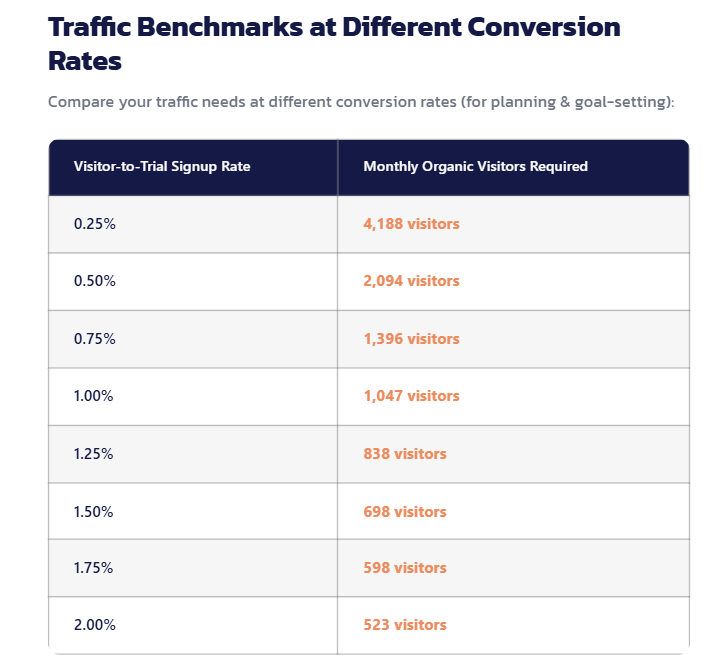
Traffic Benchmarks at Different Conversion Rates
Compare your traffic needs at different conversion rates (for planning & goal-setting):
| Visitor-to-Trial Signup Rate | Monthly Organic Visitors Required |
|---|
Calculate the Real ROI of Your SaaS SEO Investment
Most B2B SaaS companies measure SEO success by the wrong metric: traffic.
You’ve probably seen reports like “We drove 50,000 visitors this month!” But when your founder, CMO, or board asks, “Is SEO worth it?”, traffic numbers don’t answer the question. You need to know: How many signups did we get? What’s our cost per acquisition? When do we break even?
That’s why we built this SaaS SEO ROI Calculator. Instead of asking “how much traffic can we get?”, it answers the question that actually matters: “How many signups do we need to justify our SEO investment?”
Whether you’re planning your first SEO hire, evaluating an agency proposal, or trying to prove ROI to stakeholders, this calculator by Your Content Mart gives you the numbers you need. Enter your budget, ARPU, and conversion rates, and you’ll see exactly how many trial signups or qualified leads you need each month to break even, plus the website traffic required to hit those targets.
How to Use This SaaS SEO ROI Calculator

Getting accurate ROI projections takes less than 2 minutes. Here’s how:
Step 1: Choose Your Business Model
Click the toggle at the top to select how your SaaS operates:
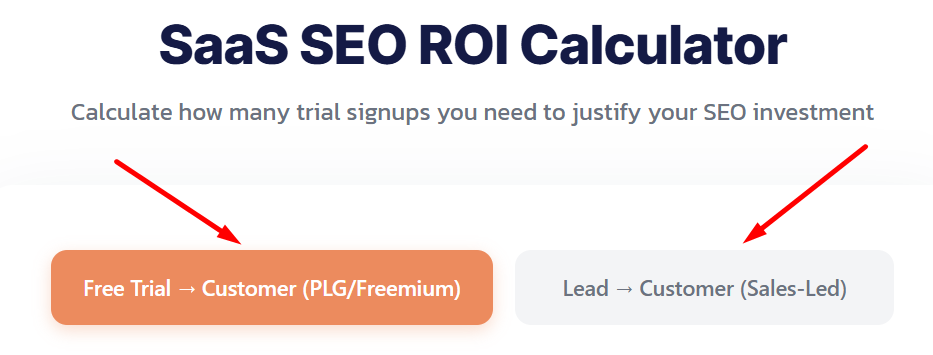
Free Trial → Customer (PLG/Freemium): Choose this if prospects can sign up and try your product before paying. Think Slack, Notion, or any self-service SaaS.
Lead → Customer (Sales-Led): Choose this if prospects book demos or sales calls before becoming customers. This applies to enterprise software and high-touch sales processes.
Step 2: Enter Your Monthly SEO Budget
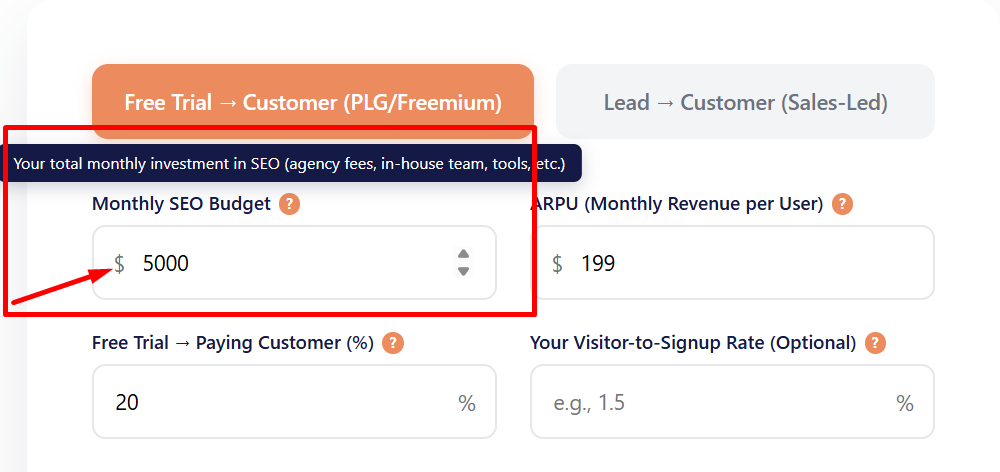
This is your total monthly investment in SEO. Include everything:
- Agency or consultant fees
- In-house SEO team salaries (prorated monthly)
- SEO tools and software (Ahrefs, Semrush, etc.)
- Content creation costs
Example: You’re paying an agency $3,500/month plus $500 for tools? Enter $4,000.
Hover over the “?” icon next to each field for helpful tips and industry benchmarks.
Step 3: Enter Your Business Metrics
For Trial Mode:

ARPU (Average Revenue Per User): Your monthly subscription price per customer. If you have multiple plans, use your average.
Example: If your standard plan is $199/month, enter $199.
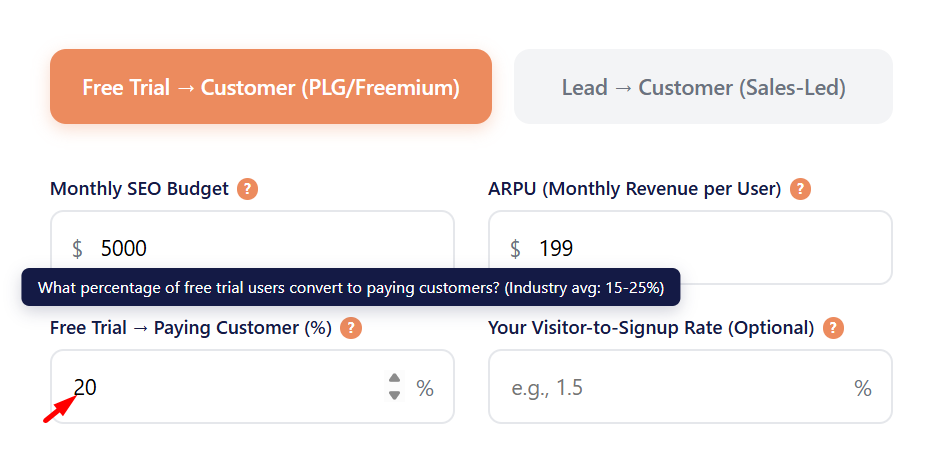
Free Trial → Paying Customer (%): What percentage of trial signups convert to paid plans? Check your analytics or CRM for your actual rate. Industry average for B2B SaaS is 15-25%. If you don’t know yours yet, start with 20%.
Example: 100 people start trials, 20 upgrade to paid. That’s 20%.
For Lead Mode:
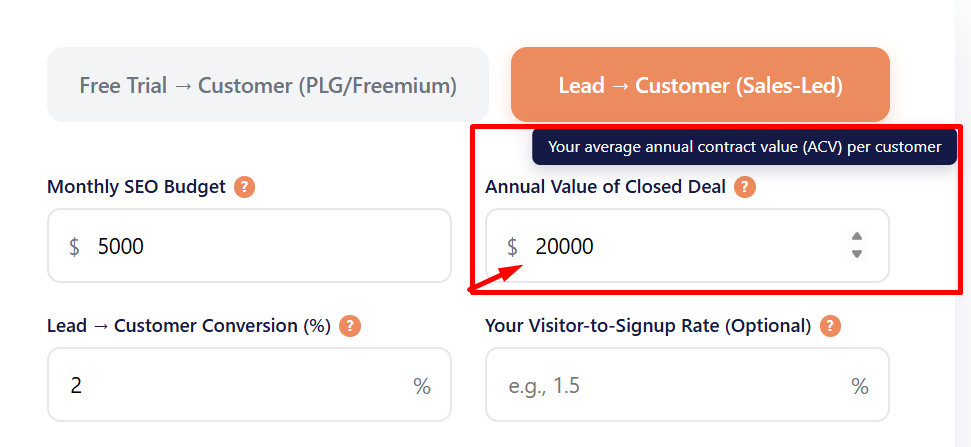
Annual Value of Closed Deal: Your average annual contract value (ACV). If customers pay monthly, multiply by 12.
Example: Customer pays $1,500/month = $18,000 annual value.
Lead → Customer Conversion (%): What percentage of qualified leads convert into customers? Industry average is 2-5%. Check your CRM for your actual close rate.
Example: You get 50 qualified leads, close 2 deals. That’s 4%.
Step 4: Add Your Conversion Rate (Optional)
If you know what percentage of your website visitors sign up for trials or request demos, enter it here. Check Google Analytics under Conversions or ask your analytics team.
Example: Last month, you had 10,000 visitors and 150 signups. That’s 1.5%.
When you enter this number, a personalized traffic target will appear showing exactly how many visitors YOU need based on YOUR conversion rate.
Don’t know this number yet? No problem. Skip it and use the benchmark table below to estimate your traffic needs at different conversion rates.
Understanding Your Results
Once you’ve entered your numbers, the calculator shows five key metrics:
Trials or Leads Needed per Month: How many you need every month for that month’s SEO budget to earn itself back within 12 months. This is your team’s goal.
Customers Needed per Month: How many of those trials or leads have to become paying customers. If your onboarding or sales team can’t close that many, more traffic won’t fix it.
12-Month Value per Customer (or Annual Deal Value): What one customer pays you in their first year. In trial mode you can add your monthly churn, so customers who cancel early count for less. This is also your break-even CAC: the most SEO can spend to win one customer and still pay for itself within a year. Compare it with what a customer costs you from paid ads.
Example: at $199 a month and no churn, a customer is worth $2,388 in their first year. With 3% monthly churn, they’re worth $2,031, so you need about 18% more trials.
Break-Even Target: The calculator assumes each month’s spend is earned back within 12 months. That clock starts when SEO starts bringing signups, which for most sites takes a few months, so expect your first months of budget to pay back later.
Revenue Needed from a Year of Signups: A year of those trials or leads, times what each is worth. It always equals 12 months of budget, because that’s the break-even point. Everything you bring in above it is profit.
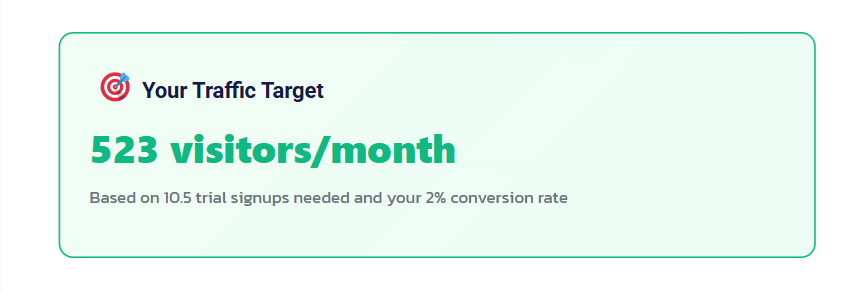
Your Traffic Target (appears when you enter conversion rate): If you filled in your visitor-to-signup rate, you’ll see a green box showing your personalized monthly traffic target based on YOUR actual conversion rate.
Traffic Benchmarks Table: Shows how many visitors you need at different conversion rates (0.25% to 2.00%). Use this for planning: “If we improve our landing page from 0.5% to 1.0%, we only need half the traffic.”
Real-World Examples: What the Calculator Tells You

Let’s look at three different SaaS companies and what the calculator reveals about their SEO investment.
Scenario 1: Freemium Project Management SaaS
The Company: A PLG project management tool targeting small teams. They offer a free plan and paid plans starting at $15/user/month.
Their Numbers:
- Monthly SEO Budget: $5,000
- ARPU: $199/month (average across all paid plans)
- Trial → Paid Conversion: 18%
- Visitor-to-Signup Rate: 1.2%
Calculator Results:
- Trials Needed: 11.6 trial signups/month
- Customers Needed: 2.1 per month
- Traffic Needed: 969 visitors/month (at their 1.2% conversion rate)
- Revenue Needed from a Year of Signups: $60,000
What This Means: This company needs just 12 trial signups per month to justify its SEO investment. At nearly 1,000 visitors/month, that’s an achievable target for a focused content strategy. Each customer is worth $2,388 in their first year, so SEO pays for itself as long as it wins customers for less than that. That’s an easy number to hold up against their paid ads.
Scenario 2: Enterprise Sales Intelligence Platform
The Company: A B2B sales intelligence tool selling to mid-market and enterprise companies. Sales-led with demos required before purchase.
Their Numbers:
- Monthly SEO Budget: $8,000
- Annual Contract Value: $24,000
- Lead → Customer Conversion: 3%
- Visitor-to-Lead Rate: 0.8%
Calculator Results:
- Leads Needed: 11.1 qualified leads/month
- Customers Needed: 0.33 per month (about one every three months)
- Traffic Needed: 1,389 visitors/month (at their 0.8% conversion rate)
- Revenue Needed from a Year of Signups: $96,000
What This Means: This company needs 11 qualified leads monthly, not just any form fills, but leads that their sales team actually wants to talk to. Each lead is worth $720 to them (3% of a $24K contract), so SEO only has to produce one new customer every three months. That works if the leads are ones their sales team can actually close.
Scenario 3: Developer Tools SaaS
The Company: A developer productivity tool with individual and team plans. Self-service signup with annual billing.
Their Numbers:
- Monthly SEO Budget: $3,500
- ARPU: $79/month
- Trial → Paid Conversion: 25%
- Visitor-to-Signup Rate: 2.1%
Calculator Results:
- Trials Needed: 14.8 trial signups/month
- Customers Needed: 3.7 per month
- Traffic Needed: 703 visitors/month (at their 2.1% conversion rate)
- Revenue Needed from a Year of Signups: $42,000
What This Means: This company has exceptional conversion metrics: 2.1% visitor-to-signup is nearly double the B2B SaaS average, and 25% trial-to-paid is excellent. Strong conversion at both steps is why they need so few trials.
The result? They only need 700 monthly visitors to justify their $3,500 SEO investment. This is the power of strong conversion rates; they don’t need massive traffic to see ROI.
Scenario 4: When the Math Reveals a Problem
The Company: An early-stage SaaS launching a social media scheduling tool in a crowded market. Trying to compete with established players.
Their Numbers:
- Monthly SEO Budget: $6,000
- ARPU: $39/month (competing on price)
- Trial → Paid Conversion: 8% (low, struggling with onboarding)
- Visitor-to-Signup Rate: 0.4% (generic landing page, weak value prop)
Calculator Results:
- Trials Needed: 160.3 trial signups/month
- Customers Needed: 12.8 per month
- Traffic Needed: 40,064 visitors/month (at their 0.4% conversion rate)
- Revenue Needed from a Year of Signups: $72,000
What This Means: Here’s the uncomfortable truth: This company needs about 40,000 monthly visitors to justify its SEO investment. For a new domain in a competitive market like social media tools, reaching that traffic level could take 18-24 months, if it’s even achievable at all.
These scenarios show why the calculator is valuable: it can reveal when your business fundamentals need work before scaling acquisition channels. Sometimes the honest answer is “fix your product and conversion rates before spending big on SEO.”
What to Do With These Numbers

You’ve run the calculator, and now you have your target: 10.5 signups per month, 2.1 new customers, 872 visitors needed. Now what?
Set Clear Team Goals
Convert your calculator results into specific, measurable targets for your content or SEO team. Instead of vague goals like “increase organic traffic,” you now have concrete targets:
“We need 10.5 trial signups per month from organic by Q3. Based on our 1.2% conversion rate, that means we need to hit 872 monthly visitors to high-intent content.”
This clarity makes a huge difference. Your team knows exactly what success looks like, and you can track progress month over month.
Use It for Stakeholder Presentations
Planning to pitch SEO investment to your CFO, board, or co-founders? These numbers make your case significantly stronger.
Instead of: “SEO is a good long-term channel for us”. Say: “At $5,000/month SEO investment, we need 10.5 trial signups a month, about 2 new customers, for each month’s spend to pay back within a year. At our 1.2% signup rate, that’s 872 visitors a month to high-intent pages. Every customer past that target is profit.”
Concrete numbers backed by your actual business metrics always beat general statements.
Benchmark Against Current Performance
If you’re already doing SEO, use the calculator to evaluate your current ROI. Run your numbers twice:
First: Enter your current monthly SEO spend and see what signups you should be hitting.
Second: Count your actual signups from organic last month.
Gap analysis: Are you above target (profitable), at target (break-even), or below target (not yet profitable)? This tells you whether to scale investment, maintain current spend, or fix your funnel first.
Make Strategic Decisions
The calculator can reveal which lever to pull:
If you need 50+ signups/month, your targets might be unrealistic. Consider increasing prices, improving conversion rates, or trying paid ads first before scaling SEO.
If your traffic target is achievable but the conversion rate is low, focus on landing page optimization and trial experience before investing more in content. Better conversion means you need less traffic.
If your cost per signup is higher than paid channels, SEO might not be your best acquisition channel right now. Or it might mean you need to focus more on bottom-funnel content that converts better.
If everything looks good, you have a green light. Set up proper tracking (GA4 goals, CRM attribution), establish monthly signup targets, and start executing.
Track Progress Monthly
Save your calculator inputs and check back monthly. As you publish more content and drive more traffic, compare actual signups to your target. This ongoing measurement keeps everyone accountable and helps you spot issues early.
If month 3 shows you’re consistently hitting 60% of target, you know something needs adjustment, either your content strategy, your conversion funnel, or your timeline expectations.
The Calculator Gave You a Target. Now What?

Let’s say you need 10.5 signups per month. You know that means 872 visitors at your current conversion rate.
The gap between knowing and doing is where most companies get stuck.
They write content that ranks but doesn’t convert. They chase high-volume keywords that attract browsers instead of buyers. They hit traffic targets but miss signup targets.
We focus on the opposite: content that might get less traffic but drives actual trial signups.
Comparison posts. Alternative pages. Buyer-intent keywords.
The stuff your competitors ignore because it “only” gets 200 searches per month, but converts at 5-10% instead of 0.5%.
That’s how we helped Copysmith grow 553% while focusing on signups over traffic. That’s how we got OneCal ranking #1, where their buyers actually search.
If your calculator numbers make sense, book a call.
We’ll review your results, look at your current funnel, and map out exactly which content would get you to your signup target fastest.
45 minutes. No pitch deck. Just a real conversation about whether we can help.


Where does your product show up in ChatGPT?
Book a call and I’ll check where you show up on Google and ChatGPT for the searches your buyers run, before we talk.


