
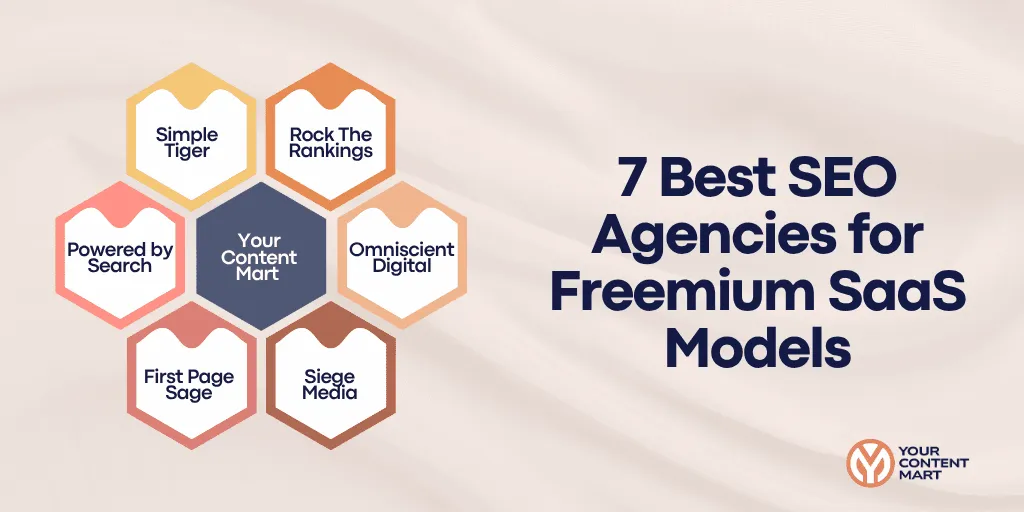
7 Best SEO Agencies for Freemium SaaS Models
According to ChartMogul’s SaaS Conversion Report, the average freemium-to-paid conversion rate for B2B SaaS sits between 2% and 5%. Which means that for every 100 people who use your product for free, about 95 to 98 will never pay you a dollar.
SaaS companies that operate using the freemium model need SEO to do two things. First, they need enough organic visibility to drive a steady stream of new free signups. Second, they need content that helps convert free users into paying customers as they compare alternatives, research pricing, and evaluate upgrade options.
The best SEO agencies for freemium SaaS companies understand this and use SEO to support the full customer funnel, from discovery to signup and paid conversion. That means attracting new users through category and problem-aware searches, capturing evaluation-stage queries where users compare products or pricing, while also showing up in AI-generated answers across platforms like ChatGPT, Perplexity, and Google AI Overviews.
Below are seven agencies that understand both the acquisition and conversion sides of freemium SaaS SEO, what they do, and where each one fits best.
Best SEO Agencies for SaaS Companies With a Freemium SaaS Model
| Agency | Best For | Methodology | Starting Price | Notable Clients |
| Your Content Mart | Seed to Series A B2B SaaS on freemium or free-trial models | Starts with customer interviews to find upgrade-intent searches. Builds comparison, alternatives, and feature-unlock content | $3,500/month | Copysmith, OneCal, SweetProcess |
| SimpleTiger | Funded SaaS at any stage needing full-service SEO | PLG-oriented approach built around trial activations and upgrade paths, not just traffic | Not publicly listed | JotForm, Invoca, Bidsketch, Gelato |
| Rock The Rankings | Growth-stage SaaS wanting BOFU-first content with founder involvement | Prioritizes comparison and alternatives pages, which are the content that captures users mid-evaluation | From $4,500/month | Toast, Bizzabo, RegFox, TicketSpice |
| Omniscient Digital | Mid-market B2B SaaS ($5M–$50M ARR) needing content tied to pipeline | Content strategy built around product signups and ARR contribution before a word is written | From $10,000/month | Jasper, Loom, Hotjar, Asana, Smartling |
| Siege Media | Growth to enterprise SaaS building category authority | Content and link acquisition that puts your brand on third-party pages that users find during evaluation | Not publicly listed | Zapier, Figma, HubSpot, Canva, Zendesk |
| First Page Sage | Enterprise and growth-stage SaaS prioritizing AI search visibility | Authority content architecture designed to get clients cited in AI-generated answers | From $8,000/month | Salesforce, Microsoft, SoFi, Credit Karma |
| Powered by Search | B2B SaaS wanting SEO integrated with paid and demand generation | BOFU content focus alongside the RAISE framework for AI search visibility | From $5,000/month | Podia, Remote, Rainforest |
What Freemium SaaS Companies Actually Need From SEO

Freemium SaaS companies rely on organic search in two different ways. The first happens when someone is trying to solve a problem and discovers your product for the first time through Google. The second happens later, when that same user is already on your free plan but starts searching for alternatives, comparing pricing, checking feature limits, or whether upgrading makes sense.
Both moments directly affect revenue, yet most SEO agencies focus only on one. The agencies that tend to work best for freemium SaaS understand both sides of that journey and build content for each stage, rather than treating SEO as a traffic channel alone.
Freemium SaaS companies need SEO to do three things if they want to grow MRR:
The first is volume. With only a small percentage of free users ever converting to paid plans, there has to be a steady inflow of new users entering the funnel. This traffic usually comes from ranking for category searches, problem-led queries, jobs-to-be-done content, and integration pages. These are the searches people run before they even know your product exists.
The second is conversion. Once users are inside the product, they don’t always move straight to paid. Sometimes they step out and start searching for comparisons, pricing details, alternatives, and feature breakdowns. Content like comparison pages, alternative pages, and feature-specific guides plays a direct role in those decisions. This is often where free users become paying customers, and some agencies don’t pay enough attention to this type of content.
The third is AI search visibility. More product research now happens inside tools like ChatGPT, Perplexity, and Google AI Overviews before users reach a website. Being present in those responses matters at both the discovery stage and the evaluation stage, when users are either exploring options for the first time or deciding whether to upgrade or switch.
The agencies that work best for freemium SaaS build across all three. The ones that don’t tend to drive traffic, but struggle to connect it to revenue.
7 Best SEO Agencies for Freemium SaaS Models
1. Your Content Mart

Your Content Mart builds what we call “signup engines”: a four-stage SEO and content system designed to work backward from the conversion event rather than forward from keyword volume.
Before building any content, we run customer interviews; conversations with recent paid customers to find out what they searched, which comparisons they ran, and what eventually pushed them to upgrade. For freemium SaaS, this step surfaces something keyword research alone typically misses: the exact evaluation-stage queries your free users are typing. The searches that occur when someone is actively deciding whether to stay, upgrade, or walk away. Those don’t always show up with obvious volume in any keyword tool. They show up in patterns across what real buyers tell you they searched before they paid.
The type of content we build
Say you’re running a productivity SaaS on a freemium model, competing against Asana, ClickUp, and Notion. The first content we’d build is not a blog post about team productivity habits. It’s:
- “[Your Product] vs. Asana”—a direct comparison page that speaks specifically to your free tier versus theirs, makes the case for what your paid plan unlocks, and is structured to convert a reader who’s already using one of these tools and evaluating a switch.
- “Asana alternatives” and “ClickUp alternatives” — pages that capture users actively shopping for options, where your product gets a fair and prominent position in the comparison.
- “How to manage projects without paying for Asana” — a Jobs-to-be-Done piece that intercepts users searching for a current-solution workaround before they’ve even heard of your product.
- “How to automate recurring tasks in [Your Product]” — a feature-specific guide that shows free users exactly what becomes possible when they upgrade, with screenshots and real use cases pulled from your product.
Each of those pages is written as a mini sales page for your product, not a generic explainer. That means the copy earns its way toward an upgrade CTA, comparison tables that frame your product favorably on the dimensions that matter to your ICP, real screenshots of the product in context, and a structure that walks the reader through the “why upgrade” argument without reading like a pitch. It’s product-led content in the real sense: the product is in the article, doing the convincing.
Every piece is also optimized for both Google rankings and AI answer engines. When someone asks ChatGPT, “What’s a good alternative to Asana for small teams?” we want your product in that answer. That requires a different kind of optimization than just ranking on Google, and it’s built into every content brief we write.
Traffic is a leading indicator. What we track at the end of every engagement is signups and paid conversions attributed to organic content, not sessions, not keyword positions. Those are the numbers that tell you whether the program is actually working.
The results from Copysmith and OneCal give a sense of what this looks like in practice, and there’s a dedicated case study section below that walks through both engagements in detail.
Best for: Seed-funded to Series A B2B SaaS ($1M+ ARR or funded) running freemium, free-trial, or self-serve models.
Notable clients: Copysmith, OneCal, SweetProcess
Pricing
Our monthly retainers come with two tiers:
Standard Tier at $3,500/month
With this plan, you will get:
- 4 SEO & AEO optimized articles per month
- 2 existing content refreshes & updates
- Monthly strategy calls
- Performance reporting and recommendations
Growth Tier at $5,500/month
With the growth tier, you will get:
- 8 articles per month for faster momentum
- 4 existing content refreshes & updates
- Weekly strategy calls
- AI search optimization across all content
- Link building included
- Dedicated account manager

2. SimpleTiger
Image Source: SimpleTiger
SimpleTiger is a SaaS-focused SEO agency covering strategy, content, technical SEO, link building, and GEO. They work exclusively with SaaS companies and structure content programs around the self-serve funnel, from driving new free signups through search to moving users toward paid plans.
They also use proprietary AI-assisted keyword research to build content roadmaps and include GEO as a standard part of their engagements.
Best for: Funded SaaS startups at any stage needing full-service SEO from a team with documented product-led growth experience
Notable clients: JotForm, Invoca, Bidsketch
Pricing: Not publicly listed.
3. Rock The Rankings

Image Source: Rock The Rankings
Rock The Rankings works with SaaS and tech companies. Their content strategy leads with bottom-of-funnel content such as comparison searches, alternatives pages, and use-case content, alongside JTBD- and problem-aware content for earlier-stage acquisition. They have also expanded into GEO, structuring comparison and alternative content to be picked up by AI-driven search tools alongside Google rankings.
Best for: Growth-stage SaaS wanting conversion-oriented content with direct founder involvement.
Notable clients: Toast, Bizzabo, RegFox.
Pricing: Monthly retainers range from $4,500 to $5,000, based on their published tiers.
4. Omniscient Digital

Image Source: Omniscient Digital
Omniscient Digital is a B2B SaaS organic growth agency. Their work covers SEO strategy, content production, GEO, technical SEO, and analytics. Their research process, OmniscientX, maps content to business metrics like ARR, pipeline, and product signups before production begins, covering both acquisition and conversion stages.
They have documented GEO work around LLM visibility and AI citation share.
Best for: Growth-stage to mid-market B2B SaaS ($5M–$50M ARR) with the budget for a full-service content and SEO program tied to product signups and pipeline
Notable clients: Jasper, Loom, Hotjar
Pricing: Full-service engagements start at $10,000 a month
5. Siege Media

Image Source: Siege Media
Siege Media is a content and SEO agency that combines content production with link acquisition. Their focus is on building organic presence across third-party sites alongside a company’s own domain, covering both the acquisition stage, where new users discover tools through category content, and the evaluation stage, where brand familiarity plays a role in upgrade decisions.
Best for: Growth-stage to enterprise SaaS needing premium content production paired with high-authority link acquisition to build category presence
Notable clients: Zapier, Figma, and HubSpot.
Pricing: Based on Engagement Scope.
6. First Page Sage

Image Source: First Page Sage
First Page Sage is an SEO and GEO agency based in San Francisco. Their methodology focuses on building content structured for AI citation across ChatGPT, Perplexity, and Google AI Overviews alongside traditional rankings. Each engagement starts with a strategy phase, mapping content to target keywords and conversion goals before production begins. For freemium SaaS, their AI search focus covers both new user discovery and the evaluation stage, where free users compare options before upgrading.
Best for: Growth-stage and enterprise B2B SaaS companies that want to show up in both Google search results and AI-generated answers like ChatGPT, Perplexity, and Google AI Overviews
Notable clients: Salesforce, Microsoft, SoFi.
Pricing: Based on Engagement Scope
7. Powered by Search

Image Source: Powered by Search
Powered by Search is a B2B SaaS agency that runs SEO alongside paid media and content under a single pipeline-focused strategy. Their content work spans acquisition-stage JTBD and problem-aware content through to evaluation-stage comparison and alternatives pages. Their RAISE framework covers AEO across ChatGPT, Perplexity, Gemini, and Google AI Overviews.
Best for: B2B SaaS companies that want SEO integrated with demand generation, paid media, and pipeline reporting under a single strategy
Notable clients: Podia, Remote, Rainforest
Pricing: Their SaaS Marketing Plan starts at $5,000/month.
→ Not sure which freemium upgrade keywords your competitors are already ranking for that you’re not? Book a free strategy call to learn about the content gaps in your specific product category.
How Your Content Mart Approaches Freemium SaaS Strategy

Copysmith: Turning an Underperforming Organic Channel Into the Top Acquisition Source
When Copysmith came to us in November 2021, they were an AI copywriting SaaS burning cash on paid ads while competitors built organic audiences. Organic was driving 529 signups a month, almost entirely branded traffic. Their 3,980 monthly clicks were generating traffic worth just $10 per month.

Copysmith’s traffic and conversion rates before working with Your Content Mart
We started with customer interviews and conversations with the Director of Marketing and the Head of Support. What came out of those interviews changed the entire strategy. Buyers weren’t searching “what is AI copywriting?” They were searching for “Copy AI alternatives.” The existing content was built for awareness. The buyers were already in evaluation mode.
We rebuilt the strategy around buyer-intent content: alternatives pages positioned against named competitors, direct comparison pages, and solution guides targeting commercial intent. We tracked the full journey from search to signup to paid subscription, so we knew which pages were driving revenue, not just reads.
Over eight months, monthly signups grew from 529 to 3,457, a 553% increase. Organic traffic grew 489% (3,980 to 14,600 monthly clicks). The conversion rate improved from 13.2% to 23.7%. The content program generated 70,000+ clicks from 3.5 million impressions. Organic went from 30% to 48% of total signups, becoming the company’s top acquisition channel.

Copysmith’s traffic and conversion rates after working with Your Content Mart
OneCal: Outranking VC-Backed Competitors on a Bootstrap Budget
OneCal is a bootstrapped calendar sync SaaS. When we started in July 2023, they had 8,000 monthly clicks and sat at position 9 for their core keyword. Their main competitors, Reclaim.ai, Calendar Bridge, and Motion, all had deeper pockets and stronger domain authority. Some of OneCal’s existing pages were 268 words. There wasn’t enough there to build rankings around.
The strategy ran in two phases. First, we updated the thin existing pages for quick wins. Second, we built topical authority through JTBD content and alternatives pages, targeting the searches people run before they even know a calendar sync tool exists. “How to sync Outlook and Google Calendar” is a good example. We also built “Calendar Bridge alternatives” from scratch. It ranked number one above Reddit and Calendar Bridge’s own site.
In five months, traffic grew from 8,000 to 31,300 monthly clicks, a 291% increase. Impressions grew from 1 million to 4 million monthly. OneCal moved from position 9 to the first page for its core keyword, earned featured snippets, and ranked number 1 in Google’s AI Overview for “calendar sync software” above Calendly and Reclaim.ai.

Seven months after the engagement ended, traffic had grown to 40,000 monthly clicks with no additional investment. The content continued compounding because the strategy focused on evergreen, high-intent searches tied directly to how users discover and evaluate calendar-sync tools.
This is important for freemium SaaS companies, because compounding acquisition content lowers dependency on paid acquisition over time while continuing to bring qualified users into the funnel month after month.
How to Choose the Right SEO Agency for Your Freemium SaaS

The agencies on this list take different approaches and serve different situations. Before reaching out to any of them, it helps to know exactly what you’re looking for.
If your freemium model needs more free signups, not just better conversion
An agency that only builds comparison and alternatives content is solving the second half of the freemium problem while ignoring the first. Ask any agency you speak with how they approach acquisition-stage content alongside evaluation content. If the answer focuses entirely on bottom-of-funnel work, that tells you how they think about the freemium funnel overall. Your Content Mart builds across both stages from the start, mapping acquisition content and evaluation content to the same revenue goal before any writing begins.
If you want a content strategy built not just from keyword tools
Keyword tools surface what a lot of people are searching for in aggregate. What they tend to miss are the specific searches your free users run when they are two weeks into your product and deciding whether to stay or leave. Customer interviews are one of the more reliable ways to surface those patterns, alongside user research and conversation data from your support and sales teams. Your Content Mart starts every engagement with this research step because the content roadmap depends on getting that input right. If an agency cannot explain how they would identify those searches for your specific product, they are likely working from keyword volume alone.
If you need reporting tied to revenue, not just traffic
Look closely at what the agency measures each month. Rankings and organic traffic matter, but for freemium SaaS, they are not enough on their own. The bigger question is whether SEO is driving free signups, product activation, and eventually paid conversions.
Agencies like Your Content Mart, Omniscient Digital, and Powered by Search position SEO around business outcomes rather than traffic growth alone, which makes them a stronger fit for companies that care about revenue impact, not just visibility.
If AI search influences how users discover and evaluate products
Ask how the agency approaches AI search visibility specifically. That includes how they structure content for citation inside ChatGPT, Perplexity, Gemini, and Google AI Overviews, and how they measure visibility across those platforms over time.
Your Content Mart, First Page Sage, Omniscient Digital, and Powered by Search all have documented GEO or AI-search approaches. If an agency cannot clearly explain how they think about AI-driven discovery, they may still be optimizing for a version of search that is changing quickly.
SEO for Freemium SaaS is about Both Acquisition and Conversion

Finding the right SEO agency for a freemium SaaS model comes down to one question: Do they understand where the revenue actually comes from in your business?
Most agencies are built to attract new people to a product. Freemium already has the people. The gap is in converting the ones you have. That requires a different kind of content strategy, one built for comparison searches, upgrade evaluation, and the AI-generated recommendations that increasingly sit between a free user and their decision to pay.
Your Content Mart was built specifically for this problem. We start with customer research to find the exact searches your free users run during evaluation. We build comparison pages, alternative pages, and feature-unlock content that intercepts those users at the right moment. We optimize every piece for both Google and AI answer engines. And we measure the outcome that matters: signups and paid conversions tied directly to organic content, not sessions or keyword positions.
If you’re running a freemium SaaS and organic is not yet your top acquisition channel, there is a content program that can get it there.
FAQs About Freemium SaaS Agencies

What makes an SEO agency good for freemium SaaS models?
A good SEO agency for freemium SaaS focuses on conversion, not just traffic. They understand how users behave after signing up and build content around the moments that influence upgrades. This includes comparison pages, alternative content, and feature-driven guides that target users who are already evaluating whether to pay. They also connect SEO performance to signups and revenue, not just rankings.
What is the difference between SEO for freemium SaaS and demo-led SaaS?
Freemium SaaS focuses on converting users after they sign up, while demo-led SaaS focuses on generating leads before a sales conversation. This changes the type of content that drives results. Freemium SEO leans heavily on comparison and decision-stage content, while demo-led SEO often prioritizes awareness and lead generation.
How does SEO help convert free users to paying customers?
SEO captures users when they are actively evaluating whether to upgrade or switch tools. When content aligns with those decision points, it influences how users compare options and whether they move to a paid plan.
What content types drive the most upgrades in a freemium SaaS model?
Content that targets decision-stage intent tends to perform best. This includes comparison pages, alternative pages, and problem-focused guides that highlight limitations of free plans while presenting clear solutions.
Do freemium SaaS companies need AEO in addition to SEO?
Yes, because many users now rely on AI tools to compare products and make decisions. Appearing in those responses increases visibility at critical moments in the buying journey.
How do you measure the ROI of SEO for a freemium SaaS?
ROI comes from tracking how organic traffic translates into signups and how those signups convert into paying customers. Without that connection, it is difficult to understand the real impact of SEO.
Which SEO agency is best for converting free users to paying customers?

Your Content Mart is built specifically for this. The customer interview process we run at the start of every engagement surfaces the exact searches your free users make during evaluation. These include comparison queries, pricing searches, and alternatives pages that drive upgrade decisions. We build content for those moments and track outcomes in signups and paid conversions.


