
6 Best SEO Agencies for Vertical SaaS Companies in 2026
Most vertical SaaS companies do not struggle with SEO because their products are weak. The problem is usually positioning.
Their site tries to speak to too many audiences at once. The messaging becomes broad, the content starts to sound generic, and buyers stop feeling like the product was built specifically for their industry.
This hurts search performance, too.
Winning SEO as a vertical SaaS company often means going narrower on purpose, building content around the industry your buyers work in, the language they use, and the specific searches they run when they’re actively evaluating tools. The best SEO agencies for vertical SaaS companies are the ones that know how to do that without defaulting to a broad horizontal strategy.
This list covers six agencies that do that well, including verified pricing where available and the level of vertical SaaS experience each agency brings.
What Is Vertical SaaS, and What Does Its SEO Actually Require?

Vertical SaaS is software built for a specific industry rather than a broad business function. For example, construction management software built exclusively for general contractors is a vertical SaaS offering. So, is billing software designed for law firms, scheduling software for outpatient clinics, workforce management tools for hospitality businesses, and property management platforms for residential landlords? What these products share is a defined industry audience with specific workflows, compliance requirements, and language that their audience understands.
Serving that kind of buyer has implications for SEO.
Smaller search volume, higher purchase intent
Vertical SaaS keywords may not drive large amounts of traffic. But the people searching for them are often far closer to buying.
Someone searching “scheduling software for multi-location outpatient clinics” already knows the type of product they need and the environment they operate in. The same goes for a landlord searching for “property management software with maintenance tracking.”
The buyer has already narrowed the market before they even land on your site. That is why vertical SaaS keywords often convert better than broad category terms. The search volume is smaller, but the intent behind the search is much stronger.
Most agencies still target the wrong keywords
Broad category terms have higher search volume, and that’s where generalist agencies naturally gravitate. But for a construction management tool or a legal billing platform, ranking for “project management software” or “billing software” puts you in direct competition with enterprise platforms that have spent years building domain authority. You will lose that fight consistently. The searches worth winning aren’t the category-level ones. They’re the searches happening inside your industry, where the buyer has already defined their context.
Searches like “Best construction management software for specialty subcontractors” or “billing software for solo immigration attorneys” are the searches where vertical SaaS can genuinely compete, and they’re the ones generalist agencies routinely overlook.
AI search favors specificity
When someone asks ChatGPT or Perplexity for software recommendations, the tools tend to pull from sources that show real topical depth inside that niche. A generic “best business software” article usually carries less weight than content built around the actual workflows and problems buyers in that industry deal with every day.
That creates a real advantage for vertical SaaS companies willing to build niche authority properly.
The companies winning visibility in AI search are often the ones creating highly specific content around industry use cases, operational pain points, comparisons, and workflow-driven searches instead of trying to sound broad enough for everyone.
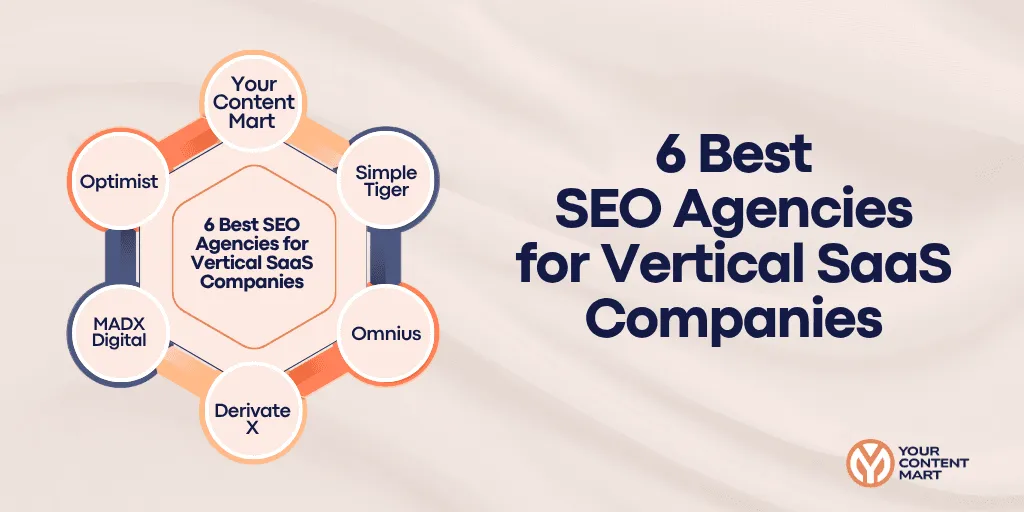
6 Best SEO Agencies for Vertical SaaS Companies
| Agency | Core Specialty | Notable Clients | Best For | Pricing |
| Your Content Mart | Signup-intent SEO and content for B2B SaaS | Copysmith, OneCal, SweetProcess | Seed to growth-stage vertical SaaS needing organic signups | Standard: $3,500/month. Growth: $5,500/month |
| SimpleTiger | SaaS-only SEO and PPC | Olo, ContractWorks, VolunteerMatters | Seed-to-growth SaaS across niche verticals | Not publicly listed |
| Omnius | SEO and GEO for SaaS and Fintech | Payoneer, Zencoder, and Atomic | SaaS and Fintech companies needing search and AI visibility | Not publicly listed |
| DerivateX | SEO and GEO for B2B SaaS | Simpli, Verito, and Gumlet | $5M–$50M ARR vertical SaaS needing niche search strategy | Engagements start at $3,000 per month. |
| MADX Digital | SEO and GEO for SaaS companies | Postalytics, Kurve, and Parcel Tracker | SaaS companies across multiple verticals needing SEO and GEO | From $2,199/month |
| Optimist | Content marketing and SEO for B2B SaaS | Semrush, ZoomInfo, and Superhuman | Growth-stage SaaS needing content-led organic growth | Not publicly listed. |
Here are 6 of the best SEO agencies for vertical SaaS companies in 2026:
1. Your Content Mart

Your Content Mart is a B2B SaaS SEO and content agency built around one metric: trial signups, not just traffic.
Most vertical SaaS companies we’ve come across have a similar problem. They’ve published content, they rank for category-level keywords, and they have traffic that doesn’t convert. The root cause is almost always the same: the content targets the right software category but the wrong buyer intent. Vertical SaaS doesn’t just need content about its software category. It also needs content built around the searches happening inside the buyer’s industry, especially the ones that signal someone is actively evaluating solutions and trying to determine whether a product fits their specific use case, workflow, operational needs, or industry requirements.
How we work
We start with customer interviews. Before writing anything, we talk to your recent signups to understand how they searched before finding you. Those conversations consistently surface buyer-intent keywords that standard keyword tools won’t show: industry-specific comparison searches, current-solution queries, and jobs-to-be-done searches tied to the exact workflows your buyers are trying to solve in their industry.
But research alone isn’t enough. We also get deep into the product. We learn how each feature works, what differentiates it from competitors, and what specific problems it solves for your vertical buyers. That product knowledge is what separates our content from agency work that treats your software as a topic to write about. We write about it as practitioners who understand what it does and why buyers choose it.
From there, we build five types of buyer-intent content, each targeting a different stage of the decision process:
Alternative pages target buyers actively looking to leave the category leader. For a dental scheduling SaaS, that might be “Best Calendly alternatives for healthcare practices.” For a construction management tool, “Best Procore alternatives for specialty contractors.” These searches signal evaluation in progress.
Comparison pages are for buyers doing their final shortlisting. “YourTool vs [Competitor] for [vertical/use case]” queries come from buyers who know what they need and are looking for the last piece of confirmation before deciding.
Jobs-to-be-done (JTBD) content intercepts buyers before they know your product exists. When we worked with OneCal, a calendar sync software, that meant writing articles like “How to sync Outlook and Google Calendar” for someone dealing with a calendar sync problem who hadn’t yet discovered that a product like OneCal could solve it. We meet them at the workflow problem and introduce the solution naturally.
Solution guides are practical, specific content built around your product’s features. A dental scheduling SaaS might publish “How to reduce patient no-shows at multi-location practices.” A fleet management SaaS might publish “How to plan delivery routes with driver time window constraints.” These aren’t generic how-tos. They’re written to show exactly how your product handles the problem, with real feature context and product screenshots.
Use case content targets industry and role-specific buyers. “Calendar sync for real estate agents managing client showings” or “Route optimization for frozen food distributors” are the kinds of pages that no horizontal competitor will build because their audience is too broad to justify targeting that specifically. For your vertical SaaS, those pages are where the highest-converting traffic lives.
Every piece we write also functions as a mini sales page, not just an article. That means introducing your product at the right moment in the reader’s journey, showing specific features in context, and writing CTAs calibrated to where the reader is in their decision. The content educates first and sells naturally, without reading like a product brochure.
Everything is optimized for both Google rankings and AI search, because vertical SaaS buyers increasingly ask AI tools for recommendations. This approach has worked across both bootstrapped SaaS companies competing against larger players and funded startups trying to reduce reliance on paid acquisition.
OneCal: Bootstrapped SaaS competing against VC-backed competitors
When OneCal came to us in July 2023, they were competing in a market dominated by VC-backed platforms despite having no funding of their own and a relatively thin content library. At the time, they were getting around 8,000 monthly clicks and ranking ninth for their core keyword.
We updated their thin pages first for quick wins, then built out their topical authority through JTBD content targeting the workflows their buyers were actually searching around. We also created alternative pages for competitors like Calendar Bridge, capturing buyers who were already comparing options but hadn’t found OneCal yet.
In five months, traffic grew 291%, from 8,000 to 31,300 monthly clicks. OneCal ranked number one for “Calendar Bridge alternatives,” above Reddit and Calendar Bridge itself. They also earned the number one spot in Google’s AI Overview for “calendar sync software,” ranking above Calendly and Reclaim.ai.

By September 2024, seven months after our engagement ended, traffic had grown further to 40,000 monthly clicks without any additional investment.
Copysmith: From 529 to 3,457 monthly signups in eight months
Copysmith came to us in late 2021 with a problem common in competitive SaaS markets. Their AI copywriting tool was solid, but they were burning cash on paid ads while competitors like Copy.ai were building organic audiences. At the time, 30% of their signups came from organic search, but most of that traffic was branded. They were getting 3,980 monthly clicks and the content they had wasn’t driving buying decisions.
We started with customer interviews, talking directly with Copysmith’s Director of Marketing and Head of Support. What we found shifted the content strategy. Their buyers weren’t necessarily searching for “AI copywriting software.” They were searching for “Copy AI alternatives,” “Jasper alternatives,” and “best AI writing tools for marketing agencies.” These weren’t showing up in any keyword tool. They were the searches that happened when buyers were already in active evaluation mode, comparing tools side by side.
We rebuilt the content around those buyer-intent searches. Comparison pages positioning Copysmith directly against the tools their buyers were already using. Alternative pages capturing buyers who were looking to switch. Solution guides built around the specific workflows their customers needed to complete. Every piece was structured to move the reader toward a trial signup.
In eight months, monthly signups grew from 529 to 3,457, a 553% increase. Organic traffic went from 3,980 to 14,600 monthly clicks. Their conversion rate climbed from 13.2% to 23.7%. Organic became their number one customer acquisition channel, growing from 30% of total signups to 48%.

Best for: Seed to growth-stage B2B vertical SaaS companies in the $500K to $5M ARR range, with lean marketing teams that need a focused organic signup channel. Particularly strong for niche software where buyer-intent searches are specific to an industry.
Pricing
For ongoing engagements, our monthly retainers include:
Standard Tier at $3,500/month
With this plan, you will get:
- 4 SEO-optimized articles per month
- 2 existing content refreshes & updates
- Monthly strategy calls
- Performance reporting and recommendations
Growth Tier at $5,500/month
With the growth tier, you will get:
- 8 articles per month for faster momentum
- 4 existing content refreshes & updates
- Weekly strategy calls
- AI search optimization across all content
- Link building included
- Dedicated account manager

2. SimpleTiger

Image Source: SimpleTiger
SimpleTiger is a SaaS-only SEO and PPC agency that has worked exclusively with software companies since 2006.
Their methodology covers technical SEO, keyword research, content production, link building, and answer engine optimization for AI search. They describe their approach as a pipeline-focused framework that connects search visibility to revenue rather than rankings. What makes them relevant to vertical SaaS is that they have built out explicit vertical industry practices: their website lists fintech, restaurant tech, legal tech, aviation, nonprofit software, and HR and payroll as areas they serve.
They have worked with the likes of Olo, ContractWorks, and VolunteerMatters.
Best for: Seed-to-growth-stage vertical SaaS companies that want a SaaS-only SEO partner with vertical industry expertise and AEO capabilities.
Pricing: Not publicly listed.
3. Omnius

Image Source: Omnius
Omnius is a B2B SEO and GEO agency that works exclusively with SaaS, Fintech, and AI companies.
Their methodology covers technical SEO, content production, generative engine optimization for AI search, and programmatic SEO. Verticals they serve with dedicated pages on their own site include SaaS broadly, Fintech, AI and LLM companies, MarTech, HR Tech, and Wealth Management SaaS.
They accept a limited number of engagements per year and have worked with companies such as Payoneer, Zencoder, and Atomic.
Best for: Fintech, MarTech, HR Tech, and AI SaaS companies that want an SEO and GEO partner with a deliberately boutique, senior-led engagement model.
Pricing: Not publicly listed and is custom-quoted.
4. DerivateX

Image Source: DerivateX
DerivateX is a B2B SaaS SEO and GEO agency that works exclusively with software companies in the $5M to $50M ARR range.
Their website’s Industries section lists 15 dedicated vertical playbooks: FinTech, HealthTech, LegalTech, MarTech, SalesTech and RevOps, AI and ML, DevTools, Data Infrastructure, Cybersecurity, HR Tech, Customer Support, E-commerce, Data and Analytics, EdTech, and PropTech SaaS.
Their methodology covers keyword research, content strategy, technical SEO, and generative engine optimization, and they describe their approach around what they call “SEO and GEO playbooks” tailored to each software vertical.
Their client list includes the likes of Simpli, Verito, and Gumlet.
Best for: Vertical SaaS companies in the $5M to $50M ARR range that want a SaaS-exclusive agency with documented playbooks for their specific software vertical.
Pricing: Engagements start at $3,000 per month.
5. MADX Digital

Image Source: MADX Digital
MADX Digital is a SaaS SEO and GEO agency with dedicated vertical pages for software companies across several industries.
Their Industries section covers Fintech SaaS, PropTech SaaS, MarTech SaaS, EdTech SaaS, Cybersecurity, AI SaaS, B2B SaaS, B2C SaaS, and Enterprise SaaS. Their methodology focuses on organic growth through SEO and GEO, and they have worked with Postalytics, Kurve, and Parcel Tracker.
Best for: SaaS companies in fintech, proptech, martech, or edtech verticals that want an agency with documented vertical SaaS SEO experience and GEO capabilities.
Pricing: From $2,199/month
6. Optimist
Image Source: Optimist
Optimist is a B2B SaaS content marketing agency that focuses exclusively on software companies. Its website features dedicated industry pages for fintech, HR tech, retail tech, and health tech, reflecting a vertical-specific approach rather than a broad B2B positioning.
The agency’s model is built around organic growth, with services spanning content strategy, content production, distribution, SEO, and Answer Engine Optimisation (AEO) for AI search. Rather than treating content as a standalone service, Optimist positions it as part of a larger demand-generation engine designed for SaaS businesses.
Its client roster includes companies such as Semrush, ZoomInfo, and Superhuman.
Best for: Growth-stage and Series A B2B SaaS companies in fintech, HR tech, retail tech, or health tech that need a content-led organic growth partner.
Pricing: Not publicly listed.
How to Choose the Right Agency for Your Vertical SaaS

Here are a few things to note before choosing your vertical saas product:
Match the agency model to your growth stage
Kalungi and Directive are built for companies that have the budget and the need for a full marketing function, either outsourced entirely or integrated across channels. SimpleTiger, Grow and Convert, and Your Content Mart are better suited to seed and Series A companies that want a specialist SEO and content partner without the overhead of a full-service engagement. Omniscient and Foundation sit in the middle, with retainer models for funded teams that want strong organic strategy and execution without building it all in-house.
Be clear about what you actually need
A company that needs SEO and content as a standalone channel with direct signup attribution is shopping for something different from a company that needs SEO woven into a multi-channel demand generation motion. If the former is you, Your Content Mart, SimpleTiger, and Grow and Convert are the closest matches. If the latter, Directive and Kalungi are the stronger fits. If your buyers live inside industry communities more than search results, Foundation’s distribution model is worth a close look.
An agency that already knows your vertical gets up to speed faster
Some agencies on this list have documented work inside specific industries. Kalungi has worked in foodservice tech, higher-ed software, and contractor platforms. SimpleTiger has explicit practices for restaurant, legal, and aviation software. Grow and Convert has worked in healthcare and logistics. When an agency already knows your buyers’ language, their compliance concerns, and how they research, you spend less time onboarding them and more time building on the work. Your Content Mart’s customer interview process also closes this gap: we research your specific buyers from scratch on every engagement, which means we get oriented quickly even in verticals we haven’t worked in before.
Our Pick for the Best SEO Agency for Vertical SaaS Companies

The agencies on this list are genuinely good at what they do, and the right choice depends on your stage and what you actually need from a partner. But there’s one thing worth saying clearly.
Vertical SaaS doesn’t have the luxury of broad keyword volume. The buyers are specific, the searches are niche, and the content has to hold up in front of someone who knows their industry deeply. Most SEO agencies approach that as a constraint. We don’t.
Part of what separates Your Content Mart is a research process that starts with your actual buyers and ends with content built around the exact searches they make when they’re deciding, not when they’re learning. For vertical SaaS companies, that buyer specificity is the difference between an organic channel that grows steadily and one that accumulates traffic with nothing to show for it in the pipeline.
We’ve helped a bootstrapped SaaS company with zero funding outrank VC-backed competitors to earn the number one spot in Google’s AI Overview. We’ve helped an AI copywriting SaaS grow from 529 to 3,457 monthly signups in eight months by stopping the guesswork and building content around what their buyers were actually searching.
If you’re a vertical SaaS company that’s tried generic SEO and gotten generic results, there’s a reason for that. And there’s a different way to do it.
Frequently Asked Questions About SEO Agencies for Vertical SaaS Companies

What is vertical SaaS?
Vertical SaaS is software built for a specific industry, such as healthcare, legal, construction, or hospitality. Unlike horizontal SaaS, it is designed around the workflows, regulations, and needs of a particular market.
Why does SEO work differently for vertical SaaS companies?
Vertical SaaS buyers use industry-specific language and search for highly specific solutions. Search volumes are often lower, but the buying intent behind those searches is usually much higher.
Can a generalist SEO agency work for vertical SaaS?
Sometimes, but industry knowledge matters. Agencies that understand your buyers, workflows, and terminology are typically better positioned to create content that drives signups instead of just traffic.
How long does SEO take for a vertical SaaS company?
In our experience, most companies start seeing meaningful results within 4–12 months, depending on competition and domain authority. SEO is a long-term growth channel that compounds over time.
What content types perform best for vertical SaaS SEO?
Comparison pages, alternative pages, use-case content, and workflow-focused guides tend to perform best. These content types target buyers who are actively evaluating solutions.
What are the best SEO agencies for vertical SaaS companies?
The best agency depends on your goals, budget, and growth stage. Based on our research, Your Content Mart, SimpleTiger, Omnius, DerivateX, MADX Digital, and Optimist are among the strongest options for vertical SaaS companies.


