
7 Best SEO Agencies for Martech Companies
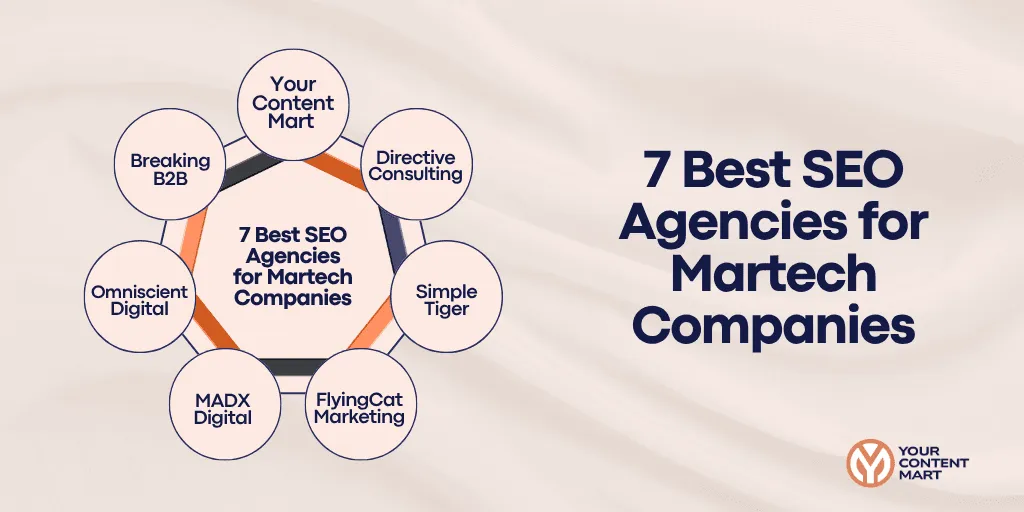
Ranking for anything useful in the martech SERP is genuinely hard. HubSpot, Salesforce, Adobe, and Marketo sit on top of most category keywords with domain authority scores and content budgets that most SaaS startups cannot compete with directly. The best SEO agencies for martech companies understand this and build accordingly. And unlike in most software verticals, your buyers are not regular software buyers. They are marketers. People who spend their entire workday evaluating content quality, identifying weak positioning, and making decisions about what is and is not worth reading.
This guide breaks down some of the best SEO agencies for martech companies based on methodology, positioning, pricing transparency, and experience working with B2B SaaS and marketing technology brands.
How to Evaluate an SEO Agency for a Martech Brand

Before you make a decision on any agency for your Martech product, here are a few things to look out for:
Do they understand buyer-intent SEO?
Informational content has its place in a martech SEO strategy. Posts that address category questions, build topical authority, and capture early-stage researchers are worth producing. The mistake is when that’s all an agency builds.
The pages that capture buyers already in evaluation mode are comparison pages, alternative pages, use-case landing pages, and integration SEO pages. These tend to drive the highest-intent traffic for martech companies. They also require deeper product knowledge to write well, which is partly why some agencies default to informational content at scale.
Do they treat SEO as a standalone strategy?
Content built independently of your sales team’s language and objections, and your product marketing team’s positioning, tends to rank without converting. The buyers who land on that content cannot make the connection between what the page says and what your product actually does for them. The best-performing martech SEO content is built around the same ICP language, objections, and differentiators that show up in sales calls. If the agency is not talking to your sales and product marketing teams regularly, that is a gap worth closing.
Martech SEO that produces pipeline is built in conversation with the people closest to the buyer, not in isolation from them.
Do they connect organic performance to pipeline?
At some point in the engagement, someone on your team will need to explain to a CMO or a board what the SEO investment is actually producing. If the agency’s reporting gives you session counts and keyword positions, that conversation is going to be difficult. Ask any agency you’re evaluating how they attribute organic performance to demo bookings, MQL quality, and ARR. How they answer reveals a lot about how they think about the work.
Are they thinking about AI search?
A growing share of martech buyers now rely on AI to help shortlist products. An agency that is not actively building for AI citation visibility alongside Google rankings is already behind the buyer’s research motion. Ask them specifically how they approach GEO and what they have done for clients in AI search.
The 7 Best SEO Agencies for Martech Companies in 2026
| Agency | Best For | Core Methodology | Pricing |
| Your Content Mart | Martech companies focused on trial signups and pipeline growth | Signup Engine Framework; BOFU content tied to signups and MRR | Standard: $3,500/month. Growth: $5,500/month |
| Directive Consulting | Mid-market to enterprise martech ($10M+ ARR) | Customer Generation; SEO, paid, RevOps, and CRO as one program | Not publicly listed |
| SimpleTiger | Seed through Series C martech SaaS | SaaS-exclusive SEO with proprietary AI keyword tooling | Not publicly listed |
| Flying Cat Marketing | Series A through enterprise martech with in-house content owner | Senior-only editorial, GEO, martech vertical specialization | Based on engagement scope |
| MADX Digital | Growth-stage martech SaaS wanting SEO, content, and digital PR in one program | Integrated SEO, content marketing, digital PR, and GEO as one system | From $2,199/month |
| Omniscient Digital | Seed through Series C, content-operations-first teams | Content strategy and operations for B2B SaaS | From $10,000/month |
| Breaking B2B | Seed through Series B wanting a BOFU-first, founder-led engagement | Money keyword framework with AEO integration | From $4,000/month |
1. Your Content Mart

Most SEO agencies treat content as a traffic channel alone. At Your Content Mart, we treat it as a customer acquisition channel. Our SEO strategy is built around generating trial signups, demos, and pipeline for SaaS companies, not just pageviews.
When it comes to SaaS products, what often drives the pipeline is content built around high-intent moments in the buyer journey. Content that answers comparison queries, addresses objections, and shows why your product is a stronger fit than competing options.
That is the foundation of the Signup Engine Framework, a proprietary framework built to help drive signups for your SaaS product.
Every content asset maps to a specific stage in the trial signup funnel. The goal is not rankings for the sake of rankings. It is trial signups, conversion rate growth, and MRR from organic search.
In practice, this means prioritizing bottom-of-funnel and mid-funnel keywords over broad awareness plays. For most martech companies, trying to outrank HubSpot or Salesforce on broad category keywords is an expensive and unrealistic path to pipeline. Building visibility where buyers are already evaluating solutions is far more effective.
The types of content we build reflect this focus:
- Competitor alternative pages capture buyers searching for replacements after evaluating another tool. These pages target queries like “best HubSpot Marketing Hub alternatives for growing SaaS teams” or “ActiveCampaign alternatives for B2B SaaS companies.”
- Comparison pages target buyers weighing multiple products during evaluation. Examples include “HubSpot vs Marketo for SaaS companies” or “[Your Product] vs Salesforce Marketing Cloud.”
- Use-case landing pages focus on buyers searching for solutions to a specific workflow or problem, such as “marketing automation software for product-led SaaS” or “best attribution software for performance marketers.”
- Category-level listicles help capture buyers building a shortlist. Examples include “best marketing automation platforms for B2B SaaS” or “best CDPs for mid-market companies in 2025.”
- Integration SEO pages target buyers researching compatibility with tools they already use. Examples include “HubSpot and Salesforce integration” or “[Your Product] + Slack.”
- Product-led content demonstrates the product solving a real workflow problem instead of simply describing features. The product is woven naturally into the process so readers can see how it works in practice.
We also place strong emphasis on AI search visibility and structured content formatting as software discovery shifts toward platforms like ChatGPT, Perplexity, and Google AI Overviews.
Two client results show some of what we’ve been able to achieve using the Signup Engine Framework:
Copysmith, an AI writing platform, came to us with a problem many martech companies face: decent organic traffic, weak conversion performance. Their existing content was broad, informational, and poorly aligned with buyer intent.
We rebuilt their strategy around the Signup Engine Framework, shifting focus toward BOFU content designed for buyers already evaluating AI writing software. That included comparison pages, competitor alternative pages, and use-case content built around the reasons buyers choose or leave tools in the category.
In eight months, monthly signups grew from 529 to 3,457, a 553% increase. Organic traffic increased from 3,980 to 14,600 monthly clicks. Conversion rates climbed from 13.2% to 23.7%, and organic search became their largest acquisition channel, growing from 30% to 48% of total signups.

OneCal, a calendar management platform, faced a different challenge: competing in a crowded category filled with well-funded competitors.
One of the clearest ways to win in saturated martech markets is to appear where buyers search for answers before finalising their shortlist. We optimised OneCal’s content for both traditional SEO and AI search visibility, targeting the kinds of queries buyers increasingly ask Google AI Overviews and tools like Perplexity during early-stage research.
We started by improving thin pages for quick wins, then expanded topical authority through JTBD-driven content built around the workflows users were actively searching for. We also launched competitor alternative pages targeting searches around tools like Calendar Bridge.
In five months, organic traffic grew 291%, increasing from 8,000 to 31,300 monthly clicks. OneCal ranked number one for “Calendar Bridge alternatives,” above both Reddit and Calendar Bridge itself. They also earned the top position in Google’s AI Overview for “calendar sync software,” ranking above Calendly and Reclaim.ai.

Both companies applied the same underlying strategy at different stages of growth: SEO content designed to drive business outcomes, not vanity metrics.
Best for: Martech companies that want organic content to produce trial signups and measurable pipeline outcomes, not traffic reports. Works across growth stages.
Pricing
For ongoing engagements, our monthly retainers include:
Standard Tier at $3,500/month
With this plan, you will get:
- 4 SEO-optimized articles per month
- 2 existing content refreshes & updates
- Monthly strategy calls
- Performance reporting and recommendations
Growth Tier at $5,500/month
With the growth tier, you will get:
- 8 articles per month for faster momentum
- 4 existing content refreshes & updates
- Weekly strategy calls
- AI search optimization across all content
- Link building included
- Dedicated account manager

2. Directive Consulting

Image Source: Directive Consulting
Directive Consulting is a B2B tech marketing agency founded in 2014. The agency combines SEO, paid media, CRO, and revenue operations within a broader revenue-focused marketing strategy. Their methodology is called Customer Generation, which connects marketing activity to qualified pipeline and revenue rather than lead volume. They also have a proprietary platform called Stratos that consolidates CRM, paid, and organic reporting into one view.
SEO is one component of a larger demand generation program here. Companies looking for a dedicated SEO partner, rather than an integrated performance marketing agency, should factor that in.
They have worked with the likes of Adobe, Calendly, and Gong.
Best for: Mid-market to enterprise martech ($10M+ ARR) that want SEO running alongside paid media and RevOps as a combined program.
Pricing: Not publicly listed.
3. SimpleTiger

Image Source: SimpleTiger
SimpleTiger is a SaaS-exclusive SEO agency founded in 2006. They cover technical SEO, content marketing, link building, paid search, paid social, GEO, and Webflow design. They use proprietary AI-powered keyword research and content prioritization tooling built into their delivery workflow.
They also name martech as an explicitly served vertical on their website and they have worked with JotForm, Segment, Bitly.
Best for: Seed through Series C martech SaaS wanting a SaaS-exclusive agency with direct founder involvement.
Pricing: Not publicly listed.
4. Flying Cat Marketing

Image Source: Flying Cat Marketing
Flying Cat Marketing was founded in early 2020 by Maeva Cifuentes. They cover SEO strategy, content production, technical SEO, and GEO. Their writers are senior-level B2B SaaS specialists and they work from a “Brand Bible” document that keeps content aligned with a client’s voice and positioning across all deliverables. Martech is named as one of three in-house specialties on their website alongside HR tech and hospitality tech.
The engagement starts with an audit month before moving into a retainer. Initial commitment is four months, with a 60-day rolling notice after that.
They have worked with ActiveCampaign, Livestorm, and Hotjar.
Best for: Series A through enterprise martech with a dedicated in-house content owner. Good fit for US martech expanding into European markets.
Pricing: Based on engagement scope
5. MADX Digital

Image Source: MADX Digital
MADX Digital is a B2B SaaS SEO agency that covers SEO, content marketing, digital PR, link building, and GEO across a single integrated program. Their approach is built around combining technical SEO with a topic-led content strategy structured around how buyers actually search, covering both traditional rankings and AI search visibility across ChatGPT, Perplexity, and Google AI Overviews.
Their martech work focuses on building pages around integrations with platforms like CRMs and ad tools, workflow-based use cases, and feature comparison pages that match real buying queries.
They have worked with Postalytics, Kurve, and Parcel Tracker.
Best for: Growth-stage martech SaaS wanting SEO, content, and digital PR managed as one program, with explicit martech vertical experience and transparent pricing.
Pricing: From $2,199/month
6. Omniscient Digital

Image Source: Omniscient Digital
Omniscient Digital was founded in 2019 by Alex Birkett, David Ly Khim, and Allie Decker. They work exclusively with B2B software companies and focus on content strategy and content operations, building repeatable production systems rather than delivering standalone articles. The approach is designed to compound over time rather than produce short-term traffic spikes.
Their client list includes the likes of Jasper, Hotjar, and Loom.
Best for: Seed through Series C martech SaaS wanting a content-operations-first SEO approach.
Pricing: From $10,000/month
7. Breaking B2B

Image Source: Breaking B2B
Breaking B2B is a B2B SaaS SEO agency founded by Sam Dunning. The agency covers SEO, AEO, technical SEO, content, and web design. The approach is BOFU-first, centered on what Dunning calls a “money keyword” framework: targeting commercial-intent queries with clear purchase signal rather than broad informational content. AEO is integrated alongside traditional SEO to cover the AI search layer.
They have worked with the likes of Checkwriters, Fibbler, and RB2B.
Best for: Seed through Series B martech SaaS wanting a BOFU-first, founder-led engagement at an accessible price point. Budget: ~$3,000–$10,000/month estimated.
Pricing: Starting at $4,000 per month.
Which Martech SEO Agency Should You Choose?

The goal of every piece of content your martech company publishes should trace back to a buyer trying your product, and that is specifically what we do at Your Content Mart. We build content that moves martech buyers from research to signup, targeting them at the exact moment they are closest to a decision and giving them a clear reason to try the product over every alternative they have been evaluating.
Before anything goes live for a client, we spend time inside the product. We use the tool, map the workflows a real user goes through, and understand what the experience actually feels like. That shapes everything we write. The examples we use, the problems we surface, the way we position the product against alternatives. It is why the content converts rather than just ranks.
Every piece we produce is also built to function as a mini sales page. It does not just inform the reader. It gives them a specific reason to try the product. That is the standard we hold every article, comparison page, and use-case landing page to, regardless of where it sits in the funnel.
FAQs About Best SEO Agencies for Martech Companies

What makes martech SEO different from regular SaaS SEO?
The buyer profile is the biggest difference. Martech buyers are professional marketers who evaluate content quality with a critical eye. Generic SaaS content that performs well in other categories tends to underperform in martech because the audience is more discerning. The competitive SERP is also harder; broad category keywords are dominated by well-resourced incumbents, which means martech companies have to be more intentional about targeting buyer-intent queries rather than chasing volume.
How much does a martech SEO agency cost?
The agencies on this list range from around $2,000 per month at the entry level to $25,000 or more per month for full-service enterprise programs. Series A and Series B martech companies typically budget between $5,000 and $15,000 per month. Scope, team involvement, and channel coverage are the main factors that move the number.
How long before a martech SEO program produces results?
BOFU content targeting high-intent buyers can see meaningful ranking movement within three to four months. Broader topical authority builds over six to twelve months and compounds from there. The first 60 days rarely show dramatic traffic changes, which is normal; it is not a signal that the strategy is not working.
Should a martech company hire an SEO agency or build in-house?
For many martech companies, especially those still in the earlier stages of growth, an agency can provide faster output and broader expertise than a single in-house hire. That said, an in-house SEO or content hire makes strong sense as the strategy matures and execution volume grows. Many companies end up with both. The decision depends on where you are in your growth stage, what your internal team can absorb, and how quickly you need results.


