
7 Best Generative Engine Optimization Agencies for SaaS Companies in 2026
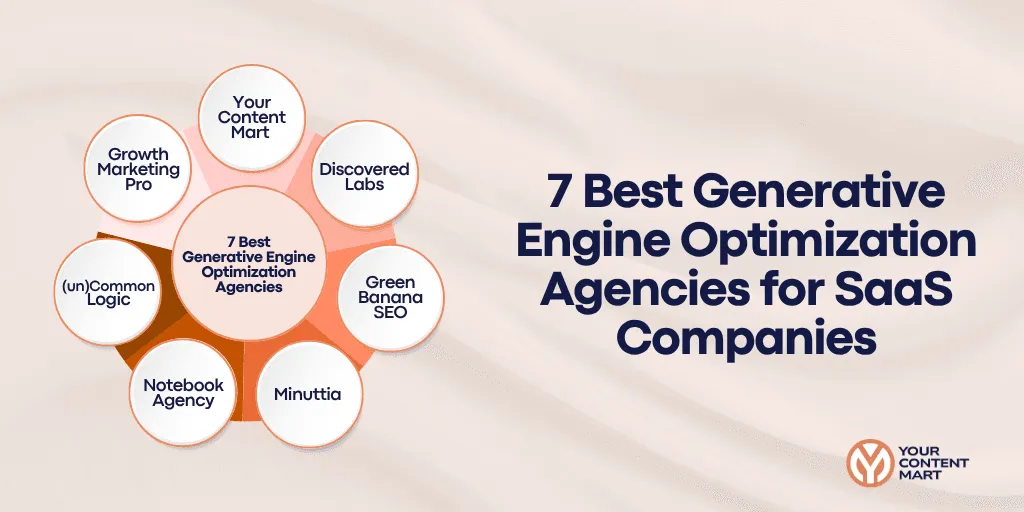
If you sell a product or service online, your buyers are no longer searching on Google alone. They are asking ChatGPT, Perplexity, and Google AI Overviews for recommendations, and getting AI-generated answers before they ever visit a website. Generative Engine Optimization (GEO) is how brands show up in AI recommendations, which is why GEO agencies are an important category in B2B marketing right now.
You can see it in how quickly organic search behavior is changing. In March 2025, Google sent 345x more traffic than ChatGPT, Gemini, and Perplexity combined. By August 2025, that gap had closed to 210x, a 38% reduction in five months. The absolute numbers still favor Google, but the direction is clear. SaaS marketing teams that ignore AI search today are building on a shrinking foundation.
But GEO is not a replacement for search engine optimization (SEO). They both work together to help your product get cited when a buyer asks an AI for a recommendation. This guide covers seven of the best generative engine optimization agencies and examines how each approaches GEO and the results they have delivered for clients.
7 Best Generative Engine Optimization (GEO) Agencies in 2026
The best generative engine optimization agencies do more than add “GEO” to their services page. They have a documented methodology for getting your brand cited across AI platforms, a way to track whether that visibility is actually changing, and a clear answer for how it connects to business outcomes like signups, pipeline, or revenue. The agencies on this list were evaluated on all three.
Here is a list of the best Generative Engine Optimization (GEO) Agencies in 2026:
| Agency | Best For | Starting Price | Notable Clients | Industries |
| Your Content Mart | B2B SaaS ($1M+ ARR) | $3,500/month | OneCal, Copysmith, SweetProcess | B2B SaaS (exclusively) |
| Discovered Labs | B2B SaaS ($2M–$50M ARR) | €6,995/month (~$7,500) | Instantly, incident.io, Granola | B2B SaaS, fintech, professional services |
| GreenBanana SEO | Mid-market, multi-channel | Custom pricing based on engagement scope. | Raytheon, Review, Aerospace | 30+ verticals |
| Omnius | B2B SaaS and fintech | Custom pricing based on engagement scope. | Anna Money, WorldFirst, TextCortex | SaaS, fintech, and AI companies |
| Notebook Agency | Enterprise, B2B SaaS | Custom pricing based on engagement scope. | RBC, FreshBooks, Cirque du Soleil, Mejuri | B2B SaaS, enterprise |
| (un)Common Logic | Enterprise companies with multi-channel marketing. | Custom pricing based on engagement scope. | TrustArc, G&W Electric, Konica Minolta | B2B, ecommerce, B2C |
| Growth Marketing Pro | SaaS full-stack growth | Custom pricing based on engagement scope. | Adobe, SentinelOne, SmartRecruiters | SaaS, tech, consumer |
1. Your Content Mart

Your Content Mart is a specialized SEO and GEO agency for growth-stage B2B SaaS companies. While most agencies report rankings and traffic, we focus on conversions as our primary metric.
Our approach to Generative Engine Optimization (GEO) service is built into the Signup Engine Framework, a five-stage methodology that starts with product research and customer interviews (not keyword tools) and ends with revenue attribution and AI search optimization. We don’t treat GEO as a separate service bolted onto SEO. Every piece of content we create is structured for both Google rankings and AI tool citations, since your buyers search in both places.
Most SaaS companies make the same content mistake. They target high-volume informational keywords like “what is project management,” “how to improve team productivity,” and “best practices for remote work,” then wonder why the traffic never converts. These are awareness-stage searches. The people running them are not buyers yet. They might never be.
We focus on a completely different layer of the funnel. The content we create is designed for buyers who have already identified the problem and are now evaluating solutions. This is bottom-of-funnel, buyer-intent content, and it looks very different from the blog posts most agencies produce.
Say you are a project management SaaS competing against Asana, Monday.com, and ClickUp. Instead of writing “10 tips for better project management,” we would build content assets like:
Comparison pages — “Your Product vs Asana,” “Your Product vs Monday.com,” “Your Product vs ClickUp.” When a buyer has narrowed their shortlist to two tools and types “[competitor] vs [your product]” into Google or asks ChatGPT “which is better, Asana or [your product]?”, your comparison page is the answer that shows up. These pages are structured to clearly show where you win, address buyers’ objections to your product, and move them toward a trial signup.
Alternative pages — “Best Asana alternatives,” “Monday.com alternatives for small teams,” “ClickUp alternatives for agencies.” These are the searches buyers run when they are frustrated with a competitor and looking for something better. They convert at a high rate because the buyer is already motivated to switch. We build these pages to position you as the obvious next step.
Use-case pages — “Project management software for creative agencies,” “project management tool for remote engineering teams,” “construction project management software.” These intercept buyers who are searching with a specific context in mind and want to know if your product fits their situation. AI platforms pull heavily from these pages when a buyer asks something like “what is the best project management tool for a remote design team?”
JTBD content — Content built around the jobs-to-be-done your buyers are trying to accomplish before they even know your product exists. For a project management tool, that might be “how to stop missing deadlines” or “how to manage client projects across multiple teams.” These capture buyers at the moment the problem becomes acute.
This content strategy is precisely what earns AI citations for buying-decision queries. When someone asks ChatGPT or Perplexity “what is the best project management tool for a remote agency?”, AI platforms pull from structured, specific, comparison-driven content. They do not pull from informational blog posts about productivity habits. Pages that directly answer “which tool should I pick and why” are the ones that get cited.
We used this framework for OneCal, a bootstrapped calendar sync tool competing against VC-backed players like Calendly and Reclaim.ai. They were getting 8,000 monthly clicks and sitting at position #9 for their core keyword. Within five months, traffic grew to 31,300 monthly clicks. Today, OneCal ranks #1 in Google’s AI Overview for “calendar sync software,” above both Calendly and Reclaim.ai.

Best for: B2B SaaS startups with $1M+ ARR looking for content that drives signups, not just organic traffic.
Industries: B2B SaaS (exclusively).
Pricing:

Our monthly retainers include:
- Standard Tier — $3,500/month: 4 SEO and GEO optimized articles, 2 existing content refreshes, monthly strategy calls, performance reporting
- Growth Tier — $5,500/month: 8 articles per month for faster momentum, 4 existing content refreshes, weekly strategy calls, AI search optimization across all content, link building, dedicated account manager
2. Discovered Labs

Source: Discovered Labs
Discovered Labs positions itself as an Answer Engine Optimization (AEO) and GEO agency for B2B companies. Their methodology runs through two named frameworks. The first is the 4D Method: Diagnose, Design, Deploy, Deepen, which starts with an AI Visibility Audit across ChatGPT, Claude, Perplexity, and Google AI Overviews, then moves into content production and off-page authority building through Reddit marketing and digital PR. The second is their CITABLE content framework, which structures each piece around direct-answer openings, block-based formatting for retrieval-augmented generation, third-party validation signals, and entity-level schema markup.
Their published case study covers an unnamed B2B SaaS company ($30M+ ARR). According to their published results, the client went from 575 AI-referred trials to over 3,500 in roughly seven weeks.
Best for: B2B SaaS companies at $2M–$50M ARR looking for a GEO-first agency with a structured content methodology.
Industries: B2B SaaS, fintech, professional services.
Pricing: Starts at €6,995 per month (about $7,500)
3. GreenBanana SEO

Source: GreenBanana SEO
GreenBanana SEO’s approach to GEO starts with what they call prompt intelligence. They map the questions buyers ask across AI tools, then build content and page structures designed to match those queries. That includes semantic HTML restructuring, schema implementation, query expansion, and E-E-A-T alignment across pages.
Based on their case studies, one B2B SaaS company reports generating 2,847 monthly visitors from AI platforms like ChatGPT, Claude, and Perplexity, with 27% of those AI-sourced visitors reportedly becoming sales-qualified leads.
Best for: Mid-market companies that want performance accountability built into the contract.
Industries: Healthcare, SaaS, construction, hospitality, defense, sports medicine, energy, and more
Pricing: Custom pricing based on engagement scope.
4. Omnius

Source: Omnius
Omnius treats GEO as an infrastructure problem first, and a content problem second.
Their work starts with how AI crawlers access and interpret your site. That includes configuring access for bots like GPTBot and PerplexityBot, implementing LLMs.txt files, structuring schema at the page level, and managing how entities and citations are presented across the site. They’ve also built an internal tracking system, Atomic AGI, to monitor how often clients appear in AI-generated responses and how that changes over time.
In terms of results, most of their published work still focuses on traditional SEO outcomes. A fintech client, Myos, reports strong signup growth over six months, while an unnamed AI SaaS company scaled to millions of organic clicks within a year. References to GEO performance tend to be more qualitative. For example, a client mentions improvements in AI Overviews visibility, but without detailed breakdowns.
Best for: B2B SaaS and fintech companies that want a technically rigorous GEO approach
Industries: SaaS, fintech, AI companies
Pricing: Custom pricing based on engagement scope
5. Notebook Agency

Source: Notebook Agency
Notebook Agency’s GEO strategy starts with an audit of how AI systems currently describe your product. That means running real buyer queries through tools like ChatGPT and analyzing the responses for accuracy, completeness, and competitive positioning.
They call this the Prompt Mirror process. It surfaces gaps such as missing features, incorrect positioning, or weak comparisons against competitors.
From there, they build content around what they call a Trust Alignment Framework. A centralized “source of truth” for product information feeds into all content, while a scoring system tracks how AI-generated descriptions evolve over time.
According to their published results for Spellbook, a legal AI company, they rewrote key pages to better align with how AI systems extract answers and ran off-page campaigns targeting platforms like ChatGPT and Perplexity. The reported outcome was strong year-over-year growth in organic clicks, although the results combine SEO and GEO impact rather than isolating AI-driven performance.
Best for: Companies that want to understand how AI tools currently represent their brand
Industries: B2B SaaS, enterprise, fintech
Pricing: Custom pricing based on engagement scope
6. (un)Common Logic

Source: (un)Common Logic
(un)Common Logic doesn’t treat GEO as a standalone service. It sits inside a larger system that includes SEO, paid media, CRO, social, analytics, and ABM.
Their GEO work involves prompt testing across multiple AI platforms, competitive citation analysis, schema implementation, and ongoing tracking of visibility in AI-generated responses. GEO outcomes are tied into the same attribution model used for paid and organic channels, rather than being tracked separately.
Based on their published case studies, TrustArc (B2B compliance tech) recorded a 10x improvement in Google’s AI Overview visibility after technical site fixes, and G&W Electric (industrial B2B) reported a 10x improvement in AI Overviews following a site migration.
Best for: Enterprise companies that want GEO integrated into a broader marketing system
Industries: B2B SaaS, ecommerce, B2C, education, industrial
Pricing: Custom pricing based on engagement scope
7. Growth Marketing Pro

Source: Growth Marketing Pro
Growth Marketing Pro focuses on building strong Google rankings first, then layering in GEO.
From there, they expand into GEO-specific tactics. That includes structuring content, so AI answers appear early on the page, implementing LLMs.txt, building citation signals through digital PR, and even using platforms like Reddit, where AI systems often source product discussions. They also use tools like Otterly.ai to track how brands show up across AI platforms.
Their GEO case study includes work with Cube, an FP&A software company. According to their published content, GEO and SEO optimizations helped position the company as one of the more frequently mentioned tools in its category across AI platforms. They also reference a fintech client in which internal testing showed that ChatGPT consistently recommended a single product.
Best for: SaaS and tech companies that want GEO layered into a broader growth strategy
Industries: SaaS, tech, fintech, consumer, health, and wellness
Pricing: Custom pricing based on engagement scope
Book a call with our team if you’re looking to build a signup engine powered by GEO.
What to Look for in a Generative Engine Optimization Agency

Most people searching for the best AEO agency want to know one thing: can this agency get our product mentioned when buyers ask AI tools for recommendations?
If you’re comparing agencies for GEO, these are some areas you should pay attention to:
1. Buyer-intent focus, not just traffic
If an agency is still centered on top-of-funnel traffic, it might not be the best fit for you.
GEO shows up most clearly in decision-stage queries. Searches like “best tools for X,” “X alternatives,” or “X vs Y.” These are the prompts AI tools rely on when generating recommendations.
Ask how they choose topics. The focus should be on queries that influence buying decisions, not just on queries that drive clicks.
2. How they structure content for AI extraction
Ranking is one thing. Being cited is another.
AI tools don’t read pages the way humans do. They extract answers. That means structure matters as much as substance.
Look for agencies that think about:
- How quickly a page answers the core question
- Whether comparisons and trade-offs are clearly stated
- How information is chunked and labeled
- Use of schema and entity signals
3. Their stance on attribution and measurement
A good GEO agency should at least have a working model for:
- Tracking AI-referred traffic
- Monitoring brand mentions across AI platforms
- Connecting key pages to signups or pipeline
If they can’t explain how they measure impact, they won’t be able to tell you what’s working.
Rand Fishkin’s research on AI visibility tracking is useful context here. His 600-person study found you can track brand citation frequency with statistical rigor across AI platforms, but only if you run the same prompts enough times and account for the randomness built into how these systems respond. He also found that rank tracking in AI is unreliable; the same question produces wildly different ordered results across sessions.
Ask your agency which specific tools they use for citation frequency tracking and how often they run the monitoring cycles.
4. Whether they treat GEO as content, infrastructure, or both
Different agencies solve different parts of the problem.
Some lean heavily into content production. Others focus on technical setup like crawler access, structured data, and entity clarity. A few try to do both.
None of these approaches is wrong, but you need to know what you’re buying.
If your site has weak content, technical fixes will not move much. If your infrastructure is broken, more content will not fix it either. Bernard Huang of Clearscope frames this as a two-layer problem: the validation layer, where models do real-time web searches to check facts, and the training layer, where brand perception is set over the long term. Content solves the first. Infrastructure and brand-building address the second.
5. Fit with your stage and resources
Some agencies are built for long-term authority building. Others are optimized for faster, conversion-driven outcomes. Some only work with a small number of high-touch clients.
Look at:
- Budget expectations
- Speed of execution
- Level of involvement required from your team
The best agency for you is the one that fits how you actually operate.
Which Generative Engine Optimization Agency Is Right for You?

GEO works best as an extension of strong SEO, not a replacement for it. Every agency on this list still does foundational search optimization. The difference is how intentionally they’ve built for generative search alongside it.
For B2B SaaS companies, the question that matters most isn’t “which agency does GEO?” It’s “which agency connects GEO visibility to the metric my business actually cares about?” Citations and AI Overview appearances are useful signals. Signups and revenue are what you’re actually optimizing for.
At Your Content Mart, our entire framework is built around converting AI search visibility into trial signups. If your competitors are showing up in AI recommendations and you’re not, or if your content ranks but doesn’t convert, we’d like to show you what’s possible.
Frequently Asked Questions About Generative Engine Optimization Agencies

What is Generative Engine Optimization (GEO)?
GEO is the practice of optimizing your content to be cited in answers generated by AI platforms such as ChatGPT, Google AI Overviews, Perplexity, and Claude. It involves structuring content for machine readability, building topical authority, implementing schema markup, and ensuring AI crawlers can access your pages.
How is GEO different from AEO?
The terms are often used interchangeably. In practice, most agencies use both terms to describe the same work.
How long does GEO take to show results?
In our experience, AI Overview placements and citation improvements can show within two to four weeks of implementation, especially for content that already ranks on Google. AI platforms favor recently updated, well-structured content, so refreshing existing pages tends to move faster than building new ones from scratch.
Does GEO replace SEO?
No. GEO builds on top of SEO fundamentals. A strong traditional SEO strategy improves your GEO performance because AI platforms weigh the same authority signals Google uses.
What internal resources are needed to work with a GEO agency?
You’ll typically need a content point of contact, product, or subject-matter input for accuracy, and occasional support from engineering for technical updates, such as schema or site structure. The level of involvement depends on the agency’s model.
How do I choose between content-focused and technical GEO agencies?
If your issue is weak or misaligned content, a content-focused agency makes more sense. If your site has structural or technical gaps, an infrastructure-focused agency will be more useful. Some companies need both, but usually one is the bigger constraint.
How should SaaS companies evaluate GEO agencies overall?
Focus on how they approach the work, how they measure impact, and whether their model fits your stage and resources. Big claims matter less than a clear, repeatable process.


