
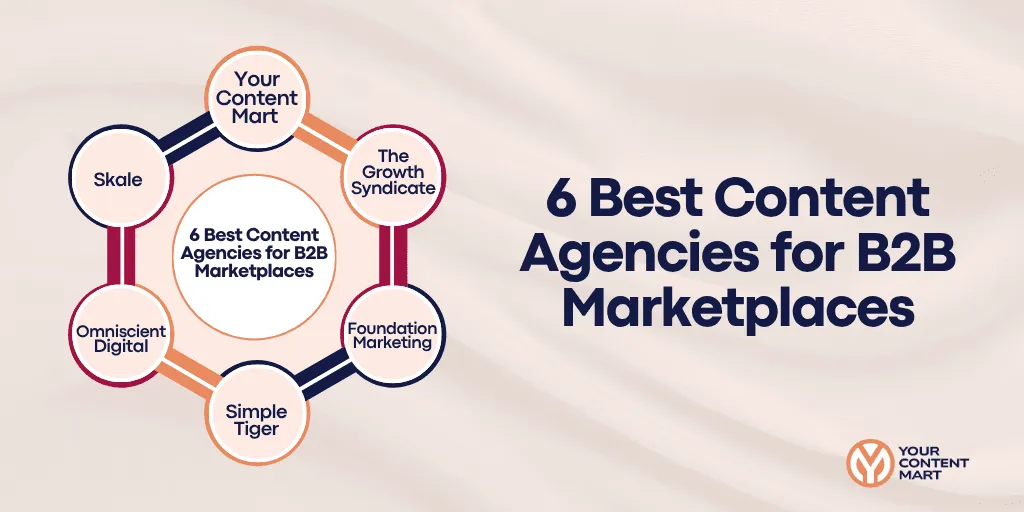
6 Best Content Agencies for B2B Marketplaces
B2B marketplaces don’t have one content problem. They have two.
A B2B marketplace has to serve two audiences with its content. One side is trying to attract buyers. The other is trying to attract suppliers. Each group has different questions, search behavior, and reasons to convert. Content that works for one side often does little for the other.
Hiring a content agency for a B2B marketplace requires a different evaluation process. Beyond content quality, you need an agency that understands two-sided growth, can build authority in competitive categories, and knows how to create content that drives marketplace activity, not just traffic.
The six agencies on this list were selected because they have either worked with marketplace-type businesses or bring a methodology that maps to how marketplace content actually needs to work. Each one is evaluated on what they do, who they work with, how they price, and how they approach content strategy differently.
What B2B Marketplace Content Actually Requires

Understanding what marketplace content actually demands will help you ask better questions during any agency evaluation and filter out agencies that don’t understand the problem you’re trying to solve.
Buyer Content and Supplier Content Need Equal Attention
Standard SaaS content is written for one buyer. Marketplace content has to work for at least two. On the buyer side, that means comparison guides, category pages, trust-building case studies, and use-case content that answers “why should I source from this platform instead of a direct relationship?” On the supplier side, it means acquisition content, onboarding resources, and practical guides on how to win business through the platform. Vendors need content that explains why listing on your platform is worth their time, who the buyers are, and what winning looks like after they’re on board.
These two audiences search differently, distrust for different reasons, and need different things before they take action. Running one content strategy and hoping it serves both rarely produces results for either side. An agency that understands this will build separate keyword maps and intent frameworks for each audience from day one.
A Blog Alone Won’t Scale a Marketplace Programmatic SEO is part of the job
Marketplaces with multiple product categories, supplier types, or geographic coverage quickly outgrow what a standard editorial calendar can produce. That’s where programmatic SEO comes in, building templated, search-optimized pages systematically across every meaningful combination of category, location, and buyer intent. Searches like “B2B wholesale office supplies for small businesses” or “procurement software for manufacturing teams” exist at volume, and they convert. Most content agencies aren’t equipped to execute this. The ones on this list that can are noted in their profiles.
Domain Authority Is Usually the First Obstacle
Newer and mid-stage B2B marketplaces are almost always competing for category keywords against incumbents that have years of domain authority built up. Publishing more blog posts won’t close that gap quickly enough. What actually moves domain authority is content that earns links: original research, data-backed industry reports, and assets that publishers and industry sites want to reference. Agencies that pair strong content production with a genuine link-earning capability are significantly more useful at this stage than those focused purely on content volume.
Awareness Content and Conversion Content Both Have a Role
A post ranking for “what is B2B procurement” builds visibility over time and can be valuable, but it will not grow a marketplace on its own. The content that drives platform metrics like supplier sign-ups, buyer transactions, and demo requests targets people further along in the decision process. These are buyers comparing platforms, suppliers weighing distribution options, and decision-makers with a clear problem and a willingness to act.
A strong marketplace content strategy covers both levels of the funnel. The difference is that most agencies default to top-of-funnel content because that’s where the search volume is. Conversion-focused content should be prioritized first, and awareness content built on top of that foundation.
AI Search Has Changed How B2B Buyers Find Platforms
B2B buyers don’t start their research exclusively on Google anymore. A growing share of purchase decisions now begins with a query in ChatGPT, Perplexity, or Google AI Overviews. According to Adobe Analytics data, generative AI referral traffic to U.S. websites grew 1,200% between July 2024 and February 2025. If your platform isn’t appearing in those AI-generated answers, you’re invisible to a meaningful and growing segment of buyers before they ever reach your organic rankings. Any agency worth hiring in 2025 should have a specific answer for how they build AI search visibility — not just a line item that says “GEO available.”
How We Selected These Agencies
Four things guided this list. First, documented experience with B2B marketplace clients or two-sided platform businesses. Second, a methodology that directly addresses the real content challenges marketplaces face. Third, transparent or independently verifiable pricing. Fourth, published case studies or independent third-party reviews confirming real client work.
6 Best Content Agencies for B2B Marketplaces in 2026
| Agency | Best For | Core Methodology | Starting Price |
| Your Content Mart | Signup-focused content for both sides of a B2B marketplace | Signup Engine Framework | $3,500/month |
| The Growth Syndicate | B2B marketplace GTM, content, and demand generation | Diagnostic-first, embedded fractional marketing | Not publicly listed. |
| Foundation Marketing | Niche buyer/supplier communities, distribution-led programs | Content Distribution | Based on the engagement scope |
| SimpleTiger | Marketplace software companies, SEO, and content | Pipeline engine framework | Based on the engagement scope |
| Omniscient Digital | Full-service SEO + GEO tied to pipeline and ARR | OmniscientX research framework | $10,000/month |
| Skale | B2B SaaS and marketplace SEO tied to revenue | Revenue-first SEO, agile sprints | Not publicly listed. |
Here are 6 of the best SEO agencies for B2B marketplaces:
1. Your Content Mart

Most content agencies measure success with traffic. At Your Content Mart, we measure it with signups. That one difference shapes everything about how we approach a content program: what we research at the start, what we produce, and what we report on at the end.
Every engagement starts with customer interviews and hands-on product research. We interview your recent buyers and active platform users to understand the exact language they used when searching for a solution before they found you. Alongside that, we spend time inside the product itself, working through the platform, mapping features to real use cases, and understanding how different user types would actually use it. The interviews surface what buyers search for. The product research ensures we write about it accurately, which is what separates genuinely useful content from generic SEO content.
For a B2B marketplace, those interviews reveal searches happening on both sides of the platform. Buyer-side interviews surface queries like “[current workflow] alternatives for procurement teams” or “how to manage [supplier category] across multiple locations.” Supplier-side interviews uncover searches like “how to reach enterprise buyers in [industry]” or “best platforms for [product category] vendors.”
From there, every piece of content we produce falls into one of these categories, each targeting a specific stage of the buyer’s evaluation:
- Alternative pages: These capture buyers in active evaluation mode. A search like “[marketplace competitor] alternatives” means someone has already considered a leading option and is now looking at what else exists. We write these to position your platform within that consideration set, with specific product context and real evidence.
- Comparison pages: “[Your platform] vs [Competitor]” pages handle the direct evaluation question before a prospect raises it in a sales call. We write these with actual product comparisons, use-case specificity, and clear positioning rather than generic feature tables.
- JTBD (Jobs-to-be-Done) content: These intercept buyers before they know your platform exists. If your marketplace connects businesses with logistics providers, a buyer searching “how to manage freight procurement for a distributed team” is a live prospect. We answer their current problem and introduce your platform naturally as the next step.
- Solution guides: Practical, product-integrated guides that demonstrate your platform’s value while solving a specific workflow problem. They walk buyers through the platform for a real task, with screenshots and actual product examples.
- Use case content: Industry and role-specific content that shows exactly how your marketplace works for a particular type of buyer or supplier. This builds trust on both sides of the platform with content that speaks directly to a reader’s situation.
We build every article as a mini sales page, in the sense that the product is woven into every section with purpose. Real product examples, actual platform screenshots, and CTAs that match where the reader is in their evaluation. We also write with AI search in mind from day one: clear structure, direct answers, and entity-rich content that language models pull from when buyers ask for platform recommendations in ChatGPT or Perplexity.
Results we’ve achieved using this process
OneCal is a bootstrapped calendar sync SaaS that came to us competing against other well-funded competitors. When we started, OneCal had 8,000 monthly clicks and sat at position nine for its core keyword.
We identified three things: thin pages that needed updating, JTBD content opportunities around searches their buyers were already making, and alternative page gaps that better-funded competitors had left open. Five months later, OneCal was at 31,300 monthly clicks; a 291% increase. They ranked #1 in Google’s AI Overview for “calendar sync software,” above Calendly and Reclaim.ai.

By September 2024, seven months after the engagement ended, traffic had grown to 40,000 monthly clicks without any additional work from either side. The content kept compounding on its own.
With Copysmith, an AI copywriting SaaS, the starting problem was different. Organic traffic existed but wasn’t converting, they had 529 monthly organic sign-ups despite a consistently published blog. Customer interviews revealed the issue: the content was targeting informational keywords while buyers were searching comparison and alternative queries. They were ready to buy, but the content wasn’t meeting them at that stage. We rebuilt the strategy around comparison and alternative pages targeting those high-intent searches.

Copysmith’s traffic and conversion rates before working with Your Content Mart
Over eight months, monthly organic sign-ups grew from 529 to 3,457, a 553% increase. Organic conversion rate improved from 13.2% to 23.7%, and organic search became their number one acquisition channel.

Copysmith’s traffic and conversion rates after working with Your Content Mart
Best for: B2B marketplaces that need content to drive sign-ups and transactions on both sides of the platform, not just organic visibility.
Pricing
For ongoing engagements, our monthly retainers include:
Standard Tier at $3,500/month
With this plan, you will get:
- 4 SEO-optimized articles per month
- 2 existing content refreshes & updates
- Monthly strategy calls
- Performance reporting and recommendations
Growth Tier at $5,500/month
With the growth tier, you will get:
- 8 articles per month for faster momentum
- 4 existing content refreshes & updates
- Weekly strategy calls
- AI search optimization across all content
- Link building included
- Dedicated account manager

2. The Growth Syndicate

Image Source: The Growth Syndicate
The Growth Syndicate is a B2B marketing agency that operates as an embedded fractional marketing team, pairing clients with senior marketers who have hands-on in-house experience at B2B companies.
Its methodology starts with diagnosis before execution. Engagements begin with an audit of the market, funnel, and competitive landscape to identify the real constraints to growth. From there, the team develops programs across GTM strategy, content and thought leadership, SEO and AI search, demand generation, and account-based marketing (ABM).
Notable clients: Cutr (B2B manufacturing marketplace), Frends (Enterprise integration platform), Rapid Circle
Best for: B2B marketplaces that need a senior-led fractional marketing team covering both strategy and execution, without a long-term agency contract.
Methodology: Diagnostic-first approach, senior-only staffing, and performance measurement tied to pipeline and revenue growth
Pricing: Not publicly listed.
3. Foundation Marketing

Image Source: Foundation Marketing
Foundation Marketing is a B2B content agency whose positioning centers on content distribution. The agency produces content and then actively places it in the communities, channels, and publications where target buyers already spend time, including Reddit threads, LinkedIn groups, and niche industry forums. They also cover SEO and Generative Engine Optimization.
The premise behind their model is that most companies over-invest in content creation and under-invest in making that content reach an audience. Their “Create once, distribute forever” methodology is built around solving that gap rather than adding more to the publishing calendar.
Notable clients: Procore, Canva, and Jobber
Best for: B2B marketplaces trying to build visibility in niche buyer or supplier communities where organic search rankings alone won’t reach the audience.
Methodology: Distribution-first content strategy with SEO and GEO built in.
Pricing: Based on engagement scope
4. SimpleTiger

Image Source: SimpleTiger
SimpleTiger is a content marketing and SEO agency with a dedicated practice for marketplace software companies. The agency positions itself as a specialist in helping marketplace platforms scale, whether they are early-stage startups or more established businesses.
Its services span SEO, technical SEO, content marketing, link building, Generative Engine Optimization (GEO), PPC, and Webflow design, giving clients support across both organic growth and paid acquisition.
Their methodology, which they call the Pipeline Engine framework, focuses on identifying the 20% of content and keyword opportunities that will drive 80% of results, rather than chasing volume across a broad editorial calendar.
Notable clients: Segment, Invoca, ContractWorks
Best for: B2B marketplace software companies that need an SEO and content partner with an explicit marketplace practice and a founder-led approach.
Methodology: Pipeline Engine framework. 80/20 prioritization on content and keyword investments. AI-powered keyword research.
Pricing: Based on engagement scope.
5. Omniscient Digital

Image Source: Omniscient Digital
Omniscient Digital is an organic growth agency that helps B2B software companies turn content into a measurable revenue channel. Their services cover SEO strategy, programmatic SEO, GEO, technical SEO, content production, and link building.
Their proprietary research framework, OmniscientX, is used to build content roadmaps tied to pipeline and revenue outcomes rather than traffic volume. The agency focuses on B2B software companies and is upfront that it is not the right fit for B2C or ecommerce brands, which keeps their focus tightly on the kinds of buyers and conversion goals that marketplace operators care about.
Notable clients: AppSumo, Order.co, and Asana
Best for: Growth-stage B2B marketplaces that want a full-service organic program with attribution to qualified leads and ARR.
Methodology: OmniscientX research framework. Programs are built around pipeline and revenue metrics from the start.
Pricing: Full-service engagements start at $10,000/month.
6. Skale

Image Source: Skale
Skale is a B2B SEO agency that works with SaaS and B2B platform companies and builds every program around a single metric: revenue. Services include SEO strategy, content production, link building, technical SEO, website migrations, and GEO.
Engagements run in 3-month agile sprints. Skale maps ICP personas from CRM and review-site data before any content goes into production.
Notable clients: G2, HubSpot, and Maze
Best for: B2B marketplace platforms that need revenue-focused SEO and link building with clear attribution to qualified leads and MRR.
Methodology: Revenue-first SEO, agile three-month sprints, CRM-driven ICP mapping, and subject matter expert-backed content production.
Pricing: Not publicly listed.
How Content Strategy Changes for B2B Marketplaces

Understanding the content challenges is one thing. Knowing how to sequence and structure the strategy is another. These are the practical decisions that separate a marketplace content program that compounds from one that produces traffic with no clear connection to platform growth.
Start with the searches closest to a transaction
The natural instinct is to start at the top of the funnel because that’s where the search volume is. For an early-stage marketplace, that usually means months of content that builds impressions but doesn’t drive sign-ups. Comparison pages, alternative pages, and category-specific content targeting buyers who are actively evaluating options convert faster and connect more directly to platform transactions. That doesn’t mean awareness content gets ignored permanently. It means the conversion-focused work gets built first, and awareness content follows as the program matures and the platform has the authority to rank for broader terms.
Set different success metrics for each side of the platform
Buyer-side and supplier-side content should be measured separately. Buyer content success looks like demo requests, trial sign-ups, and first transactions. Supplier content success looks like vendor registration rates, listing completions, and onboarding completion. Running both under a single traffic-based KPI makes it nearly impossible to see what’s actually working. Programs with separate measurement tracks produce more useful data and make optimization decisions significantly cleaner.
Build category by category, not all at once
Treating the entire marketplace as one content project produces a sprawling editorial calendar that’s hard to prioritize and harder to measure. A more effective approach is to sequence content by category or vertical, building complete coverage for one buyer or supplier segment before moving to the next. This creates topic clusters that rank better, builds internal link equity more efficiently, and lets you observe actual category-level conversion data before scaling the same approach across the whole platform.
Supplier spotlight content earns more trust than platform claims
Buyers on a B2B marketplace carry more risk than buyers of a SaaS tool. They’re not evaluating software; they’re trusting a platform to connect them with real vendors who will deliver real goods or services. A page that says “we have 5,000 verified vendors” is a claim. A content series that profiles actual vendors with specific examples, real client outcomes, and verifiable details is evidence. Supplier spotlight content builds buyer confidence and gives listed vendors a reason to invest in the platform. It’s one of the most underbuilt content types in marketplace programs.
Finding the Right Content Agency for Your B2B Marketplace

The best content agency for a B2B marketplace understands that growth isn’t just about attracting more traffic. It’s about bringing buyers and suppliers onto the platform and creating enough momentum for transactions to happen.
That’s why marketplace content requires a different approach from traditional SaaS content marketing. The strategy has to account for both sides of the marketplace and guide each audience toward meaningful actions.
At Your Content Mart, that’s how we approach every engagement. Using our Signup Engine Framework, we research both sides of your marketplace, identify the buyer-intent keywords that matter most, and build separate content tracks for buyers and suppliers. Every piece of content is designed with a clear conversion goal in mind, whether that’s generating supplier applications, driving quote requests, or increasing product signups.
If you’re evaluating agencies from this list, one question you should be asking is: How would you approach content for our buyers differently from content for our suppliers?
The answer will tell you a lot about whether the agency truly understands marketplace growth.
Frequently Asked Questions (FAQs) About Best Content Agencies for B2B Marketplaces

What does a B2B marketplace content agency do?
It creates content that drives buyers and suppliers to your platform and moves them toward transactions, including SEO content, buyer guides, category pages, comparison pages, and programmatic SEO at scale. Strong agencies also optimize for AI search tools like ChatGPT and Perplexity, not just Google.
How is B2B marketplace content different from SaaS content?
A SaaS company writes for one buyer. A marketplace has to serve at least two: buyers who need to trust the platform and suppliers who need a reason to list. Those audiences have different search behaviors and require separate content programs to convert.
How much does a B2B content marketing agency charge?
The agencies on this list range from $3,500 to $10,000+ per month, depending on scope and services. Your Content Mart starts at $3,500/month (Standard) and $5,500/month (Growth), while Omniscient Digital’s full-service engagements begin at $10,000/month.
Can a content agency handle content for both sides of a B2B marketplace?
Some can, but most don’t approach it that way by default. Ask any agency you’re evaluating how they’d build separate strategies for your buyers and suppliers.


