

6 Best One-Time SEO Sprint Agencies for SaaS in 2026
Most SaaS teams don’t go looking for the best one-time SEO sprint agencies unless there’s a specific need driving it. You might have a defined project, such as launching specific pages or filling gaps in your content strategy, but not enough scope to justify a long-term retainer. Or you’re trying to validate whether SEO can produce results before committing more budget to it.
In both cases, a full retainer feels like overkill. You don’t want ongoing execution yet. You want clarity, direction, and a focused push to solve a problem or prove a point.
One-time SEO sprints are built for that exact situation. They give you a fixed scope, clear deliverables, and a timeline that fits how SaaS teams actually plan and test growth channels.
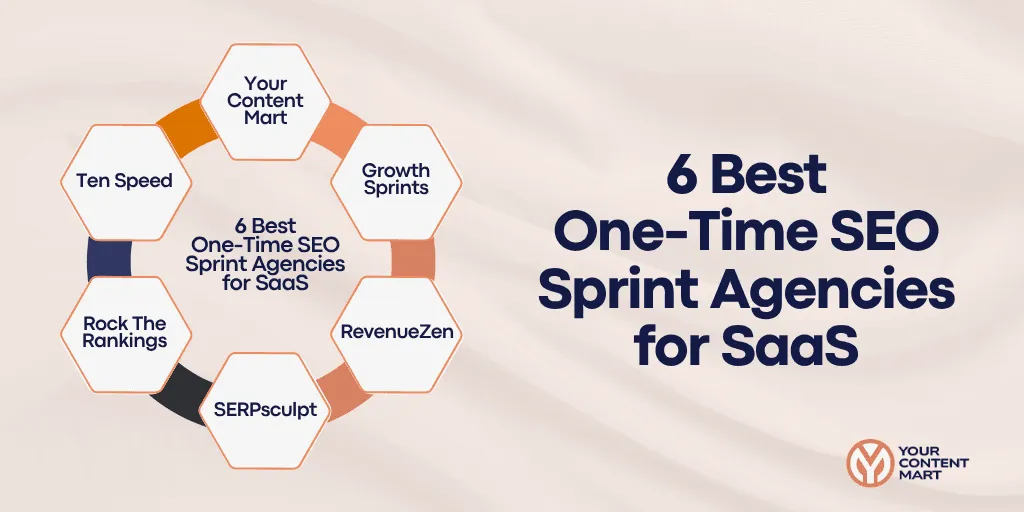
This guide covers 6 of the best one-time SEO sprint agencies for B2B SaaS, and what to look for before you pick one.
SEO Sprint vs. SEO Retainer. Which is better?

An SEO retainer is an ongoing monthly engagement. You pay a fixed monthly fee, and the agency handles strategy, content, and optimization on a rolling basis. The value builds through compounding effort over time. For companies that have already validated SEO as a channel and have the runway to sustain it over the long term, a retainer makes sense.
A one-time SEO sprint is a project. You agree to a defined scope up front, pay a flat fee, and the engagement ends on a specific date. Everything produced belongs to you when it closes, and there is no obligation to continue.
For B2B SaaS companies, sprints tend to fit well in a few situations. If you want to test whether organic search can drive conversions for your specific product before committing to monthly spend, a sprint lets you do that without the risk of a long-term contract. If you have a specific problem to solve, whether a technical issue, a content gap, or a missing keyword strategy, a sprint helps you do that. If your budget is in quarters rather than years, a sprint might better match how your team actually plans.
The right choice depends on where your company is and what goal you’re trying to meet.
6 Best One-Time SEO Sprint Agencies for B2B SaaS Companies
Here is a list of 6 of the best one-time SEO sprint agencies for SaaS companies
| Agency | Sprint Pricing | Sprint Duration | Best For | Notable Clients | Industries |
| Your Content Mart | No one-time sprints; $5,000/month, month to month | Month to month (stop with 30 days’ notice) | Growth-stage SaaS needing signups, not just traffic | OneCal, Copysmith, Sweet Process | B2B SaaS only |
| Growth Sprints | Not listed publicly | 8 to 12 weeks | SaaS companies that want a senior-led, customer-research-driven strategy | Fathom Analytics, AngelList, SparkToro | SaaS only |
| RevenueZen | $2,500/month (~$7,500 total) | Up to 90 days | B2B companies wanting published pricing and a full team | Expensify, Carevoyance, Incfile | B2B SaaS, professional services, healthcare, financial services |
| SERPsculpt | $4,988 one-time | 6 weeks | SaaS companies at $1M to $50M ARR needing a flat-fee strategy sprint | Link My Books, GetResponse, Wiza | B2B SaaS, fintech, complex tech |
| Rock The Rankings | Not listed publicly | ~10 business days | SaaS companies that need a thorough diagnostic before committing to SEO work | Exploding Topics, MoonPay, Hemingway Editor | SaaS, tech |
| Ten Speed | Not publicly listed | Custom scope | B2B SaaS companies wanting a custom one-time project with a proven SaaS team | Bitly, Workvivo, Visible | B2B SaaS, PLG, fintech, cybersecurity, data, and AI |
1. Your Content Mart

Your Content Mart is a B2B SaaS-focused SEO and AI search agency with one clear goal: trial signups. We no longer sell one-time sprints. Our one offer, the Signup Engine, is done-for-you SEO and AI search on a month-to-month plan, and your first month’s fee comes back if you’re not happy, so it is still a low-risk way to test organic as a channel. Our focus isn’t just on how much traffic content brings in, but whether the content drives real conversions.
Every engagement is built on the Signup Engine Framework, which begins with product research rather than keyword tools. We conduct customer interviews to understand what buyers searched for before they found the product and what problems they were trying to solve before they knew a solution like yours existed. We also use the product itself to understand how buyers interact with it day to day. That combination surfaces buyer-intent keyword opportunities that don’t appear as high-volume terms in keyword research tools, because they represent very specific moments in the buying decision rather than broad searches.
For example, a billing software company might get an alternative page targeting “QuickBooks alternatives” for buyers already shopping around, a comparison page targeting “FreshBooks vs [product]” for buyers evaluating specific options side by side, and jobs-to-be-done content (JTBD) content targeting “how to automate invoice reminders” for buyers solving a problem manually without yet knowing a dedicated tool exists.
That’s the kind of foundation we build with every client, and in practice, it leads to results like this:
OneCal, a bootstrapped calendar-sync tool, was up against VC-backed competitors such as Reclaim.ai and Calendar Bridge. At the time, they were getting around 8,000 monthly clicks and sitting at position nine for their main keyword.
Through customer research, it became clear what their buyers were actually searching for. One of those queries was “Calendar Bridge alternatives.” It’s not a term that shows up strongly in most keyword tools, but it signals a buyer who has already evaluated an option and is actively looking to switch. We helped OneCal rank number one for that query, ahead of Calendar Bridge’s own site.
We also created JTBD content around searches like “how to sync Outlook and Google Calendar.” That content earned featured snippet placements and appeared in multiple People Also Ask sections, capturing users who were still solving the problem manually before considering a dedicated tool.
Over five months, organic traffic grew from 8,000 to 31,300 monthly clicks, a 291% increase. OneCal also secured the top spot in Google’s AI Overview for “calendar sync software,” ahead of tools like Calendly and Reclaim.ai. Seven months after the engagement ended, with no additional investment, traffic had grown further to 40,000 monthly clicks.

Traffic is very important. But for a SaaS company, what matters more is whether that traffic becomes signups. Our engagement with Copysmith shows that side of the work.
Copysmith, an AI copywriting platform, was spending heavily on paid ads while organic was generating around 529 monthly signups, mostly branded traffic. Customer interviews revealed that buyers weren’t searching for “what is AI copywriting.” They were searching for “Copy AI alternatives.” They had already decided they wanted an AI writing tool. They were deciding which one. The content strategy shifted to target those decision-stage searches: comparison pages, alternative pages, and solution guides built around how buyers in that category evaluated their options.

Copysmith’s traffic and conversion rates before working with Your Content Mart
Over 8 months, monthly organic signups grew from 529 to 3,457, a 553% increase. Organic traffic grew from 3,980 to 14,600 monthly clicks. Conversion rate improved from 13.2% to 23.7%, meaning the traffic being driven was higher quality, not just higher volume. Organic search moved from 30% to 48% of total signups, making it Copysmith’s number one customer acquisition channel.

Copysmith’s traffic and conversion rates after working with Your Content Mart
Notable Clients: OneCal, Copysmith, SweetProcess
Best for: Growth-stage B2B SaaS companies ($1M+ ARR or seed-funded) that are getting traffic but not signups, or that want to prove organic as a channel month to month before committing to a longer plan.
Pricing
We no longer sell one-time sprints. We now offer one plan, the Signup Engine: done-for-you SEO and AI search for B2B SaaS.
Signup Engine: $5,000 a month, month to month
Stop with 30 days’ notice. You can also pay $4,500 a month on a 3-month plan, or $4,250 a month on a 6-month plan. The work and the guarantee are the same on every plan. See pricing for details.
What’s included:
- 4 new product-tested pages a month (2 in month one): alternatives, comparison, best-of and use-case pages, written by people who have used your product
- 2 refreshes of existing pages a month
- On-page and technical work: internal links, titles, meta and schema
- AI search checks on 25 buyer questions across ChatGPT, Perplexity, Gemini and Google’s AI Overviews
- Disclosed Reddit and community answers
- Outreach for links every month
- Signup tracking set up in month one, and a monthly report with the signup count
- A monthly strategy call and weekly written updates
- One linkable asset a quarter, such as an original stats page or data study
The low-risk way to try it
If you came here looking for a sprint to test SEO before committing, the month-to-month plan is how to do that with us. Work starts in week one: refreshes go live in week 2, and the first 2 new pages go live in weeks 3 and 4. There is no month-long strategy phase. If you’re not happy with the first month, ask within 30 days and we’ll give that month’s fee back.
We also guarantee results. By month six, the signups our pages bring from Google and AI assistants will be worth at least $5,000 a month. We set that number in month one from your own signup-to-paid rate and first-year revenue per customer. If we miss it, we keep working for free for up to three months. We only offer this when our forecast is at least twice that number. The full terms are in our refund policy.
Our founder, Shehu AbdulGaniy, leads every account. Paid ads, social media, and website design or development are not included.
2. Growth Sprints

Source: Growth Sprints
Growth Sprints is Brendan Hufford’s solo-practitioner agency focused exclusively on SaaS. Engagements run 8 to 12 weeks, and clients work directly with Hufford throughout, with no account managers in between.
The methodology is built around a “3S strategy” that draws from sales, success, and support conversations rather than keyword tools. The idea is to surface what buyers actually search for at each stage of evaluation. Sprints incorporate Answer Engine Optimization alongside traditional SEO for visibility in AI search tools and Google.
Notable clients: AngelList, Fathom Analytics, SparkToro
Best for: SaaS companies that want direct senior-level access throughout an engagement and a content strategy built from customer conversations rather than search volume data.
Sprint pricing: Not publicly listed
3. RevenueZen

Source: RevenueZen
RevenueZen is a B2B SEO agency, now owned by Onfolio Holdings, with a published sprint tier on their pricing page. Each sprint is staffed with a VP of Strategy, Senior SEO Strategist, Content Manager, Editor, and Analytics Strategist. The sprint is described as focused on solving one high-impact problem or unlocking a specific growth opportunity within 90 days. Their process covers goal setting, data gathering, strategy, execution, measurement, and iteration. Sprints also incorporate GEO (Generative Engine Optimization) for AI search visibility.
Notable clients: Expensify, Carevoyance, Incfile.
Best for: B2B companies that want a full agency team across the engagement and want to review published pricing before getting on a call.
Sprint pricing: $2,500/month billed monthly for a 90-day engagement
4. SERPsculpt

Source: SERPsculpt
SERPsculpt is a B2B SaaS-focused agency that offers a clearly defined one-time package. Their Gold Package is a standalone, non-recurring engagement priced at $4,988 with a 6-week delivery window. It covers SEO and GEO strategy, ICP research, a content and website audit, a content workbook with a 6-month plan, and a follow-up support consultation. The client’s team handles execution after delivery.
The agency focuses exclusively on B2B SaaS, fintech, and complex tech companies at the $1M to $50M ARR stage. Their sprint methodology is described as “short, high-focus cycles that deliver measurable growth within 90 days.” Beyond the one-time Gold Package, execution tiers are available at higher price points for companies that need ongoing implementation support.
Notable clients: Link My Books, GetResponse, Wiza
Best for: B2B SaaS companies at $1M to $50M ARR looking for a US-based option with a transparent, flat one-time fee for a strategy-focused sprint.
Sprint pricing: $4,988 one-time, with a 6-week delivery time
5. Rock The Rankings

Source: Rock The Rankings
Rock The Rankings offers a standalone B2B SEO Audit as a one-time, fixed-scope project. The audit covers 200+ ranking factors across five areas: a technical SEO audit, an on-page SEO audit, a content audit, a backlink profile review, and a Google Analytics and Search Console analysis.
The agency focuses on growth-stage SaaS and tech businesses. Their site positions the audit as a diagnostic project with clear recommendations. Implementation of those recommendations is available at additional cost but is not bundled into the audit itself.
Notable clients: Exploding Topics, MoonPay, Hemingway Editor
Best for: B2B SaaS companies that need a thorough diagnostic before committing to any SEO work, or that want a clear picture of what to fix before running a broader sprint.
Sprint pricing: Not publicly listed
6. Ten Speed

Source: Ten Speed
Ten Speed is a B2B organic growth agency that works with SaaS companies from seed stage through Series C. Their services page confirms they offer one-time projects alongside ongoing engagements covering strategy, content optimization, technical SEO, and on-site improvements. One-time project scope and pricing are defined through a proposal process rather than a packaged offering.
The agency was founded by Nate Turner and Kevin King, who previously built the SEO content program at Sprout Social.
Notable clients: Bitly, Workvivo, Visible.
Best for: B2B SaaS companies that want a custom-scoped, one-time SEO project from a team with a proven SaaS content track record, and are comfortable defining deliverables through a proposal conversation rather than buying a pre-packaged sprint.
Sprint Pricing: Not publicly listed
What to Look for in a One-Time SEO Sprint Agency for SaaS

Two agencies can sound equally convincing on a sales call, but the difference shows up later in how the work is scoped, executed, and measured.
1. Clearly Defined Scope and Deliverables
A legitimate sprint comes with defined outputs before you sign anything.
That could be a set number of pages, a structured content roadmap, technical fixes, or a mix of both. What matters is that the deliverables are tied to a timeline and documented upfront.
If the proposal feels flexible or leaves too much room for misinterpretation, the scope can easily change mid-project.
2. SaaS Experience
SaaS SEO works differently because of how buyers evaluate products.
When people are close to making a decision, their searches tend to shift. Instead of broad topics, they look for comparisons, alternatives, and specific ways to solve the problem your product addresses. That’s where you start to see stronger conversion signals.
Agencies that understand this build content around those moments. Others stay focused on general topics that bring visibility but don’t always translate into signups.
3. Clear Definition of Success
Rankings and traffic can show progress, but they don’t tell you whether the work is impacting your pipeline.
A strong sprint connects its output to outcomes that matter for SaaS companies, like trial signups or product-qualified leads. The goal isn’t immediate results, but a strategy built around attracting users who are more likely to convert.
4. A Sprint that stands on its own
Some agencies position a sprint as the first phase of a longer engagement. That’s a valid model, but it’s different from a true one-time sprint. The deliverables should be immediately usable, whether or not you continue. If the output only makes sense in the context of future work with that agency, it’s not a standalone sprint.
5. Pricing That Matches a True Sprint
A one-time SEO sprint should feel like a defined project, not a shortened version of a retainer.
During SEO sprints, you’re paying for a specific outcome within a fixed scope and timeline. The pricing should reflect that clearly. There should be no rolling fees, or ambiguity around what’s included, and no need for ongoing commitment to make the work usable.
When pricing is structured this way, it forces clarity on both sides. You know exactly what you’re getting, and the agency is accountable for delivering it within that scope.
What Separates Your Content Mart From Other One-Time SEO Sprint Agencies

We no longer sell one-time sprints, and the way we work explains why. We’re not just trying to ship deliverables. We’re trying to build a channel that brings in trial signups consistently, and that starts with how we approach the problem.
Before writing a single brief, we interview your recent customers to understand the searches they made before finding your product, and we use the product itself to understand how it fits into a buyer’s workflow day to day. That research surfaces buyer-intent keywords competitors aren’t targeting because they’re too specific and too decision-stage to show up as high-volume in any tool. Those are exactly the searches that convert.
For example, instead of chasing broad terms like “calendar management tips,” we look for searches like “X alternatives” or “how to solve [specific workflow problem].” These are not always high-volume keywords, but they signal intent. They tell us the person searching is already in the market for a solution.
Every piece of content we produce is structured like a mini sales page. We write to the specific mindset of the reader at that moment in their decision process, position your product as the solution, incorporate real screenshots and use cases, and close with a CTA matched to where that reader is. A buyer on a “QuickBooks alternatives” page is in a different frame of mind from someone reading “how to automate invoice reminders.” We write to that difference and guide the reader toward trying your product.
We also lean heavily on product-led content. Instead of writing generic advice, we show how the problem gets solved using your product. That could mean walkthroughs, comparisons, or use-case pages that mirror how your users actually think about the product.
You also don’t need a long contract to find out if it works. The plan runs month to month, and you can stop with 30 days’ notice. Work starts in week one, and the first 2 new pages go live in weeks 3 and 4. If you’re not happy with the first month, you get that month’s fee back.
For us, the end is not just rankings or traffic. We also track how content contributes to trial signups. This means looking at which pages bring in users, how those users behave, and whether they convert. We set up signup tracking in month one, and every monthly report shows the signup count. It keeps the work grounded in what matters for a SaaS business.
Frequently Asked Questions about One-Time Sprint Agencies

Can I hire a sprint agency once and then take the work in-house?
Yes, and this is one of the arguments for the sprint model. A well-built engagement ends with a keyword strategy, published content, and attribution tracking that are yours. Many SaaS companies use the initial project to validate the organic channel, then hire a writer to continue building content using the same strategy.
What are the best practices for transitioning from a sprint to ongoing in-house SEO efforts?
Treat the sprint deliverables as your foundation, not a finished project. Before the engagement wraps up, make sure your internal team has everything they need to continue the work. That includes the keyword strategy, content briefs, and any attribution setup used to track performance. Without those in place, it’s hard to maintain momentum. It also helps to involve your in-house writer early. Have them review the content produced during the sprint so they understand how topics were chosen, how pages are structured, and how CTAs are positioned to drive signups.
What deliverables should I expect from a one-time SEO sprint?
It depends on the sprint type. A content sprint should deliver a buyer-intent keyword strategy and published articles targeting those keywords. A technical sprint should deliver a prioritized list of fixes with implementation guidance. Strategy-only projects often deliver a roadmap without execution. Before signing any engagement, ask the agency for a sample deliverable from a past client.
How quickly will I see results?
SEO takes time to compound, but well-targeted sprints tend to move faster than retainers because the scope is focused rather than broad. Timelines vary based on how competitive the keyword landscape is and whether the content targets buyer-intent searches or broad informational terms.
Do I need to move to a retainer after the sprint ends?
No. A well-structured sprint should produce standalone results. If you’re happy with what the sprint delivered and want to keep building on it, most agencies on this list offer a path to ongoing work. Your Content Mart no longer sells one-time sprints. Our plan runs month to month, so you can stop with 30 days’ notice whenever you choose.
What internal resources or team skills do I need to maximize a sprint’s value?
It depends on the sprint type. A strategy-only sprint requires someone in-house who can execute against a roadmap, typically a writer or marketing manager comfortable working from a brief. A full execution sprint needs a point of contact for product feedback, draft approvals, and CMS publishing. A technical sprint needs developer access to implement fixes. If you have no in-house content capacity, a strategy-only sprint will likely underdeliver. A full execution sprint is a better fit.


