Not every SaaS company is ready for a long-term content retainer, and not every content marketing need requires one.
If you are evaluating project-based content agencies for SaaS, it is because you already have a specific goal in mind, not just a general content strategy problem. It could be a gap competitors are taking advantage of, or a defined piece of work you want handled without committing to ongoing support. In those cases, a project-based setup often fits better than a broad, open-ended engagement.
The issue is that most content agencies are built around retainers. That structure influences how they price work, onboard clients, and even scope projects. As a result, genuinely project-friendly options are less common than you would expect.
This guide looks at five agencies that offer project-based content programs. It breaks down how they structure projects, what their pricing looks like, and the situations in which each agency is a better fit.
Why You Should Consider Working With a Project-Based Content Agency
Retainers work well when you have already validated content as a growth channel and need consistent monthly output to compound results over time. But some SaaS teams are not in that position yet. In most cases, their need is specific rather than broad.
Here are the situations where project-based content agencies make the most sense:
- You have a gap in your funnel where competitors are already ranking for buyer-intent keywords that should be yours, and you need a focused sprint to close it before it compounds further.
- You need a defined set of deliverables, whether that is comparison pages, alternative pages, JTBD articles, or a batch of case studies, and none of that justifies an ongoing monthly commitment.
- You want to test whether SEO and content can serve as an acquisition channel for your product before committing a significant long-term budget to it.
- You have internal writing or execution capacity but need strategic direction delivered as a defined project rather than an open-ended consulting arrangement.
- You have worked with a retainer agency before, the traffic went up, but the signups didn’t follow, and you want to see results on a smaller scope before committing again.
A project-based model gives you a way to solve any of those problems with a defined scope from the start. You know what you are getting, how long it will take, and what success should look like before a single word is written.
But project-based work is not a replacement for long-term content investment, and the agencies on this list will be the first to tell you that. Content compounds over time, and the best results tend to come from sustained effort rather than a single sprint. But for SaaS teams that want to move carefully, test before committing, or close a specific gap without overextending their budgets, project-based content agencies offer a more controlled, lower-risk way to start.
→ Want to see what a scoped content project looks like for a B2B SaaS company? Book a free strategy call to map out a content sprint targeting your highest-priority buyer-intent keywords.
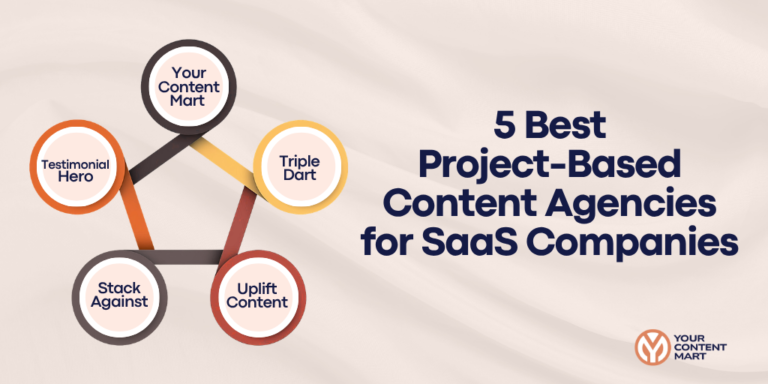
5 Best Project-Based Content Agencies for SaaS Companies
Here is a list of 6 of the best Project-based agencies for SaaS companies:
| Agency | Best For | SaaS Focus | Notable Clients | Pricing |
| Your Content Mart | Growth-stage B2B SaaS ($1M–$20M ARR) needing buyer-intent content tied to trial signups | Exclusively B2B SaaS | OneCal, Copysmith, SweetProcess | Three tiers: Strategy Sprint ($1,500), Proof of Concept Sprint ($2,500), Full Execution Sprint ($5,000) |
| TripleDart | B2B SaaS companies that need content produced on a project basis with design execution included | B2B SaaS and tech | Plivo, Multiplier, Freshworks | Editorial blogs from $800, content strategy from $3,000. |
| Uplift Content | B2B SaaS teams that know what content they need and want clean execution without overhead | B2B SaaS | ClickUp, Okta, WalkMe | Blog posts start at $400, while eBooks and white papers start at $2,000 |
| Stack Against | B2B SaaS companies needing SEO-optimized comparison pages on a project basis | B2B SaaS-focused | FreshBooks, Cloudways, Signaturely | Comparison page projects start at $3,000 |
| Testimonial Hero | B2B SaaS companies that need customer proof points delivered as a complete bundle of written and video assets | B2B-focused (software, SaaS, and other industries) | Gong, Intercom, and Docusign | Basic plan starts at $6,000 |
1. Your Content Mart
Your Content Mart is a SaaS-focused content agency that approaches project-based work differently from most agencies. Instead of focusing on content volume or broad top-of-funnel traffic, we prioritize content that drives trial signups, demo bookings, and revenue.
Our project-based model is structured around clearly defined sprints, each designed to solve a specific growth problem. Every project comes with a fixed scope, timeline, and outcome tied to buyer-intent search. This makes it easier for SaaS teams to test content as a channel without committing to a long-term retainer.
The work typically sits in the middle and bottom of the funnel. Instead of publishing large volumes of blog content, the focus is on high-impact pages that sit closer to conversion. Comparison pages are one example, where a piece like “Klaviyo vs Mailchimp” positions your product directly in front of buyers who are already side-by-side evaluating tools in your category. Alternatives pages are another, like “Best Intercom alternatives” or “Best Loom alternatives,” which capture buyers who are actively looking to move away from a competitor and are evaluating what else is on the market. Beyond those, JTBD content targets buyers through the problems they are already searching to solve before they even know your product exists, whether that’s “how to reduce customer churn with email automation” for a CRM SaaS or “how to manage contractor payments across multiple currencies” for a fintech tool. Solution-driven landing pages round out the mix, showing exactly what your product does for specific buyer types with enough specificity that the reader recognizes their situation and takes action.
What differentiates our approach is how we handle keyword research and content strategy. Rather than relying solely on SEO tools, we incorporate customer research to understand how buyers actually search when they are close to making a decision. This often leads to targeting lower-volume but higher-intent keywords that convert at a significantly higher rate. We also structure content to align with how modern search works, including AI-driven results and answer engines.
Our case studies reflect this approach.
In our work with Copysmith, an AI copywriting SaaS company, the initial challenge was an overreliance on paid acquisition and underperforming organic content. At the start of the engagement, organic traffic generated around 3,980 monthly clicks, but this translated to only 529 monthly signups, most of which came from branded searches. The existing blog content was not influencing buying decisions.
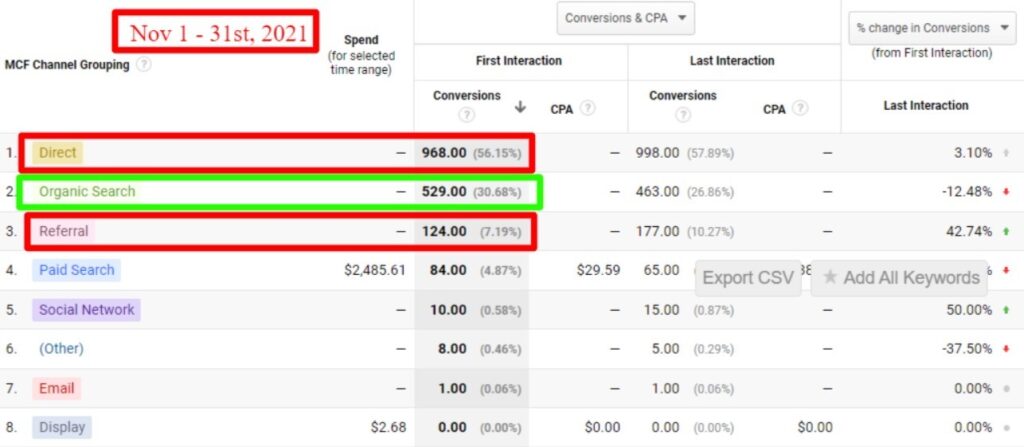
Copysmith’s traffic and conversion rates before working with Your Content Mart
We shifted the focus toward buyer-intent content. Through customer research, we identified that users were searching for alternatives and comparisons rather than general informational topics. Based on this insight, we built a set of comparison pages, alternative pages, and solution-focused content targeting middle and bottom-of-funnel keywords. We also tracked the full journey from search to signup to better understand conversion performance.
During our engagement with Copysmith, monthly signups from organic increased from 529 to 3,457, representing a 553% increase. Organic traffic grew from 3,980 to 14,600 monthly clicks. Conversion rates improved from 13.2% to 23.7%, indicating that the traffic being generated was more aligned with buying intent. Organic search also increased its contribution to total signups, moving from 30% to 48%.
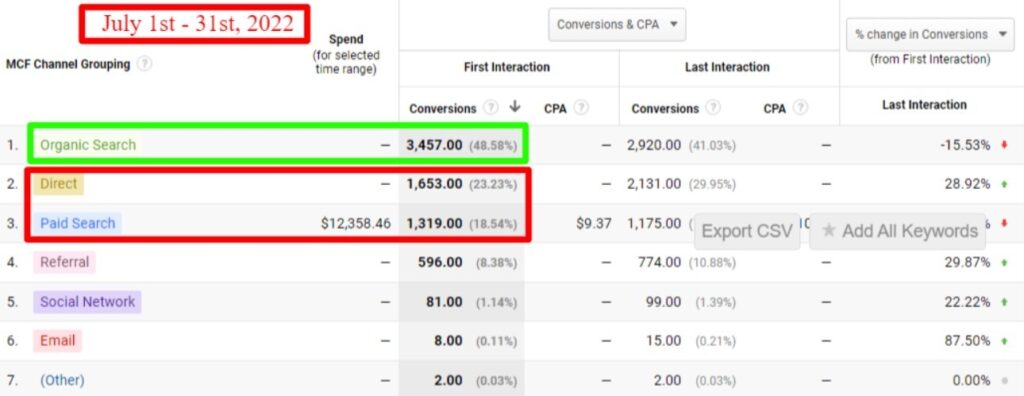
Copysmith’s traffic and conversion rates after working with Your Content Mart
A similar pattern can be seen in our work with OneCal, a calendar sync SaaS product competing against larger, well-funded competitors. At the start of the engagement, the company was generating around 8,000 monthly clicks and ranking on the second page for its core keyword. Its existing content was thin, and competitors had stronger domain authority and larger content budgets.
Instead of competing directly on high-volume keywords, we focused on building topical authority through problem-driven content. This included updating underperforming pages for quick wins and creating content around jobs-to-be-done queries, such as syncing different calendar platforms. We also developed alternative pages that competitors had not fully covered.
Within five months, traffic increased from 8,000 to 31,300 monthly clicks, and impressions grew from one million to four million monthly. The company achieved a number one ranking for “Calendar Bridge alternatives” and secured the top position in Google’s AI Overview for “calendar sync software,” ahead of larger competitors. The content continued to generate results after the engagement ended, growing to approximately 40,000 monthly clicks without additional investment.
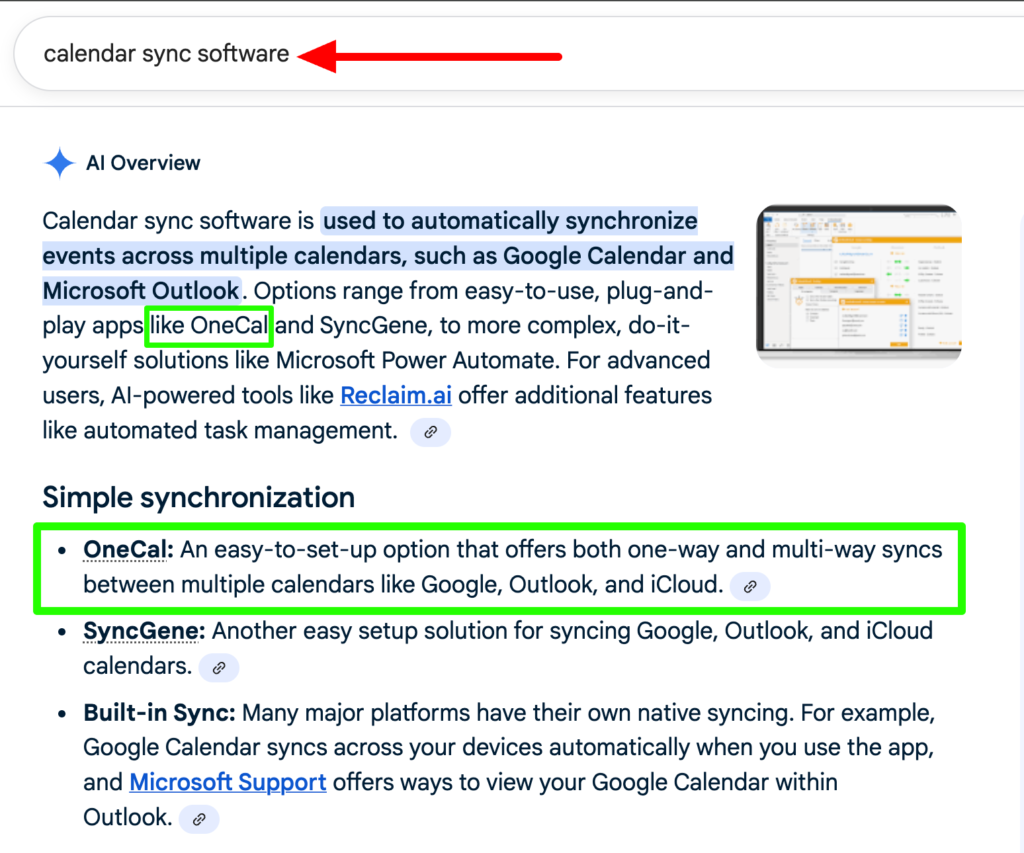
These case studies highlight a consistent pattern. Instead of trying to compete on volume or budget, we focus on capturing high-intent demand and converting that demand into measurable business outcomes.
Best for: Growth-stage B2B SaaS companies ($1M–$20M ARR) that need buyer-intent content tied to trial signups, not just organic traffic.
Notable clients: OneCal, Copysmith, Sweet Process
Pricing
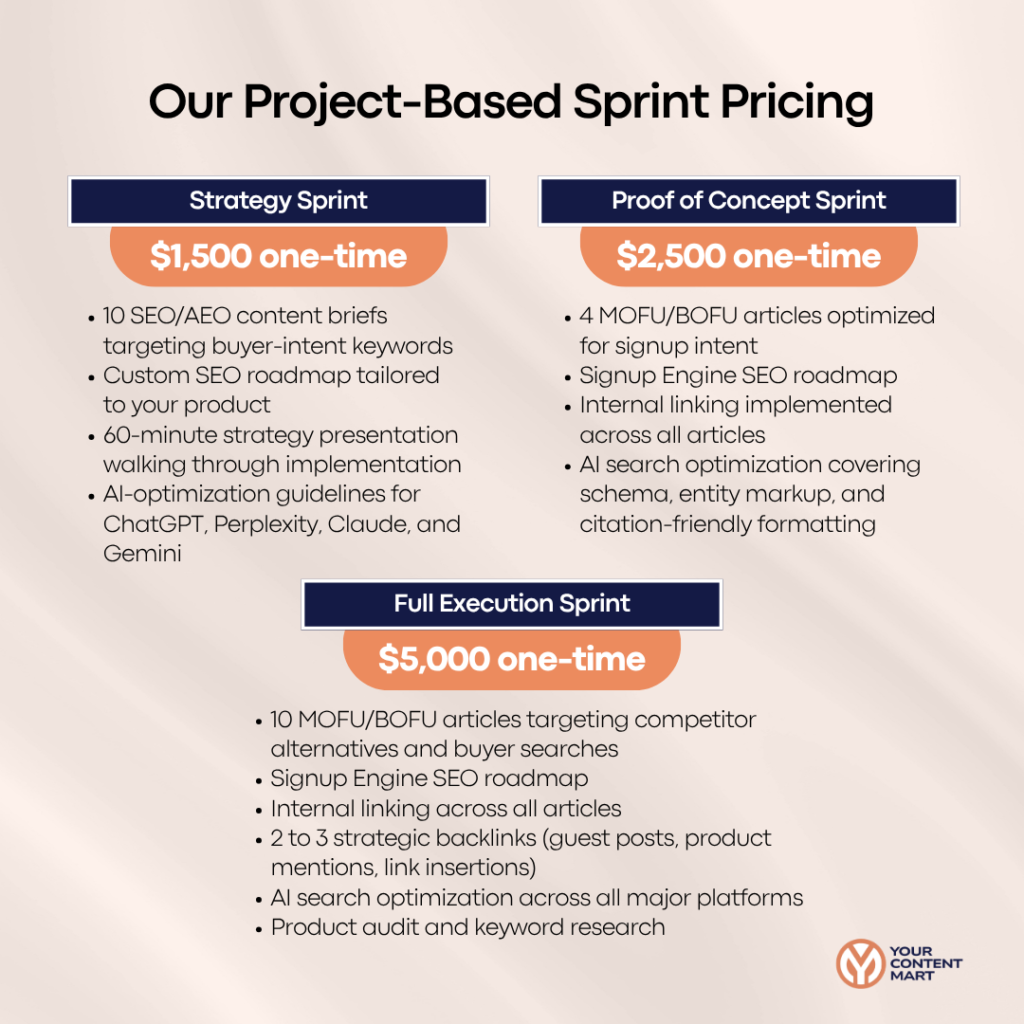
We offer three project-based sprints, structured into three tiers based on where you are and what you need.
Strategy Sprint — $1,500 one-time payment
A clear roadmap to start generating signups from organic search, no execution required. Delivery time is 2 weeks.
What’s included:
- 10 SEO/AEO content briefs targeting buyer-intent keywords
- Custom SEO roadmap tailored to your product
- 60-minute strategy presentation walking through implementation
- AI-optimization guidelines for ChatGPT, Perplexity, Claude, and Gemini
Proof of Concept Sprint — $2,500 one-time payment
Real execution to test what’s possible before committing long-term. Delivery time is 4 to 6 weeks.
What’s included:
- 4 MOFU/BOFU articles optimized for signup intent
- Signup Engine SEO roadmap
- Internal linking implemented across all articles
- AI search optimization covering schema, entity markup, and citation-friendly formatting
Full Execution Sprint — $5,000 one-time payment
A complete signup-focused content foundation, built fast. Delivery time is 30 to 45 days. Capped at 2 clients per month.
What’s included:
- 10 MOFU/BOFU articles targeting competitor alternatives and buyer searches
- Signup Engine SEO roadmap
- Internal linking across all articles
- 2 to 3 strategic backlinks (guest posts, product mentions, link insertions)
- AI search optimization across all major platforms
- Product audit and keyword research
2. TripleDart
Image Source: TripleDart
TripleDart is a full-service B2B SaaS marketing agency covering SEO, paid media, ABM, RevOps, and content. Their Brand and Content Services page offers a project-by-project engagement model for teams with a specific, immediate content need, alongside a subscription option for ongoing output. The content types they cover include original guides and playbooks, first-party research reports, competitor comparisons and battlecards, editorial content, and case studies.
Best for: B2B SaaS companies that need content produced on a project basis, with design execution handled in the same engagement.
Notable Clients: Plivo, Multiplier, Freshworks.
Pricing: Editorial blogs start at $800 each, and content strategy engagements start at $3,000. Other deliverables including original guides, research reports, and webinar series are also priced on their Brand and Content Services page.
3. Uplift Content
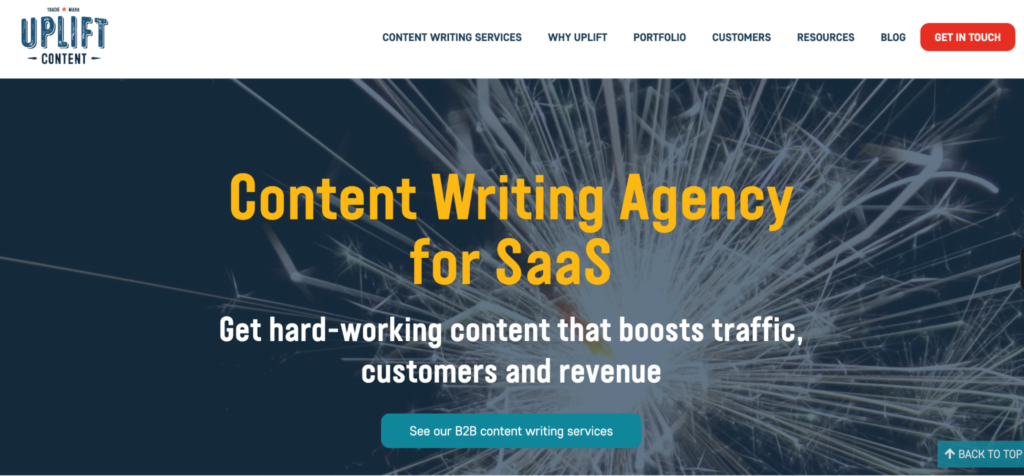
Image Source: Uplift Content
Uplift Content takes a production-first approach. They focus on writing, particularly case studies, blog posts, and long-form assets like eBooks and white papers.
There is no contract requirement, and work is priced per asset. This makes them easy to work with if you already know what you need and want a straightforward way to get it produced.
Their background in journalism shows in how they handle storytelling, especially for customer case studies. The output is often clear, structured, and useful for sales teams that need credible proof points.
They lean less on SEO strategy and more on execution. For teams that already have a content plan in place, this works well. For teams that need direction, that layer would need to come from elsewhere.
Best for: B2B SaaS marketing teams that know exactly what content they need and want expert writing execution without the overhead of a full-service engagement.
Notable clients: ClickUp, Okta, WalkMe
Pricing: Blog posts start at $400, while eBooks and white papers start at $2,000.
4. Stack Against
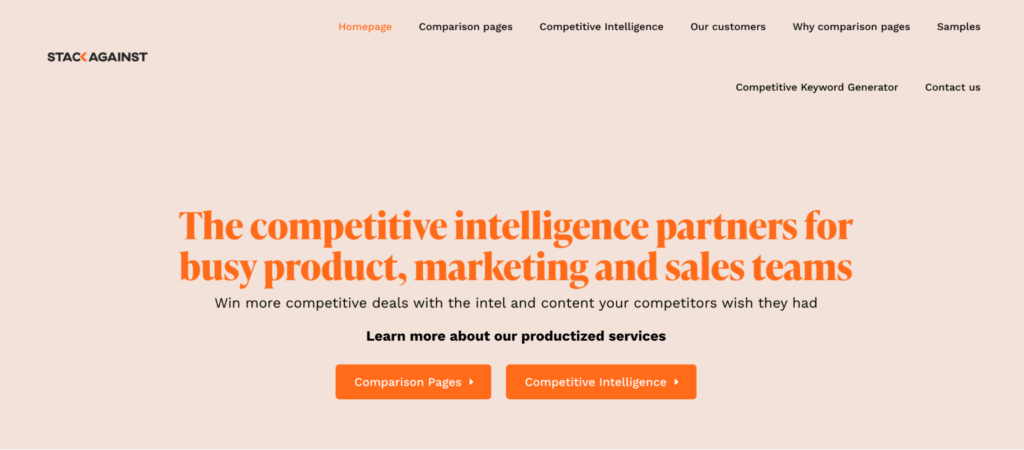
Image Source: Stack Against
Stack Against focuses exclusively on competitor comparison pages and competitive intelligence for SaaS companies. Their comparison page service covers research, SEO-optimized copywriting, and design, all delivered as a defined project with pricing confirmed on their live homepage. This makes them a focused option if comparison content is the specific gap you need to close and you do not want to engage a broader content agency for a single content type.
Best for: B2B SaaS companies that need SEO-optimized comparison pages built to capture buyers who are actively evaluating tools in their category.
Notable clients: FreshBooks, Cloudways, Signaturely.
Pricing: Comparison page projects start at $3,000.
5. Testimonial Hero
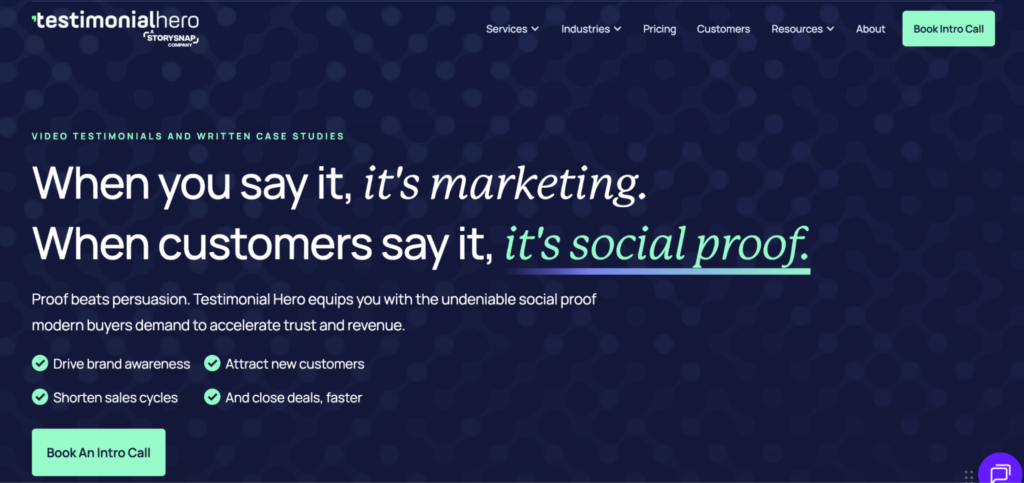
Image Source: Testimonial Hero
Testimonial Hero is a customer story agency that produces video testimonials and written case studies for B2B companies. They expanded into written case studies through their acquisition of Case Study Buddy, an agency that specialized in interview-driven case studies for B2B software companies. That written capability now sits alongside their core video testimonial service, giving clients the option to produce both formats from a single customer interview.
Each engagement includes onboarding, a dedicated project manager, and a customer advocacy strategy session. Testimonial Hero handles interview scheduling, recording logistics, and production end-to-end, which reduces the internal coordination that typically makes case study production slow for lean SaaS marketing teams.
Best for: B2B SaaS companies that need customer proof points delivered as a complete bundle of written and sales-ready assets, without managing production internally.
Notable clients: Gong, Intercom, and Docusign.
Pricing: Basic plan starts at $6,000.
4 Factors to Consider When Choosing a Project-Based SaaS Content Agency
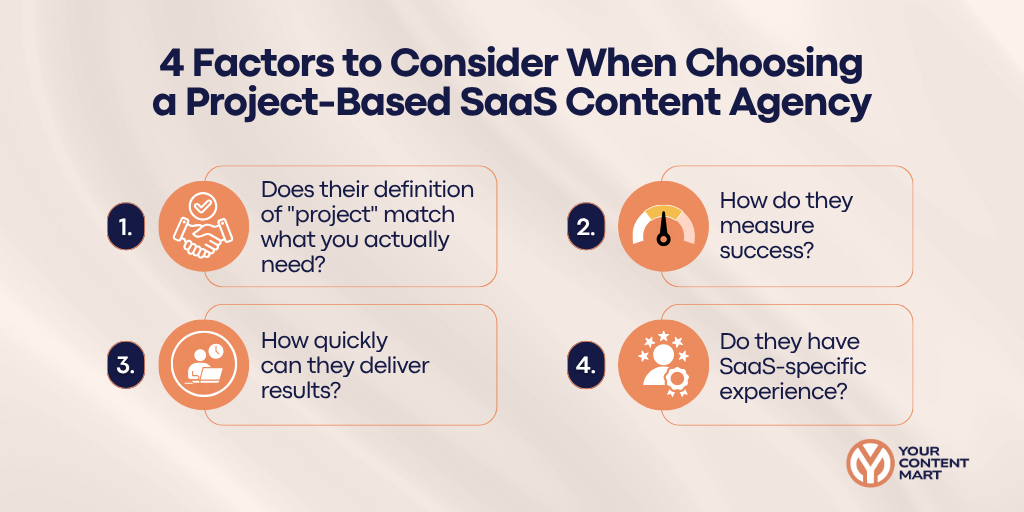
Not every agency that says “we do project work” is actually set up for it. Before you get on a discovery call, use these four criteria to filter your shortlist.
1. Does their definition of “project” match what you actually need?
Some agencies use “project-based” loosely. For some, it’s a strategy audit or content roadmap with no writing included. For others, it’s a 3-month pilot with monthly output. A proper project has a defined scope from the start. You should know exactly what you’re getting, whether that’s ten bottom-of-funnel pages, a set of comparison pages, or a content refresh for existing assets. It should also come with a fixed timeline and clearly stated deliverables.
2. How do they measure success?
For SaaS companies, trial signups and pipeline matter more than pageviews. An agency that reports on keyword rankings and monthly traffic but can’t connect content to signups is a risk on any engagement model. Ask upfront: what does success look like at the end of this project, and how will you track it?
When there’s no clear link between content and revenue, it becomes difficult to justify the spend later. The strongest agencies define success in terms that your sales or growth team already cares about.
3. How quickly can they deliver results?
Project-based work usually comes into play when there’s a need for speed. That doesn’t mean instant rankings, but it does mean a shorter path to seeing signals.
You should be able to understand when the first pieces will go live, what early traction might look like, and what happens after delivery. Some agencies disappear once the content is published, which leaves you figuring out performance on your own.
SEO still takes time to compound, but experienced teams know how to reduce the delay between publishing and seeing meaningful movement. That early signal often determines whether the project continues or stops.
4. Do they have SaaS-specific experience?
There’s a noticeable gap between general B2B content and SaaS content that drives conversions.
SaaS content sits closer to the product. It often involves comparison pages, alternative pages, and landing pages that align with how users evaluate tools. It also needs to connect with onboarding flows and the product experience itself.
Agencies that mainly work across broad industries can still deliver, but you’ll need to check how often they’ve handled SaaS-specific use cases. Without that context, the content may read well but struggle to influence buying decisions.
Which Project-Based SaaS Content Marketing Agency Is Right for You?
The right agency is the one that understands how your product works and is bought, focuses on metrics that tie back to revenue, and works within a clearly defined scope that leads to something measurable.
That distinction matters more in project-based work. You are not buying ongoing support. You are investing in a defined outcome. If the agency cannot connect its work to pipeline, it becomes difficult to justify the spend once the project ends.
If your primary goal is traffic, you will find several agencies that can help you get there. But if you are looking for content that drives trial signups, demo bookings, and actual growth, your options become more limited.
That is where our approach at Your Content Mart tends to stand out. We focus on the parts of content that influence buying decisions, not just visibility. Our project-based sprints are designed to capture high-intent demand and convert it into signups, with a clear scope and timeline from the start.
If you are testing content as a channel or trying to fix content that is not converting, the right choice is the agency that treats content as a revenue driver, not just a publishing function.
FAQs About Best Project-Based Content Agencies for SaaS Companies
What is a project-based content agency?
A project-based content agency works on a fixed scope rather than an ongoing monthly retainer. The engagement is defined upfront, including the deliverables, timeline, and expected outcomes. This could involve a batch of articles, a set of landing pages, or a specific content initiative like comparison pages or case studies. Once the project is completed, the engagement ends unless both sides agree to continue.
How much does a SaaS content project typically cost?
The cost of a SaaS content project varies depending on the scope, complexity, and level of strategy involved. Smaller projects, such as a few blog posts or basic content updates, can start in the low thousands. More comprehensive projects that include strategy, keyword research, and high-intent content production often range from $3,000 to $20,000 or more. Pricing also depends on the agency’s experience and how closely the work is tied to revenue outcomes.
Does project-based content work better than a retainer for SaaS companies?
Project-based content work is not inherently better or worse than a retainer. It depends on your goals and stage. Projects work well when you have a specific need, want to test content as a channel, or need defined deliverables within a short timeframe. Retainers are more suitable when you have already validated content as a growth channel and want to invest in consistent, long-term output that compounds over time.
How long does a typical SaaS content sprint take?
Most SaaS content projects run between four and twelve weeks. The exact timeline depends on the scope of the work and the complexity of the content. Smaller projects can be completed within a few weeks, while more involved engagements that include research, strategy, and multiple assets may take longer. Clear timelines are usually agreed upon before the project begins.
What content types work best for a SaaS content sprint?
Content that targets users closer to a buying decision tends to perform best in a project-based sprint. This includes comparison pages, alternatives pages, and solution-focused landing pages. These types of content align with buyer intent and are more likely to influence signups or demo requests. Educational blog content can still be useful, but it often takes longer to show direct impact.
How do I know if a content agency is right for my SaaS company?
The right agency should demonstrate an understanding of your product, your audience, and how your customers make decisions. They should be able to define a clear scope, explain how success will be measured, and show examples of similar work. It also helps if their approach aligns with your goals, whether that is driving traffic, improving conversion, or building a pipeline. If those elements are unclear, it is usually a sign to look elsewhere.