

6 Best SEO Agencies for Technical B2B SaaS Products in 2026
Writing for a technical product requires a level of depth that some general SaaS agencies struggle to handle. Engineers, DevOps teams, security leads, and technical buyers expect accuracy, nuance, and a clear understanding of the product before they trust anything they read.
Technical audiences are quick to spot vague explanations or generic SEO writing, especially when they are comparing products or researching implementation details. As a result, companies seeking the best SEO agencies for technical B2B SaaS products often look for agencies that balance technical depth with commercial SEO strategy.
This list covers six agencies that stand out in that area, whether through technical SaaS specialization, developer-focused content expertise, or proven experience driving organic growth for complex B2B products. We looked at what the agency does and where each one fits best, depending on your product and growth stage.
TABLE OF CONTENTS
Why Technical B2B SaaS Is a Different SEO Problem

If you’re selling developer infrastructure, security software, or any technical B2B SaaS product, here are a few things to consider when approaching SEO for this kind of audience:
1. Technical buyers read content differently
A software engineer evaluating infrastructure tools reads content to verify, not just to learn. They’re checking whether the explanation holds up technically, whether the comparisons reflect how products actually behave, and whether the author has ever worked in the category they’re writing about. Surface-level content that stays vague on technical specifics gets dismissed fast.
This doesn’t mean technical content has to be inaccessible. It means it has to be accurate and specific. An agency that has never written for a technical audience defaults to the level of detail they’re comfortable with, which usually isn’t enough for this kind of buyer.
This matters even more for technical SaaS products built on a product-led growth model. Engineers can sign up, test a free tier, and form opinions within minutes. What they read before that point shapes what they expect when they land in the product. If the content feels inflated or stays shallow, the mismatch between expectation and reality shows up later in low trial-to-paid conversion rates, where users sign up but don’t see enough value to upgrade.
2. Keyword research sometimes misses high-intent technical searches
One of the biggest mistakes in technical SaaS SEO is treating search volume as the main signal for keyword value. Take a query like “Stripe vs Paddle for SaaS billing.” Compared to broader terms like “payment processing software,” the search volume for this term is relatively low in many keyword tools, which makes it seem less important. But the intent behind the search is completely different.
Someone searching for “payment processing software” could be at any stage of research. They may be learning about the category for the first time. They may not even be evaluating SaaS billing tools specifically. A search like “Stripe vs Paddle,” on the other hand, usually signals a much narrower decision stage. The buyer already understands the category and is actively comparing options.
For technical SaaS companies, the more valuable opportunities are often buried in smaller, specific searches tied to implementation, integrations, comparisons, migrations, or alternatives.
3. Your buyer rarely makes the decision alone
When an engineer finds your product through an organic search, they’re usually not in a position to approve the purchase on their own. They’re building a case internally, looking for information to bring to their team, or evaluating options before a broader conversation with their manager. A security engineer assessing a data loss prevention tool, for example, typically needs input from a VP of Security, a head of IT, a legal team reviewing data handling practices, and a finance team approving the contract. Forrester’s 2025 Buyers’ Journey Survey found that the average B2B purchase now involves 13 internal stakeholders, and for technical SaaS categories such as cybersecurity, compliance, and infrastructure, that number tends to be higher.
This applies to PLG products too. An engineer who signs up, tests your free tier, and decides they want to pay for it still has to make a case internally. At that point, they go back to search, looking for ROI examples, security documentation, and competitive comparisons to answer the questions their manager will ask. If that content doesn’t exist, the internal deal stalls not because the product failed to impress, but because the engineer didn’t have enough to work with.
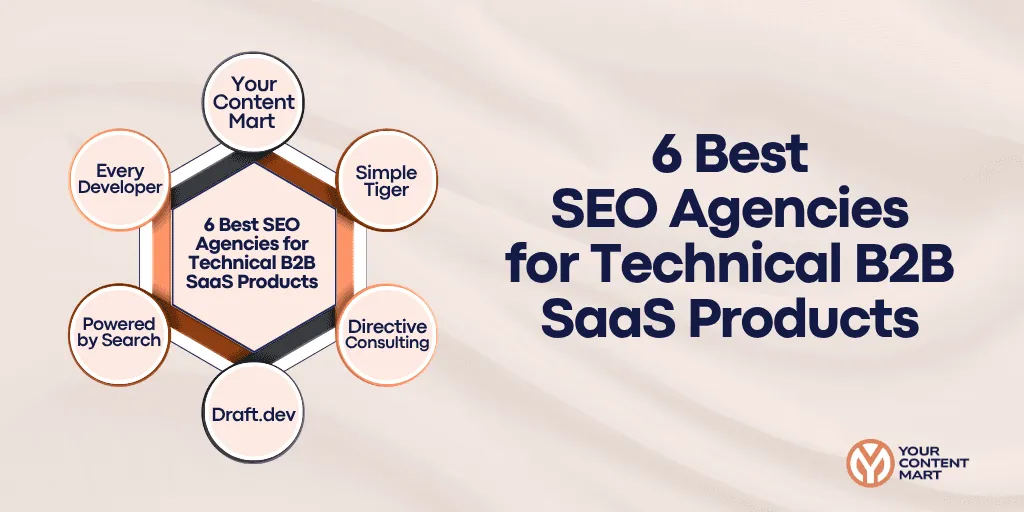
6 Best SEO Agencies for Technical B2B SaaS Product}
| Agency | Best For | Starting Price |
| Your Content Mart | Technical B2B SaaS that needs buyer-intent content tied directly to trial signups | $4,250/month (6-month plan) |
| SimpleTiger | Series A–B SaaS needing SEO + content for its technical product under one engagement | Not publicly disclosed |
| Directive Consulting | Enterprise tech SaaS running paid + organic together | $6,500/month (startup package) |
| Draft.dev | Series A+ developer-tools and technical B2B SaaS needing engineer-written content at volume | Not publicly disclosed |
| Powered by Search | High-ACV SaaS with long sales cycles and buying committees | $7,500/month |
| EveryDeveloper | API platforms and developer-tools companies needing content strategy and AI/LLM search visibility | Not publicly disclosed |
Here are 6 of the best SEO agencies for Technical B2B SaaS products:
1. Your Content Mart

Best for: Technical B2B SaaS companies that need content built around how their buyers actually search, to increase trial signups.
Your Content Mart is a B2B SaaS SEO agency that writes for technical buyers and builds content strategies designed to convert that audience into trial signups. For technical SaaS, those are two distinct problems, and some agencies optimize for only one. Writing an article that earns a senior engineer’s trust requires technical accuracy and depth. Getting that engineer to sign up for a trial requires finding them at the right moment in their search journey, before they’ve committed to an alternative. Your Content Mart approaches both problems together. We’ve worked with SaaS companies since 2016, and founder Shehu AbdulGaniy leads every account.
Before building a keyword strategy, we study what your buyers search for, which alternatives they evaluate, and which searches move them toward a trial. Alongside that research, we create an account and spend real time inside your product, going through its features, understanding how it works in practice, and learning the specific language your users use to describe what it does. That combination of buyer research and product familiarity helps us create content that converts and helps drive trial signups for your product. The content we create targets different stages of the technical buyer’s journey. Some of which include:
Alternative pages target buyers who already know the market leader and are actively looking for other options. For a security SaaS competing with CrowdStrike, that looks like “best CrowdStrike alternatives for mid-market security teams.” The buyer typing that search has already decided to evaluate alternatives. They arrive on the page ready to compare.
Comparison pages target buyers choosing between two specific products. “Datadog vs Grafana for Kubernetes monitoring” connects with an engineer who has narrowed their shortlist to two tools and needs to make a final call. Getting on that page, making the comparison accurate and technically credible, and positioning your product as the right answer is where comparison content drives signups.
JTBD content targets buyers who are solving a specific technical problem and haven’t yet connected that problem to a product category. “How to set up automated alerts for API latency spikes” shows up for an engineer mid-troubleshoot. They’re not searching for a monitoring tool. They’re searching for a solution to a problem your product solves. That’s where the conversion opportunity sits: giving them a technically accurate answer that introduces your product as the right tool for the job.
Solution guides go deeper into a specific use case your product handles well. “How to reduce false positive alerts in a Kubernetes environment” walks the reader through the problem with enough detail to build credibility, then shows how your product addresses it. For a technical buyer doing due diligence, this kind of content answers questions they’d otherwise have to book a demo to ask.
Use case content brings in context specific to an industry or role. “API rate limiting for FinTech companies handling high transaction volumes” speaks directly to a compliance engineer who recognizes their exact situation in the headline. It shortens the time it takes a technically specific buyer to see your product as relevant to them.
Every piece is also optimized for Google AI Overviews, ChatGPT, Perplexity, and Gemini, and every month we check 25 of your buyers’ questions across all four to see who gets named. Over 51% of B2B software buyers start their research with an AI chatbot more often than Google, according to G2’s AI Search Insight Report. Showing up only in Google results means missing part of the shortlisting conversation.
We set up signup tracking in month one, and each page gets tracked back to actual signups, so performance is measured by product impact, not just rankings. This gives every content decision a clear connection to business results.
This approach works particularly well for technical SaaS companies competing against better-funded alternatives. For example, OneCal, a bootstrapped calendar sync SaaS, was getting 8,000 monthly visitors while up against VC-backed players such as Reclaim.ai. Within five months of working with us, organic traffic grew 291% from 8,000 to 31,300 monthly clicks, and OneCal ranked first in Google’s AI Overview for “calendar sync software,” appearing above the likes of Calendly.

The traffic continued compounding to 40,000 monthly clicks by September 2024, seven months after the engagement ended, without any additional investment. That result didn’t come from a bigger content budget. It came from identifying the searches their buyers were running before they knew calendar sync software existed as a category.
Pricing
We offer one monthly service, the Signup Engine, on three plans, with the same work and the same guarantee on each (see pricing):
$5,000/month month to month, $4,500/month on a 3-month plan, or $4,250/month on a 6-month plan
Every month, you will get:
- 4 new product-tested pages (2 in month one): alternatives, comparison, best-of and use-case pages, written by people who have used your product
- 2 refreshes of your existing pages
- On-page and technical work: internal links, titles, meta and schema
- AI search checks on 25 buyer questions across ChatGPT, Perplexity, Gemini and Google’s AI Overviews
- Disclosed Reddit and community answers
- Outreach for links, plus one linkable asset a quarter (an original stats page or data study)
- A monthly report with your signup count, a monthly strategy call, and weekly written updates
Also on every plan
With any plan, you also get:
- Signup tracking set up in month one, with refreshes live in week 2 and your first 2 new pages live in weeks 3 and 4
- Shehu AbdulGaniy, our founder, leading your account
- A signup guarantee: by month six, the signups our pages bring from Google and AI assistants will be worth at least $5,000 a month, or we keep working for free for up to three months (offered when our forecast is at least twice that number)
- Your first month’s fee back if you’re not happy, if you ask within 30 days (refund policy)
- Month to month means you can stop with 30 days’ notice

2. SimpleTiger

Image Source: SimpleTiger
SimpleTiger is a SaaS-only SEO agency that covers keyword research, content, link building, and paid search under one engagement. They’ve worked with SaaS clients exclusively since 2006 and structure their process around the SaaS buying cycle. Their approach runs keyword research and content work in parallel rather than treating them as separate phases. They have worked with JotForm, Segment, and Bitly.
Best for: SaaS companies at Series A through mid-market with technically complex products that need content written for a technical audience alongside ongoing SEO.
Pricing: Not publicly listed.
3. Directive Consulting

Image Source: Directive Consulting
Directive Consulting is a performance marketing agency that works exclusively with technology companies. They run SEO, content, paid media, CRO, and RevOps under a methodology they call Customer Generation, which ties organic and paid output to revenue reporting rather than traffic metrics. For technical SaaS companies that want both channels managed under one attribution model, they offer that scope. They have worked with SentinelOne, ZoomInfo, and Gong.
Best for: Enterprise technical SaaS at $10M+ ARR where SEO needs to sit alongside a paid media operation under shared attribution reporting.
Pricing: Startup package from $6,500/month. Larger engagements typically range from $10,000 to $50,000+ per month.
4. Draft.dev

Image Source: Draft.dev
Draft.dev is a technical content agency that works exclusively with developer-tools and B2B SaaS companies. Every piece is written by a vetted engineer from a network of 300+ subject-matter experts, then reviewed by technical editors before it goes to the client. Their process starts with a content strategy. Engineers use your product, audit competitor content, and identify keyword gaps before drafting anything. They have worked with the likes of Docker, JetBrains, and Cloudflare.
Best for: Developer-tools and technical B2B SaaS companies at Series A and above that need technically accurate content written by practicing engineers at consistent volume.
Pricing: Not publicly disclosed.
5. Powered by Search

Image Source: Powered by Search
Powered by Search is a B2B SaaS agency that works with companies selling high-ACV products through long buying cycles. They run SEO, paid media, and content under a framework they call Predictable Growth, which maps content and paid activity to buying committee stages rather than individual users. They have also built a framework for AI search visibility alongside their traditional SEO work. They have worked with Varonis, Fortra, and Collibra.
Best for: Technical SaaS companies selling to security, engineering, compliance, or data teams where deals involve multiple stakeholders and sales cycles run six months or longer.
Pricing: $7,500/month minimum, one-year minimum engagement.
6. EveryDeveloper

Image Source: EveryDeveloper
EveryDeveloper is a developer content strategy agency that helps companies decide what to publish, how to align content with the developer search journey, and how to earn visibility across both Google and AI-powered search tools. Its D.E.V. Content Framework is built around the real problems developers are trying to solve, rather than product features, allowing brands to create content that matches user intent at every stage of the journey. The agency has worked with companies such as Stoplight, Algolia, and Render.
Best for: API platforms and developer-tools companies that need a content strategy built around how developers discover and evaluate tools, including through AI search.
Pricing: Not publicly disclosed.
Four Questions to Ask Before Hiring a Technical B2B SaaS SEO Agency

These questions usually reveal more about an agency’s capabilities regarding technical SaaS products.
Can they show you content written for a technical audience?
Ask for a sample written for engineers, DevOps teams, security professionals, or data teams, not a general SaaS audience. Technical content has a different standard for accuracy, depth, and clarity. If the examples feel vague or oversimplified, it usually indicates that the agency struggles to write for technical buyers.
How do they approach low-volume, high-intent keywords?
Some of the most valuable searches in technical SaaS barely register in SEO tools. A good agency understands that buyer intent matters more than raw volume and can explain how it identifies and prioritizes those opportunities. If the conversation immediately shifts toward broader, higher-volume traffic keywords, that is often a red flag.
Can they write for both technical and business stakeholders?
Technical SaaS purchases rarely involve one person. An engineer may evaluate the product first, but leadership, procurement, or finance teams often influence the final decision. The best agencies know how to create content that meets technical scrutiny while still communicating business value clearly to non-technical stakeholders.
How do they measure SEO performance?
Traffic alone is not enough, especially in technical SaaS, where sales cycles can stretch for months. Ask how they connect SEO performance to signups, demo requests, pipeline, or revenue attribution. A strong agency should be able to explain how they track organic acquisition beyond rankings and pageviews.
Why SEO Still Matters for B2B Tech & SaaS Growth in 2026

The case for investing in SEO as a technical SaaS company has gotten stronger over the last two years, partly because of what’s happened to paid acquisition costs and partly because of how B2B buyers now research software.
On the paid side, Dreamdata’s B2B Google Search Ads benchmark found that non-branded CPCs jumped approximately 29% between August 2024 and July 2025, with click-through rates falling 26% over the same period. More spend, fewer clicks, no guarantee the budget holds next quarter. Organic content built around the right buyer intent continues to work after it’s published. The content engine Your Content Mart built for OneCal in 2023 continued driving traffic seven months after the engagement ended, growing from 31,300 to over 40,000 monthly clicks without additional spend. That’s the trade-off that makes organic worth building for a technical SaaS company with a long sales cycle and high customer lifetime value.
The rise of AI search is also another thing to consider. According to G2’s 2025 Buyer Behavior Report, 50% of B2B software buyers now start their research with AI chatbots, and GenAI tools have become the single most influential source for vendor shortlists, ranking ahead of software review sites, vendor websites, and peer recommendations. For tech buyers specifically, Responsive’s 2025 research found that 80% now use generative AI as much as or more than traditional search when evaluating vendors. A technical SaaS company whose content isn’t structured to be cited by AI tools is invisible during the most influential phase of the buyer’s research, before they’ve contacted anyone, before they’ve visited your website, and before your sales team knows they exist.
For technical SaaS companies, the content that earns a place on the shortlist has to be accurate enough to satisfy a technical buyer, well-structured enough for AI systems to cite, and targeted to the specific searches those buyers run when they’re closest to a decision. That combination is what separates a content strategy that builds a pipeline from one that only builds traffic.
Which SEO Agency Should You Hire for Your Technical B2B SaaS Product?

Most agencies on this list can grow your traffic. The harder part is what that traffic actually turns into.
For technical SaaS products, a lot of organic visits never become trial signups. An engineer who lands on a generic article about API monitoring might read it, nod along, and leave. Compare that with someone who finds a page that directly contrasts your tool with what they already use. That second person is closer to testing the product, not just learning about it.
That difference is what shapes how Your Content Mart approaches SEO. Every strategy is focused on how it will help drive signups for your product. It’s also why the Signup Engine comes with a signup guarantee, from $4,250/month on a 6-month plan or $5,000/month month to month.
FAQs about SEO Agencies for Technical SaaS Products

Does a technical SaaS product actually need a specialist agency, or will any experienced SEO agency do?
It depends on your buyer. If your ICP includes software engineers, security architects, or platform team leads, a generalist agency will almost always produce content that isn’t specific enough to convert them. That mismatch tends to show up in conversion rates before it shows up in traffic numbers. Technical buyers move past shallow content quickly, and rebuilding credibility in a niche community after publishing inaccurate or generic work takes longer than getting it right from the start.
How do you know if a SaaS SEO agency actually understands your technical product?
Ask them to review your product page and, in one paragraph, describe who you’re competing against and what searches your buyer runs before they find you. A strong agency gives you a specific, opinionated answer based on your category and buyer type. A weak one gives you a reworded version of your homepage.
What’s a realistic timeline to see pipeline impact from SEO for a technical SaaS product?
It depends on the category’s competitiveness, your existing domain authority, and the type of content you’re publishing. In most cases, technical SaaS companies start seeing early signals such as improved rankings, indexed pages, and qualified organic traffic within the first few months. Pipeline impact usually takes longer because technical buying cycles are often slower and involve multiple stakeholders.
Does a technical B2B SaaS SEO agency also handle technical SEO audits?
Many do, but not all of them. Some agencies focus mainly on content and strategy, while others also cover technical SEO issues like site architecture, crawlability, indexing, internal linking, and Core Web Vitals. For technical SaaS companies, it is worth confirming how deep their technical SEO capabilities go before signing an engagement.


