When you’re searching for the best content marketing agencies for developer-focused SaaS, writing quality isn’t the only decision criterion on your mind. Clear, accurate writing is important, but what matters just as much is whether the agency understands how developers actually think when they’re researching a tool, comparing alternatives, or deciding whether something is worth integrating into their existing workflow.
A backend engineer evaluating an API platform or a DevOps lead looking into infrastructure tooling is not reading content the same way a general B2B buyer would. They are constantly looking for signs that the person behind the content understands the problem beyond surface-level explanations. The moment a tutorial feels forced, an explanation sounds watered down, or a technical detail is clearly off, credibility starts to slip. And once that trust disappears, it becomes harder for the brand itself to feel reliable.
Developers are not easily impressed by polished copy or broad educational content. They pay attention to accuracy, depth, and whether the content reflects real-world use cases and workflows. In many cases, they are using the content itself to judge how well a company understands the audience it’s trying to serve.
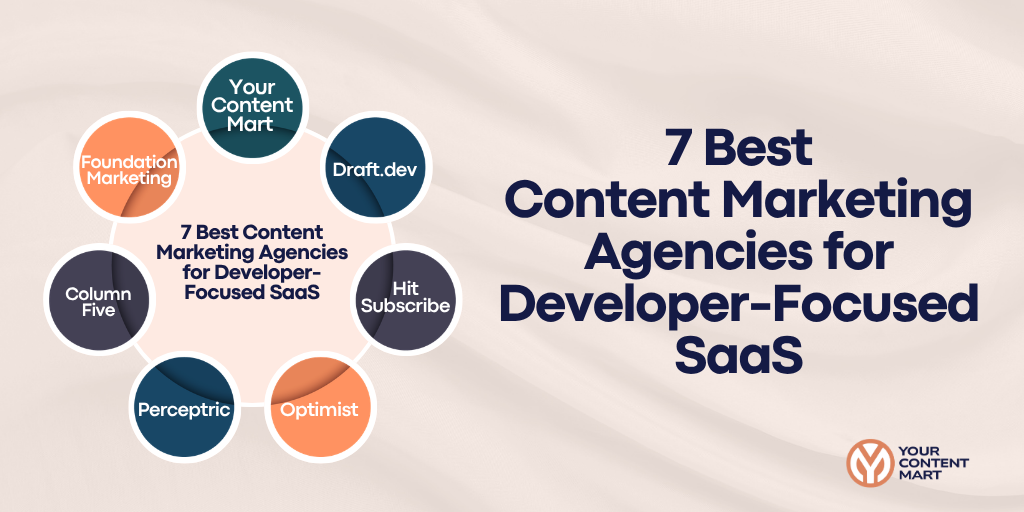
This list covers seven agencies that understand what it means to create content for developer-focused SaaS audiences and have the results to back it up.
What to Look For in a Content Marketing Agency for Developer-Focused SaaS
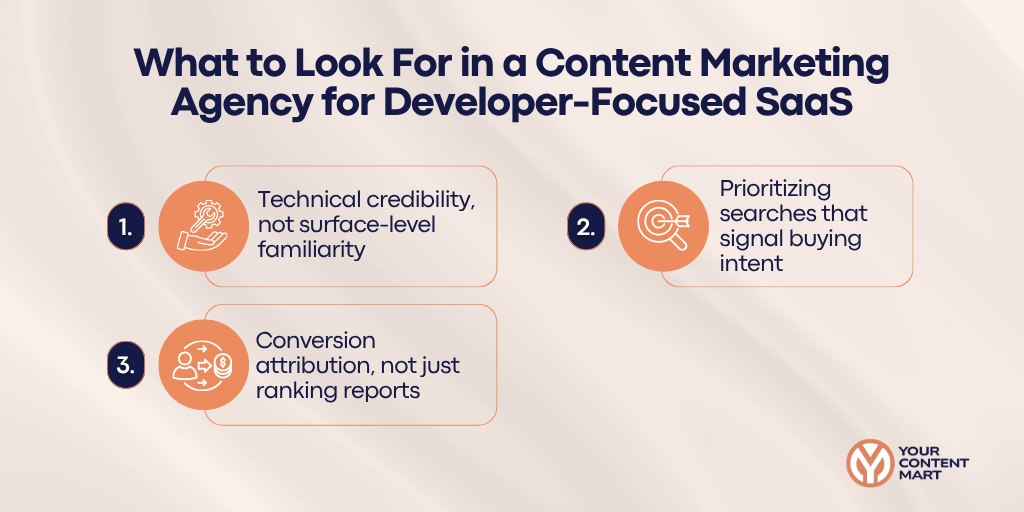
1. Technical credibility, not surface-level familiarity
There’s a meaningful gap between an agency that has worked with a SaaS company and one that understands how developers actually evaluate tools. Agencies that haven’t navigated this credibility problem before tend to produce content that uses correct vocabulary but reveals a shallow understanding of how the technology works, and developer buyers, who live in this space every day, can tell the difference almost immediately. Whether you need engineer-written tutorials or buyer-intent comparison pages, the agency’s content needs to hold up to technical scrutiny.
2. Prioritizing searches that signal buying intent
There’s a version of content strategy that can generate a lot of traffic without producing many signups. It usually happens when the strategy is built around learning-stage searches, like “how to set up a staging environment in Docker,” rather than searches tied to evaluation and product decisions. Both types of keywords can rank well, but only one consistently puts your product in front of users when they’re actively comparing tools or considering a trial.
A developer searching “how to add a collaborator to a GitHub repository” is learning how to do something. While a developer searching for “GitHub alternatives for private repository” is already questioning whether they want to stay on GitHub. These are not the same type of search, and they should not get the same content response. The agencies that understand this distinction build content roadmaps around the evaluation-stage searches first, because that’s where actual conversion happens.
3. Conversion attribution, not just ranking reports
Most agencies report success through keyword rankings and traffic growth. Those numbers are useful, but they don’t tell you whether the content is helping turn visitors into product users. Someone can read a blog post, leave, and never come back. That makes it difficult to tell which pieces of content are attracting people who are genuinely evaluating tools and which ones are simply bringing in passive readers.
The better agencies pay attention to what happens after the click. They look at which pages contribute to trial signups, how users move from content into the product, and what types of topics tend to attract people who are closer to making a decision.
That doesn’t always require complicated reporting systems. But it does require a strategy built around business outcomes instead of vanity metrics. If the only thing being measured is traffic, the content strategy usually drifts toward topics that attract visitors rather than topics that drive product adoption.
7 Best Content Marketing Agencies for Developer-Focused SaaS
| Agency | Best For | Content Strengths | Starting Price |
| Your Content Mart | Developer-focused SaaS needing trial signups from organic search | Alternative pages, JTBD content, comparison pages, integration guides | $3,500/month |
| Draft.dev | Engineer-written technical content at scale | Technical tutorials, code samples, developer education | $9,000/month |
| Hit Subscribe | DevOps teams, lower price point for engineer-written content | Engineer-authored posts, SEO, content analytics | $5,000/month |
| Optimist | Developer-adjacent SaaS needing SEO and AEO together | SEO strategy, AEO, content at scale, distribution | $10,000/month |
| Perceptric | BOFU content tied to pipeline attribution | BOFU content, technical SEO, research articles | $2,000/month |
| Column Five | Brand story and content system for technical SaaS | Brand positioning, long-form, video, interactive content | Not published |
| Foundation Marketing | Distribution and Reddit presence for developer-focused SaaS | Reddit marketing, distribution, GEO, long-form | Not published |
Here are 7 of the best content marketing agencies for developer-focused SaaS companies:
1. Your Content Mart
If your content is driving traffic but not translating into trial signups, the issue usually goes beyond execution. In many cases, it also comes down to content strategy. For example, publishing more informational content will get you more traffic from developers who are learning about a category, but learning and evaluating are two completely different buyer states, and content built for the first state consistently underperforms at driving conversions for the second.
What we build at Your Content Mart is content designed to intercept developers at the evaluation stage, when they’re actively comparing tools, researching alternatives, or trying to solve a specific problem within their current stack.
Everything starts with Product-First Research, which includes customer interviews and hands-on product usage. We speak with users who converted through organic search to understand what they were looking for before they found the product, the alternatives they considered, and the exact queries they ran as they evaluated options. In parallel, we spend time inside the product itself. Not at a surface level, but deep enough to understand how it fits into real workflows, where it creates value, and how it compares to competing tools. That combination gives us a clearer picture of real buyer intent than any keyword tool can provide.
From there, the rest of the framework builds on that foundation. The Signup-Intent Strategy focuses on searches that occur during evaluation rather than in early-stage learning. Conversion-Focused Content turns those insights into pages that meet buyers at the right moment, whether they’re comparing tools, exploring alternatives, or trying to make a switch. Revenue Attribution links those pages back to actual signups, so performance is measured by product impact, not just rankings.
Every piece is also structured with Answer Engine Optimization in mind, so it can surface not only in Google results but also in AI-generated responses when developers ask tools like ChatGPT, Perplexity, Claude, or Gemini for recommendations.
The content types that drive the most trial signups for developer-focused SaaS tend to fall into a few categories. Here’s what each one looks like and who it’s designed to catch.
Alternative pages are built for developers who are already paying customers elsewhere. Maybe their vendor raised prices, deprecated a feature they depended on, or just isn’t scaling the way their team needs it to. They usually type queries like “[Competitor] alternatives” into Google, and if your alternative page is the most useful result on that Search Engine Results Page (SERP), that developer lands on your site already predisposed to switch. These pages consistently outperform informational blog posts on conversion rate because the person reading them is already looking for a reason to leave.
Jobs-to-be-Done (JTBD) content is aimed at a developer who doesn’t yet know your product exists. For example, “how to schedule automated email reminders in Python” or “how to send Slack notifications when a form is submitted.” These are searches from developers who are mid-workflow, patching something together, or using a workaround because they haven’t discovered that a dedicated tool handles it cleanly. A well-written JTBD article walks through the manual approach honestly, earns trust by demonstrating real technical understanding, and then naturally surfaces why a purpose-built solution handles it better. This is how you get in front of buyers before they know they’re evaluating anything.
Comparison pages serve the developer with a shortlist who is conducting final due diligence. They usually make searches like, “Datadog vs. New Relic for small engineering teams” or “Vercel vs. Netlify for monorepo deployments.” A page that addresses the comparison honestly, including the trade-offs your product loses, earns more trust than a one-sided pitch, and trust is part of what converts a developer who came to compare into one who clicks “start a free trial.”
Integration and use-case guides answer a question developers ask when they’re evaluating whether a tool fits their existing stack: will this work with how we already build? For example, “How to connect [Your Tool] with GitHub Actions” or “using [Your Product] with a Terraform workflow” are the kinds of searches that signal serious evaluation intent. A guide that answers the question directly, with real configuration examples and working code, removes one of the most common blockers between trial start and paid conversion.
OneCal is an example of how we used this content type to drive trial signups for a technical product. They came to us in mid-2023 as a bootstrapped calendar-sync tool with 8,000 monthly organic clicks, and with VC-backed competitors that had structural search advantages they couldn’t close through volume alone.
Instead of trying to outpublish competitors who could always move faster, we focused on the searches users make when they are already comparing calendar sync tools. At the time, there was little to no content addressing queries like “Calendar Bridge alternatives,” and very few pages targeting the Jobs-to-be-Done searches that come up when teams are dealing with scheduling conflicts across different tools.
We built content around those gaps. That included comparison pages and integration guides tied to specific workflows, such as syncing Outlook and Google Calendar. These are the kinds of searches that surface when users are already working within a competing setup, often before they come across OneCal.
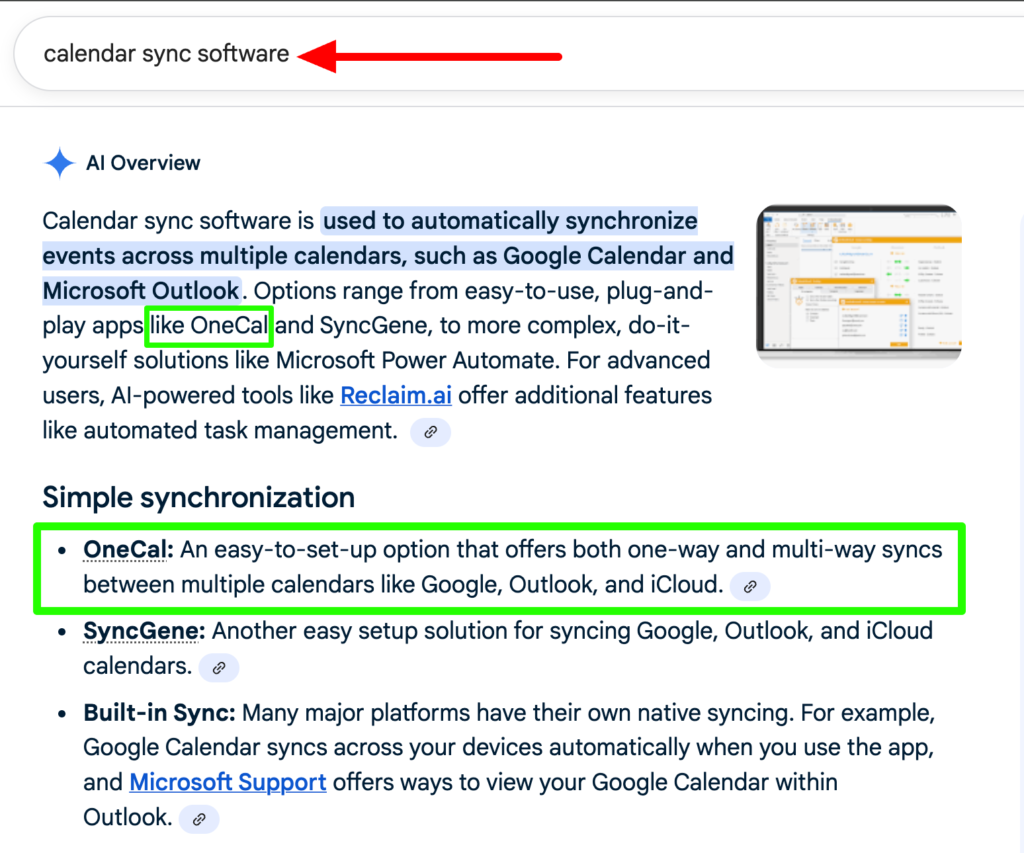
In five months, organic traffic grew 291% from 8,000 to 31,300 monthly clicks, and OneCal ranked first in Google’s AI Overview for “calendar sync software,” appearing above both Calendly and Reclaim.ai.
The traffic continued compounding to 40,000 monthly clicks by September 2024, seven months after the engagement ended, without any additional investment. That compounding effect, where organic growth continues past the end of the engagement, is the natural outcome of building content around searches developers actually run when they’re evaluating tools, not learning about a category.
Best for: Developer-focused SaaS founders who need trial signups from organic search for their SaaS product
Pricing
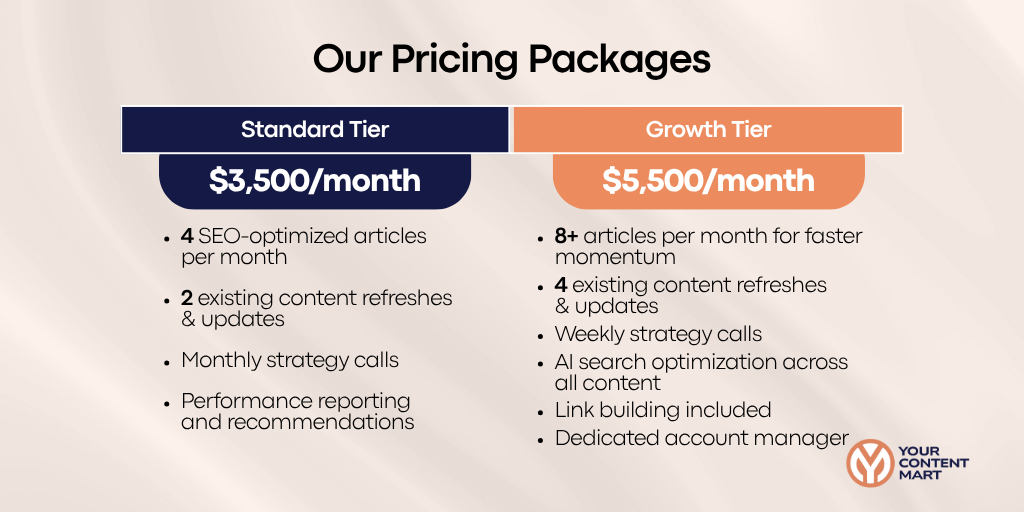
For ongoing engagements, our monthly retainers include:
Standard Tier at $3,500/month
With this plan, you will get:
- 4 SEO-optimized articles per month
- 2 existing content refreshes & updates
- Monthly strategy calls
- Performance reporting and recommendations
Growth Tier at $5,500/month
With the growth tier, you will get:
- 8 articles per month for faster momentum
- 4 existing content refreshes & updates
- Weekly strategy calls
- AI search optimization across all content
- Link building included
- Dedicated account manager
2. Draft.dev
Image Source: DraftDev
Draft.dev is a technical content agency built exclusively for developer tools and platforms, and every piece of content they produce is written by a practicing engineer. Their network of over 300 vetted engineer-writers spans DevOps, cloud infrastructure, data engineering, Kubernetes, and developer platforms.
Their service scope covers the full production lifecycle: blog posts, technical tutorials, comparison pages, landing and onboarding content, lead magnets, content refreshes, tutorial and demo videos, code samples, Content Management System (CMS) publishing, Search Engine Optimization (SEO) and Generative Engine Optimization (GEO) research, and analytics reporting. They focus exclusively on Series A and B developer tools, DevOps, and data engineering with clients including Docker, JetBrains, and Supabase.
Best For: Developer-focused companies that need engineer-written technical content
Pricing: Starts at $9,000/month with a 3-month minimum engagement.
3. Hit Subscribe
Image Source: HitSubscribe
Hit Subscribe is a developer-focused content and Search Engine Optimization (SEO) agency whose model is built around the idea that the best person to write for a technical audience is someone who has worked in that environment.
Their pool of over 250 practitioners skews heavily toward DevOps and infrastructure, which shows clearly in the client list: CloudBees, Splunk (now Cisco), Kentik. Their Osiris platform handles content analytics and SEO tooling, and their enterprise tier includes vendor-of-record billing and parallel production at scale for companies that need higher output volumes.
Best For: DevOps teams that need engineer-written content at a lower entry point.
Pricing: The core tier starts at $5,000/month, and the enterprise tier typically starts at $10,000/month.
4. Optimist
Image Source: Optimist
Optimist is a B2B SaaS content agency that lists developer tools as a served vertical on their website. Founder Tyler Hakes founded the agency in 2016 and runs what he describes as an “anti-agency” collective model, a hand-picked network of freelance strategists, writers, editors, and designers rather than a traditional in-house production pyramid. Their flagship framework, Complete Organic Revenue Engine (CORE), integrates traditional Search Engine Optimization (SEO) and Answer Engine Optimization (AEO) so that content is built to rank in Google and get cited in AI-powered answer surfaces simultaneously.
Their client list includes several developer-adjacent companies: Sendbird, Appfire, and Glide.
Best For: Developer-adjacent SaaS that needs SEO and AI search visibility working together.
Pricing: Full-service engagements start at $10,000/month.
5. Perceptric
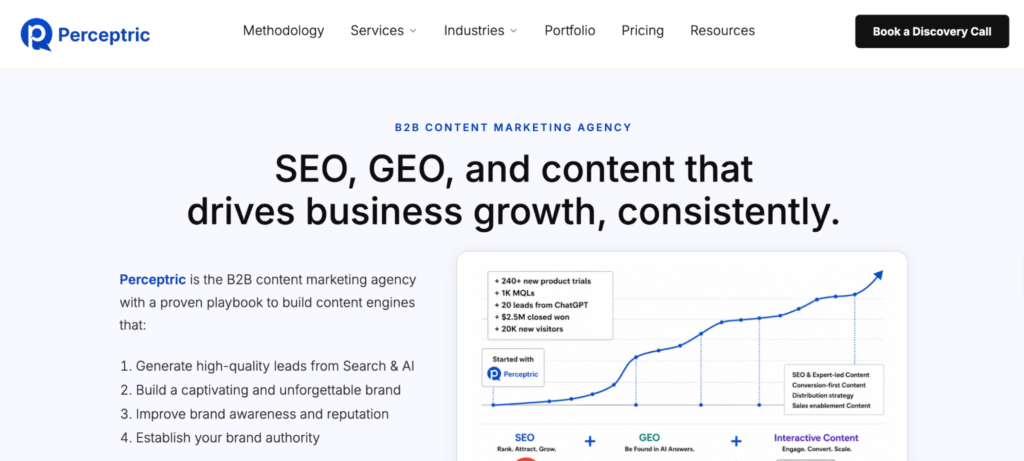
Image Source: Perceptric
Perceptric is a B2B SaaS content marketing and Search Engine Optimization (SEO) agency that builds its methodology around bottom-of-funnel (BOFU) content, content built specifically for buyers already in evaluation mode, rather than buyers who are still learning about a category. They call their framework the Knowledge-Narrative model, which combines keyword-driven SEO content with narrative-led brand positioning.
Their workflow starts with deep product research: reading your documentation, interviewing internal subject matter experts, and using the product before producing anything. They work across B2B SaaS, fintech, health technology, and other technical products, with clients including Altexsoft, Anduin, and Scout.
Best for: B2B SaaS teams that want bottom-of-funnel content tied to pipeline attribution.
Pricing: Their retainers start at $2,000/month.
6. Column Five
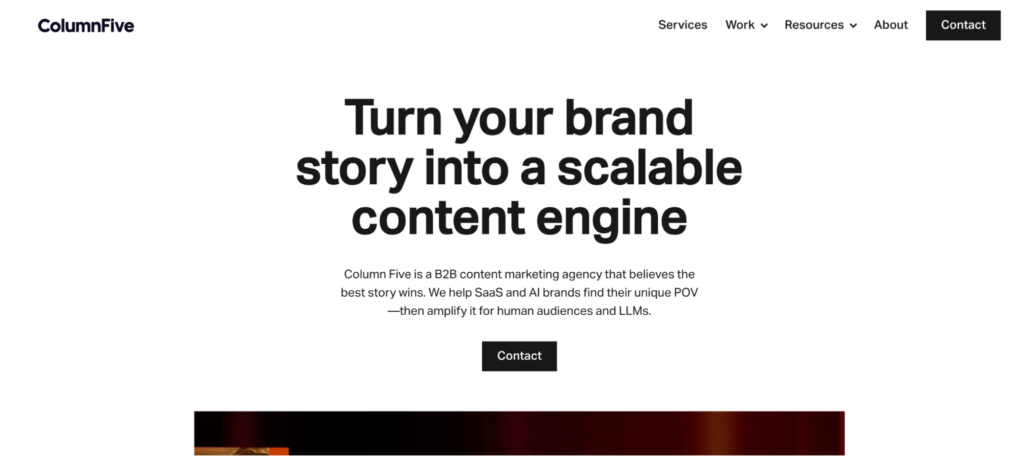
Image Source: Column Five
Column Five is a B2B content agency founded in 2009 that positions itself around what they call brand storytelling systems. Their core argument is that most Software as a Service (SaaS) companies have a clarity problem beneath their content problem: fragmented messaging, inconsistent positioning, and content that never coheres into a single, distinctive brand story.
For developer-focused SaaS specifically, Column Five is most relevant when your audience spans both technical users and executive or business buyers, and you need content that speaks credibly to engineers without losing business-value framing for the budget holders. Their client list includes Vercel, Databricks, and GitHub.
Best For: Developer SaaS companies that need a brand story and a content system built together.
Pricing: Not publicly listed.
7. Foundation Marketing
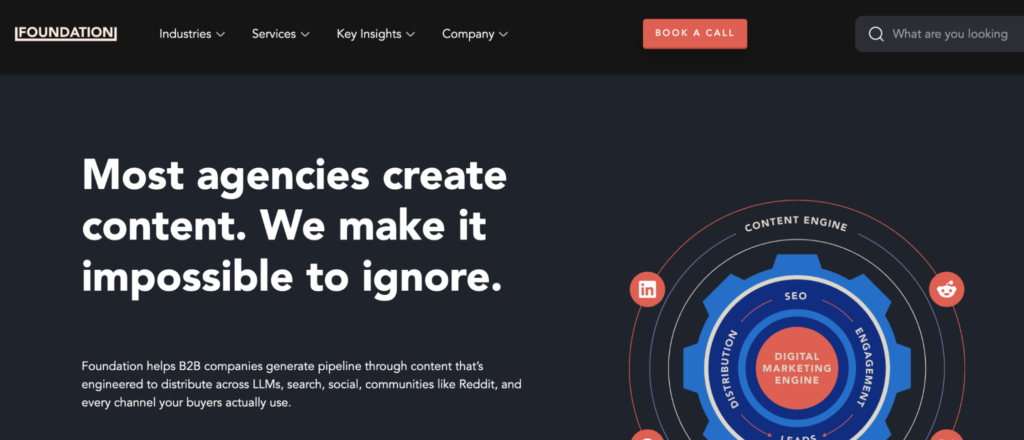
Image Source: Foundation Marketing
Foundation Marketing, led by founder Ross Simmonds, puts significant emphasis on getting content in front of audiences through channels beyond Google rankings. Where most content agencies concentrate on production and search optimization, Foundation’s central argument is “create once, distribute forever,” and the most relevant capability for developer-focused SaaS is their productized Reddit marketing service. Developer communities on Reddit have become active research channels for engineers when evaluating tools.
Beyond Reddit, their full service scope includes content strategy, long-form and social content, Generative Engine Optimization (GEO), link building, technical Search Engine Optimization (SEO), paid search, Conversion Rate Optimization (CRO), and AI marketing services. Their client list includes Snowflake, Webex, Procore, and Bitly.
Best For: Developer SaaS that needs distribution and Reddit presence
Pricing: Not publicly listed.
How to Choose the Right Agency for Your Developer-Focused SaaS Company
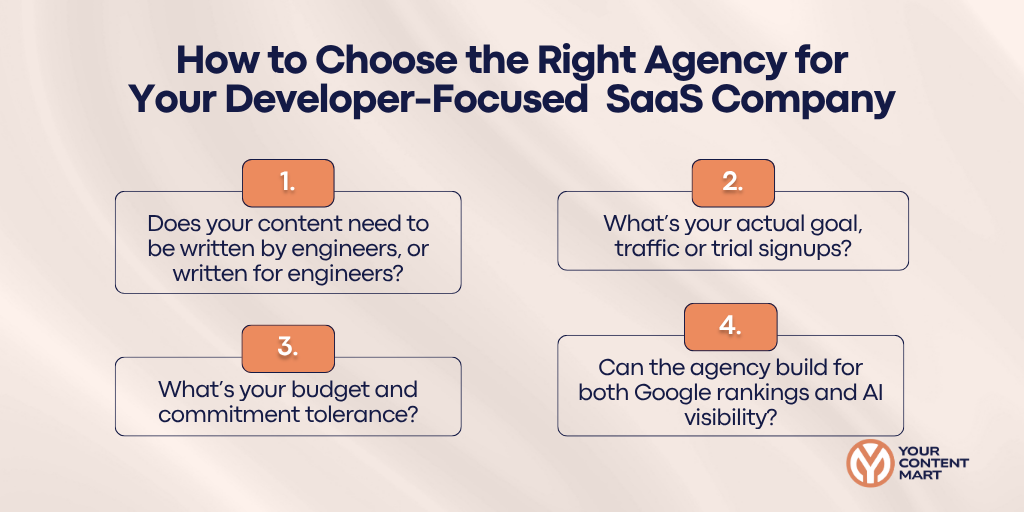
1. Does your content need to be written by engineers, or written for engineers?
Writing for developers requires accuracy, clarity, and a solid grasp of how the product fits into real workflows. That does not always mean every piece has to be written by an engineer.
If your strategy leans heavily on tutorials, deep integrations, or implementation-heavy content, then having engineers involved in writing or reviewing becomes important. That’s where credibility can easily be broken if handled poorly.
But for comparison pages, alternatives, and evaluation-stage content, what matters more is whether the writer understands the problem space and can translate it into something that resonates with a technical buyer. In most cases, a strong editorial process, backed by subject-matter input, is enough to produce content that holds up.
The goal is not to check a box on who writes the content. The goal is to ensure it reads as if it were written by someone who understands the trade-offs your audience is weighing.
2. What’s your actual goal, traffic or trial signups?
If your goal is traffic, you can afford to go broad. Informational content, high-volume keywords, and educational topics will get you there. If your goal is trial signups, that approach usually underperforms.
Developer-focused SaaS buyers don’t convert just because they read a long guide explaining a concept. They convert when they’re comparing tools, looking for alternatives, or trying to solve a specific problem with something they’re already using.
That means your content needs to be built around intent, not just volume. Fewer topics, a tighter focus, and a clearer connection to product use cases will do more for your product than just broadly writing informational content.
If an agency cannot clearly explain how its content ties back to signups, you’ll likely end up with traffic that looks good on paper but doesn’t move the business.
3. What’s your budget and commitment tolerance?
Developer-focused content is more demanding than most teams expect. It takes longer to produce because it requires deeper research, tighter reviews, and often multiple rounds of refinement to get the details right. That affects both cost and output.
That means you need to be comfortable committing to a strategy that may take a few months before you see meaningful traction. Short-term experiments rarely give you enough signal to make good decisions.
If your expectation is quick wins, content is unlikely to meet it. If your expectation is steady, compounding growth tied to product usage, then the investment starts to make more sense.
4. Can the agency build for both Google rankings and AI visibility?
This is not an either-or decision anymore. The same content that performs well in Google is increasingly the content that gets picked up in AI-generated answers. The overlap is growing because both systems reward clarity, structure, and depth.
Content has to answer specific questions cleanly, cover related concepts logically, and make it easy for both humans and machines to understand what the page is about. That includes how sections are structured, how topics are grouped, and how directly the content addresses real queries.
If you’re investing in content for the long term, you don’t need separate strategies for Google and AI. You need one strategy that’s built well enough to perform in both.
Which Developer-Focused SaaS Content Marketing Agency Should You Choose?
Hiring a content agency for a developer-focused SaaS product is genuinely one of those decisions where the wrong fit costs you more than just money. It costs time; months of content that ranks for searches your buyers aren’t running, or technically thin articles that signal to engineers exactly the kind of company you don’t want to be. The agencies on this list approach the problem from different angles, and the right one depends on what your content program is actually missing right now.
At Your Content Mart, we’ve helped bootstrapped developer SaaS companies rank above VC-backed competitors by going after the searches that actually convert. If you’re generating organic traffic from developer audiences but the trial signup numbers aren’t reflecting it, we can show you exactly where those gaps exist for your product before you commit to anything.
FAQs about Content Marketing Agencies for Developer-Focused SaaS Products
What is a developer-focused SaaS company?
A developer-focused SaaS company builds products primarily used by engineers, developers, DevOps teams, or technical decision-makers. These products are usually integrated into workflows, infrastructure, or software development processes rather than used as standalone business tools. Examples include API platforms, observability tools, CI/CD software, developer infrastructure products, and database management platforms.
What are the best content marketing agencies for developer-focused SaaS?
The seven agencies covered in this guide are among the strongest options available, but they all tend to approach the space differently depending on their strengths. Draft.dev is known for technical content written by engineers, particularly tutorials and developer education content. Perceptric focuses on technical SEO and AI search visibility for SaaS companies. Your Content Mart works with product-led SaaS brands on buyer-intent content designed to support trial signups and self-serve acquisition. Agencies like Hit Subscribe and Foundation Marketing also support SaaS companies targeting technical audiences through SEO, content strategy, and distribution.
How is content marketing different for PLG (product-led growth) dev-tool SaaS?
Content marketing for PLG developer SaaS tends to focus more on product evaluation and self-serve adoption than lead generation. Instead of creating broad educational content aimed at collecting leads for a sales team, the strategy usually centers on helping users discover, compare, and try the product directly. That often means prioritizing comparison pages, alternative content, integration guides, and workflow-specific searches that align closely with signup intent.
Can content marketing generate trial signups for developer SaaS?
Yes, but only when the content is aligned with high-intent searches and real product use cases. Informational traffic alone rarely drives meaningful conversions in developer SaaS. The content that tends to perform best is content targeting users who are already evaluating tools, researching alternatives, or trying to solve a problem within their existing stack. When paired with strong positioning and product-market fit, that type of content can become a consistent acquisition channel for trial signups.