People don’t search ChatGPT the way they search Google.
No one opens ChatGPT and types “HubSpot vs Monday.” They type something like: “What’s the difference between HubSpot and Monday.com in terms of integration with other tools?”
Same buying intent. Completely different format.
Gaetano DiNardi calls these “money prompts” — and it’s one of the sharpest reframings of AI search strategy in B2B SaaS marketing right now.
If you’ve been doing SEO for any length of time, you know what money keywords are: the middle and bottom-of-funnel search terms that signal buying intent. Terms like “project management software,” “HubSpot alternatives,” or “HubSpot pricing.”
Money prompts are their AI-search equivalent with the same purchase intent. It is phrased the way real buyers actually talk, using full sentences, with specific context and conversational language.
And if your brand isn’t showing up when buyers ask these questions inside ChatGPT, Claude, or Perplexity, you’re invisible at the exact moment a purchase decision is being made.
Why Money Prompts Matter for Your AEO Strategy

On Google, people have learned to speak in keywords. Short, stripped-down phrases that match how search engines index content.
On AI platforms, they speak like humans. And this creates a gap that most SaaS companies haven’t closed yet.
A typical Answer Engine Optimization (AEO) strategy focuses on making content quotable and structured so AI models can pull from it. That’s useful for informational queries. But money prompts are different. They’re the high-intent, bottom-of-funnel queries where a buyer is actively weighing options. They are the kind of prompts where getting mentioned (or not) directly influences a purchase decision.
According to 6sense’s 2025 Buyer Experience Report, 94% of B2B buyers now use large language models during their buying process, and 94% rank their preferred vendors before ever contacting sales. The shortlisting is happening in AI-generated answers, often before your website enters the picture at all.
Most SaaS companies are optimizing their AEO efforts around broad informational queries while completely ignoring these high-intent conversational ones. That’s a gap worth closing now.
The Money Prompt Generator: Find Your 28 Buyer Prompts in 30 Seconds

Finding your money prompts manually works, but it is slow. Taking a keyword like “project management software” and generating 20+ natural-language questions that actually sound like real buyers is harder than it looks.
You need to understand how your buyers talk, what problems they’re trying to solve, which competitors they’re weighing you against, and how all of that translates into the full-sentence, context-heavy questions people type into ChatGPT. Imagine trying to do that across ten or more keywords. Most people try it for one or two keywords and stop, which isn’t enough to build a real picture of your AI search visibility.
So we built a tool that does it for you.
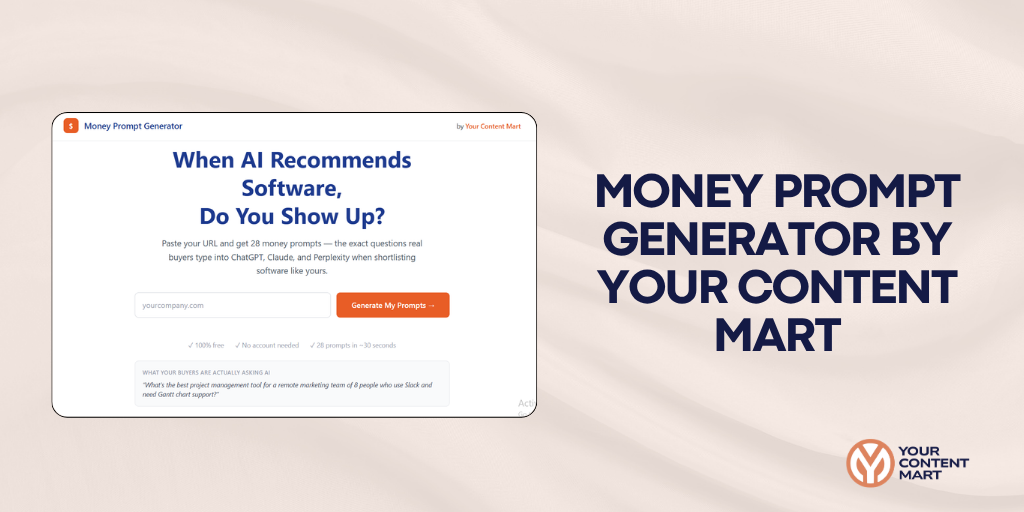
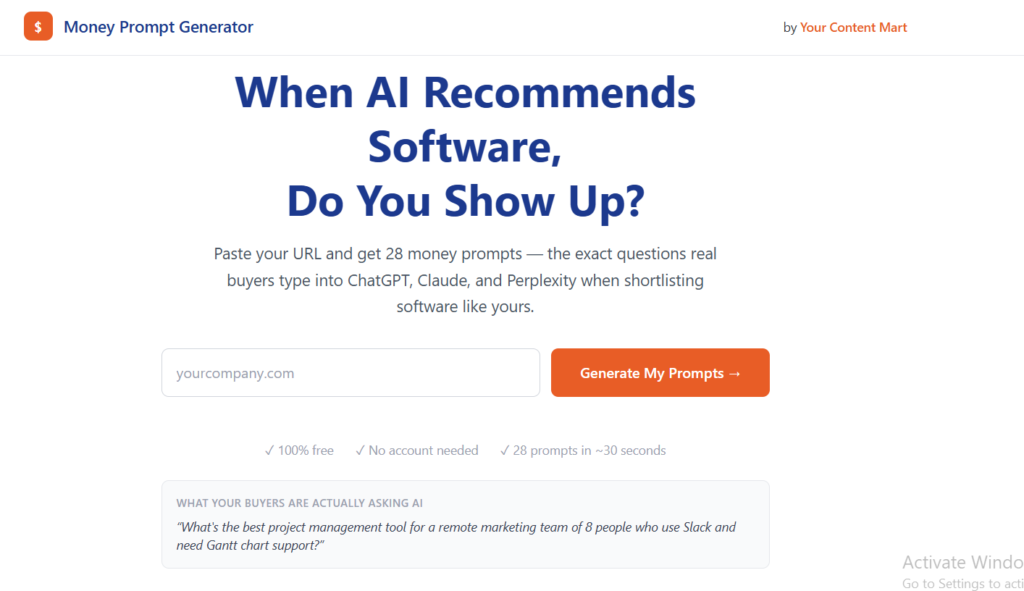
The Money Prompt Generator takes your website URL, analyzes your product, and generates 28 buyer-specific money prompts tailored to your category, competitors, and use cases in about 30 seconds.
→ Try the Money Prompt Generator — it’s free
How to Use The Money Prompt Generator
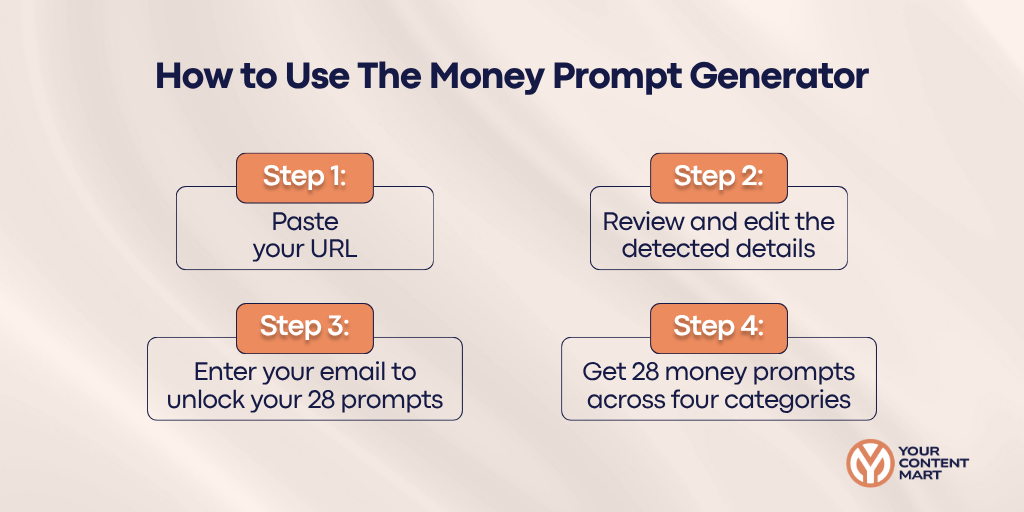
Step 1: Paste your URL
The tool scrapes your site and automatically identifies your product category, primary use cases, target audience, and main competitors. You don’t fill in any forms. It reads your site and does the work.
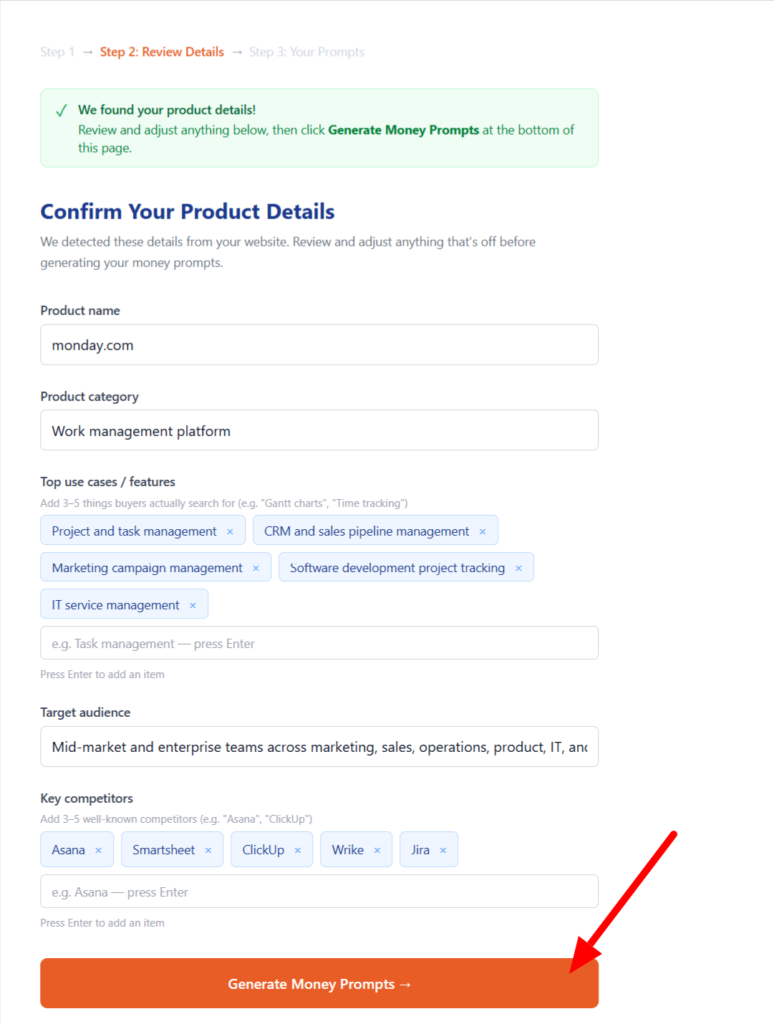
Step 2: Review and edit the detected details
Before generating anything, the tool shows you exactly what it found: your product description, the problems you solve, the competitors it identified, and the audience it detected. You can edit any of this before moving forward. This step matters — the more accurate the inputs, the more realistic the prompts.
Step 3: Enter your email to unlock your 28 prompts
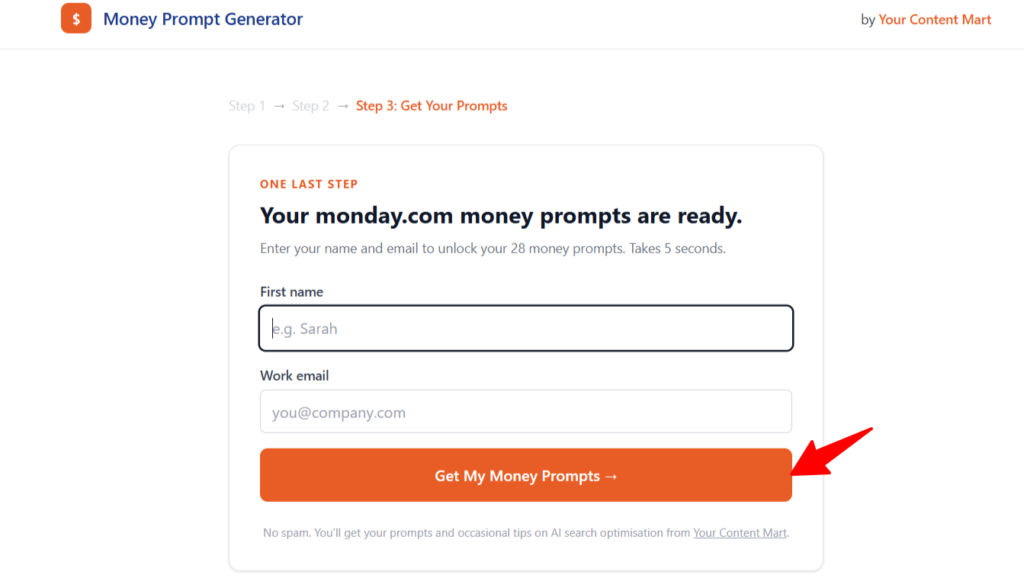
Every generation is an API call that costs real money to run, so the tool asks for your email before showing the full output. The site analysis itself is completely free and ungated — you’ll see your product details and can verify the inputs before deciding whether to continue. No account creation, no credit card.
Step 4: Get 28 money prompts across four categories
The output is organized into four prompt types, each targeting a different stage of the AI-assisted buying journey.
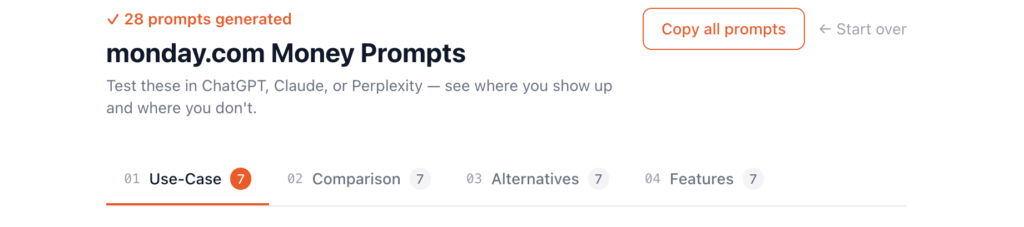
Types of Prompts Generated by the Money Prompt Generator
Four different categories of prompts are generated by the AI prompt generator. They are:
Use-case prompts
They capture buyers who are describing a specific problem and asking AI which tool solves it. These are often the broadest in terms of competition — the AI will recommend several tools — but getting mentioned consistently here builds category-level visibility.
Comparison prompts
They capture buyers who have narrowed their list and are asking AI to help them decide between two or three finalists. These are high-stakes. A buyer asking “should we go with [your product] or [competitor]?” is one AI response away from making a decision.
Alternative-seeking prompts
They capture buyers who have already decided to leave a competitor and are asking AI what to use instead. These are some of the highest-converting queries in SaaS — the buyer is motivated, has a budget, and is actively looking for a switch.
Feature and integration prompts
They capture buyers with specific technical requirements who are asking whether your product can handle their exact setup. These tend to be longer, more detailed, and asked by buyers who are serious enough to have mapped out their requirements.
What the Money Prompts Generated Actually Look Like [Case study of Monday.com]
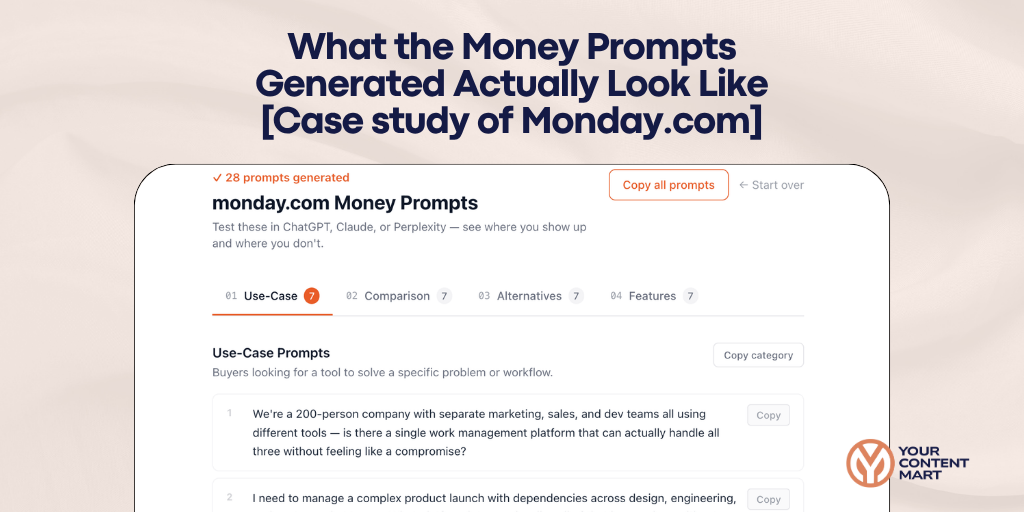
Here’s a sample across all four categories, generated for Monday.com:
Use-case prompts for Monday.com:
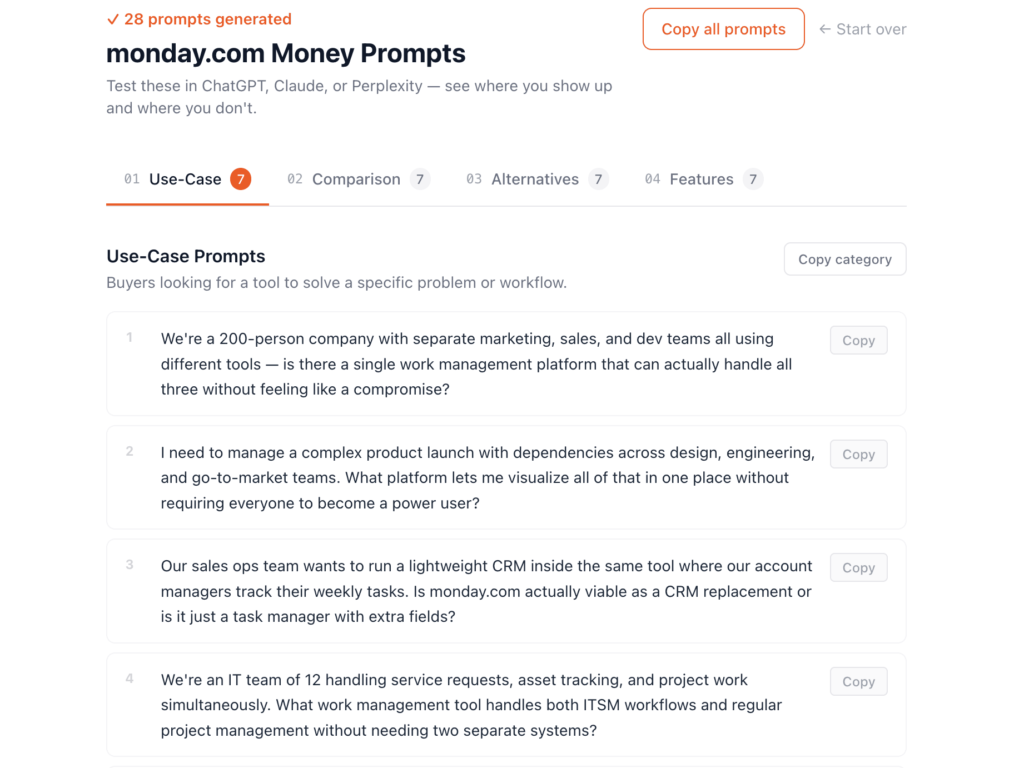
- → “We’re a 200-person company with separate marketing, sales, and dev teams all using different tools. Is there a single work management platform that can actually handle all three without feeling like a compromise?”
- → “Our sales ops team wants to run a lightweight CRM inside the same tool where our account managers track their weekly tasks. Is monday.com actually viable as a CRM replacement, or is it just a task manager with extra fields?”
Comparison prompts for Monday.com:
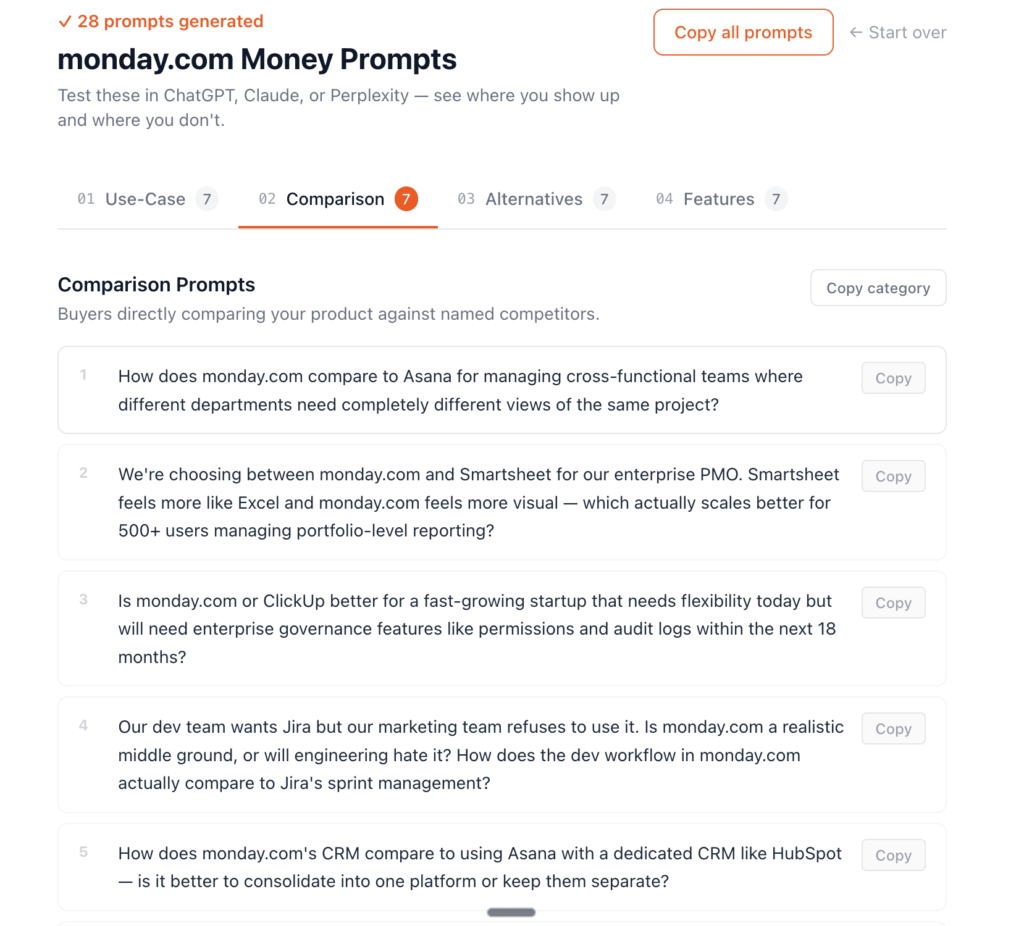
- → “Our dev team wants Jira, but our marketing team refuses to use it. Is monday.com a realistic middle ground, or will engineering hate it? How does the dev workflow in monday.com actually compare to Jira’s sprint management?”
- → “We’re choosing between monday.com and Smartsheet for our enterprise PMO. Smartsheet feels more like Excel, and monday.com feels more visual. Which actually scales better for 500+ users managing portfolio-level reporting?”
Alternative-seeking prompts Monday.com:
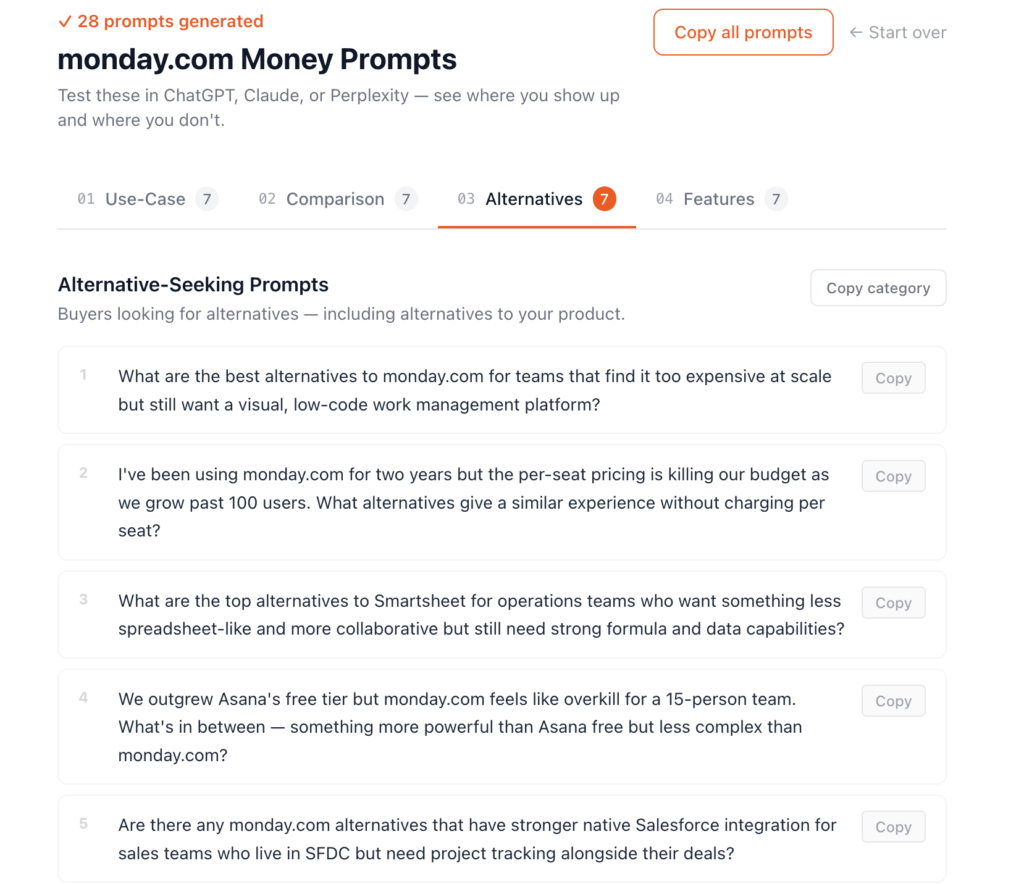
- → “I’ve been using monday.com for two years, but the per-seat pricing is killing our budget as we grow past 100 users. What alternatives give a similar experience without charging per seat?”
- → “We outgrew Asana’s free tier, but monday.com feels like overkill for a 15-person team. What’s in between — something more powerful than Asana free but less complex than monday.com?”
Feature and integration prompts for Monday.com:
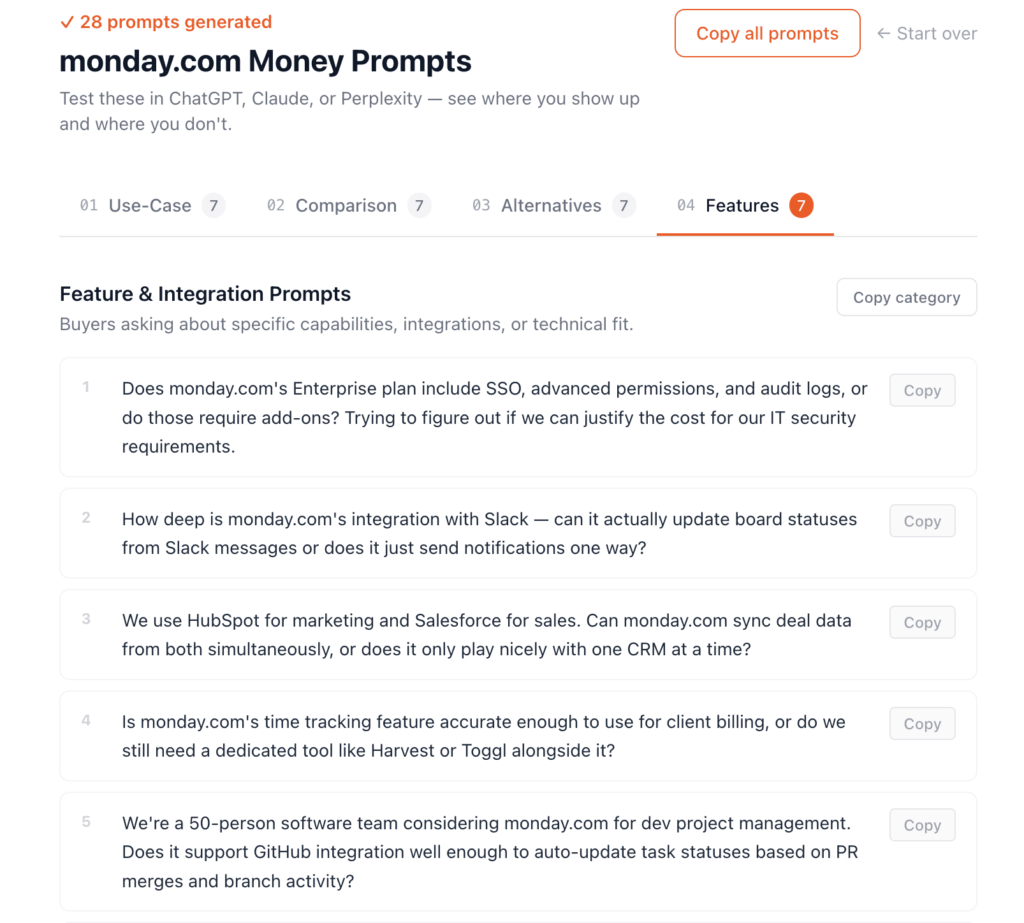
- → “How deep is monday.com’s integration with Slack — can it actually update board statuses from Slack messages, or does it just send notifications one way?”
- → “We use HubSpot for marketing and Salesforce for sales. Can monday.com sync deal data from both simultaneously, or does it only play nicely with one CRM at a time?”
Read that Jira vs. monday.com prompt again slowly. That’s a real internal conversation happening inside a real company right now. The dev team wants one tool. The marketing team wants another. Someone has been tasked with figuring it out, and they’ve opened ChatGPT to help them decide.
If monday.com’s content doesn’t give the AI model enough context to recommend them as the middle ground — if there’s no page that directly addresses why monday.com bridges this exact divide — they lose that deal without ever knowing it existed. The buyer never visits their site. Never sees their positioning. Never speaks to sales.
That’s the gap AI money prompts reveal. And that’s exactly what the tool surfaces for your product in 30 seconds.
Why 28 Prompts?

Most SaaS companies, when they think about AI visibility, focus on one or two obvious queries — usually their category name and maybe a “vs competitor” search. That’s not enough.
The 28-prompt output is designed to give you full coverage across your buying funnel in AI search: top-of-funnel awareness, mid-funnel evaluation, and bottom-of-funnel decision queries. It also covers different buyer archetypes — the technical evaluator, the budget-conscious decision-maker, the frustrated current customer of a competitor — because different buyers phrase the same need very differently.
You almost certainly won’t be invisible across all 28. But the gaps you find will tell you exactly which parts of your AI search presence need work.
→ Generate your 28 money prompts for free
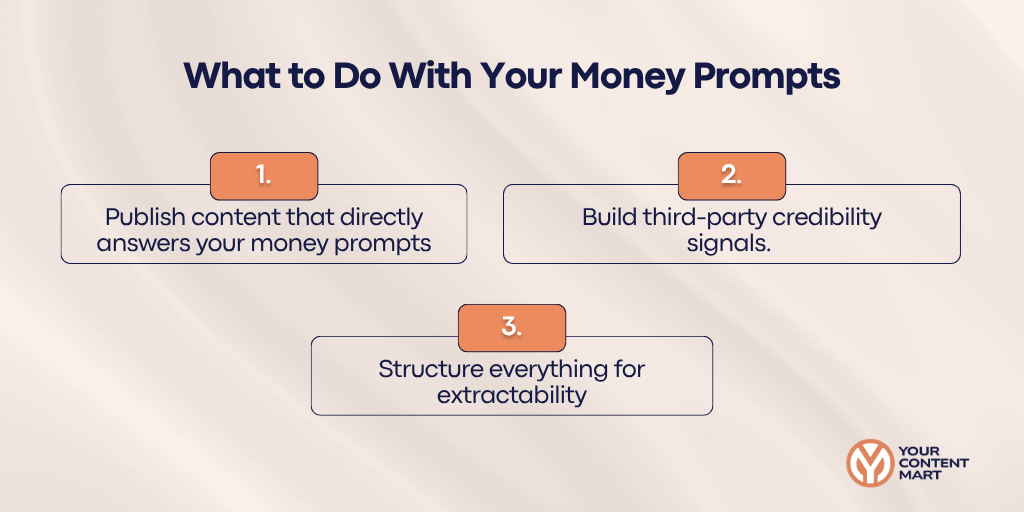
What to Do With Your Money Prompts
Start by testing your visibility. Open ChatGPT, Claude, or Perplexity and type in your top 5–10 money prompts. If your brand doesn’t show up, that’s a gap worth closing. You probably won’t appear for all of them, so you need to identify the 3–5 where your absence hurts most, the ones with the strongest buying intent for your specific product.
Then create content that earns the mention. Three things actually move the needle here:
Publish content that directly answers your money prompts
If one of your prompts is “What’s the best CRM for startups under $50/month?”, you need a page that answers that question in depth, with specific and up-to-date pricing. AI models pull from content that comprehensively addresses the query — not content that dances around it.
Build third-party credibility signals.
AI models weigh mentions across the web, not just your own site. Getting featured in comparison articles, review sites, and industry roundups increases the likelihood of being cited in AI responses. Your owned content alone isn’t enough.
Structure everything for extractability
Use clear headings, comparison tables, and direct answer formats that make it easy for models to pull and attribute information. The more structured and quotable your content is, the more likely it surfaces. This is exactly the formatting logic behind OneCal’s AI Overview result — the content we built wasn’t just comprehensive, it was easy for Google’s AI to parse and cite.
This isn’t a one-time project. Like SEO, earning money-prompt visibility compounds over time. But the SaaS companies building this muscle now will have a meaningful head start as AI-driven discovery continues to mature. The Money Prompt Generator gives you the starting point — 28 prompts that map your full buying funnel in AI search, generated in 30 seconds. Everything after that is the work: tracking where you stand, prioritizing the gaps that matter most, and building the content that earns the mention.
How OneCal Went from Invisible to #1 in Google’s AI Overview

The best way to understand why money prompts matter is to see what happens when a SaaS company builds content specifically for the way buyers search in AI.
OneCal is a bootstrapped calendar sync tool that came to us competing against VC-backed players like Reclaim.ai (which raised $6.3M before being acquired by Dropbox) and Calendar Bridge. When we started working with them, they were getting around 8,000 monthly clicks and sitting at position #9 for their core keyword — “calendar sync software.”
They couldn’t outspend competitors on content or link building. They had to be smarter about what they targeted.
The strategy we built was essentially a money prompt strategy before we called it that.
Instead of chasing high-volume informational keywords, we worked backward from the questions buyers were actually asking when they were close to a decision. Customer interviews revealed specific things:
- Buyers searching “Calendar Bridge alternatives” had already evaluated Calendar Bridge and were actively looking to switch
- Buyers searching “how to sync Outlook and Google Calendar” were solving a manual problem and didn’t yet know a dedicated tool existed
- Buyers comparing tools head-to-head were at the final stage of a purchase decision
We created content targeting each of these moments: JTBD content around practical problems like “how to sync Outlook and Google Calendar,” alternatives pages positioning OneCal for buyers ready to switch, and comparison content for buyers in the final evaluation stage.
The results over five months:
- Organic traffic grew from 8,000 to 31,300 monthly clicks — a 291% increase
- “Calendar Bridge alternatives” ranked #1 on Google, above Reddit and Calendar Bridge’s own site
- Multiple how-to articles earned featured snippets and People Also Ask placements
- Seven months after the engagement ended, with no additional investment, traffic had grown further to 40,000 monthly clicks
But the most significant result was the AI Overview.
When you search “calendar sync software” on Google today, the AI Overview leads with OneCal — not Calendly, not Reclaim.ai. OneCal, a bootstrapped startup, was recommended first by Google’s AI above competitors with millions in funding.
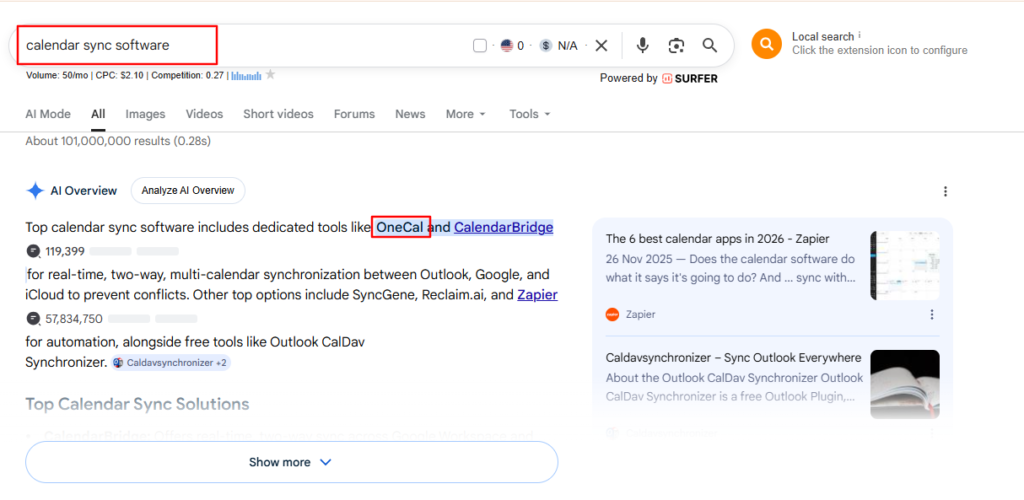
This happened because the JTBD content we built answered the specific questions buyers ask when evaluating calendar sync tools. It gave Google’s AI exactly what it needed to pull from when forming a recommendation. It’s the same principle behind money prompts: content that matches the conversational, specific, problem-oriented way buyers search in AI platforms is the content that gets cited.
The Buyers Are Searching. The Question Is Whether You Show Up

Money prompts aren’t a future consideration. They’re active right now, inside ChatGPT, Claude, and Perplexity, being typed by buyers who are days or weeks away from a purchase decision. The only question is whether your product is part of the answer they get back.
The SaaS companies that will win in AI search aren’t the ones with the biggest budgets or the highest domain authority. They’re the ones who understand how their buyers actually talk when they’re evaluating software — and who build content around those specific moments.
Start with your prompts. Test your visibility. Find the gaps. Then build the content that closes them.
If you want help turning what you find into a strategy that actually moves the number, book a free strategy call. We’ll show you what your competitors see when they look at your AI search visibility — and exactly what it would take to close the gap.