Something changed when Google started embedding AI into everything.
Not just in Search, but in Chrome, Gmail, Workspace, and Android. When a company with Google’s resources makes that kind of commitment, it signals something real is happening. AI isn’t a feature being tested in a lab. It’s being built into the infrastructure of how people find information.
For B2B SaaS marketers, that shift raises urgent questions. How do AI tools decide what to recommend? What content gets cited and why? Does traditional SEO still work? And if the rules are changing, what are the new ones?
This is what people mean when they talk about Answer Engine Optimization. It’s the practice of ensuring AI tools can find, understand, and recommend your product when your target audience asks relevant questions. You’re not just optimizing a webpage for a crawler. You’re training AI models to recognize your brand as a credible answer.
Unlike Google’s search algorithm, where years of documentation gave marketers something to work with, AI search tools haven’t provided a manual. There’s no official guidance from ChatGPT on citation logic. No public documentation from Perplexity explaining why one brand appears and another doesn’t.
What we do have is research. Independent studies analyzing millions of AI responses. Large-scale data on how ChatGPT, Google AI Overviews, and Perplexity actually behave in practice. Real patterns emerging from real queries.
This post synthesizes 15+ primary research sources to show what’s actually happening in AI search, backed by evidence instead of speculation. The goal isn’t to overwhelm you with data. It’s to give you clarity on what’s actually happening, where most brands are failing, and what you can do about it.
Each section below ends with a key takeaway you can apply directly to your strategy. No theory. Just what the data shows.
How We Collected this Data
This analysis combines first-party research with large-scale datasets from leading SEO and AI search intelligence platforms. Sources include Ahrefs, TechCrunch, Conductor, Semrush, Gartner, Seer Interactive, BrightEdge, AirOps, G2, and TryProFound, along with publicly available platform usage data and independent industry studies. We focused specifically on research examining how AI answer engines such as ChatGPT, Perplexity, and Google AI Overviews select, cite, and rank information.
The AI Search Shift: Growth vs. Current Reality
The growth numbers are hard to ignore.
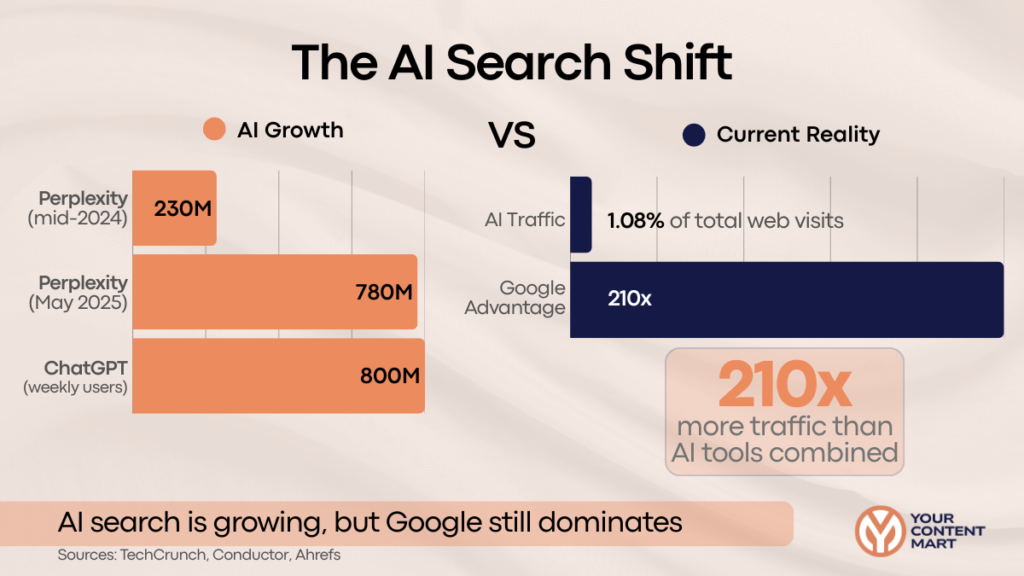
Perplexity processed 780 million queries in May 2025, up from 230 million in mid-2024. That’s 239% growth in under a year. ChatGPT hit 800 million weekly active users, making it one of the fastest-growing platforms in history.
But here’s the reality check: AI referral traffic accounts for just 1.08% of total web visits. And Google still sends 210x more traffic than ChatGPT, Gemini, and Perplexity combined.
That 210x gap is shrinking, though. In March 2025, it was 345x. Five months later, it had narrowed by nearly 40%. The trend is clear, even if the absolute numbers remain small.
Gartner predicted traditional search engine volume would drop 25% by 2026 due to AI chatbots. We’re in February 2026 now, and based on what we’re seeing in client analytics, that prediction hasn’t held up. AI search is growing, but not at the catastrophic pace some forecasts suggested.
What is accelerating: zero-click behavior. 58.5% of US Google searches now end without a click to any website. Zero-click behavior isn’t new, but AI Overviews are making it worse. Users get answers directly in the search interface instead of visiting sites.
What this means: Google remains the dominant source of traffic for most B2B SaaS companies. But its grip is loosening, and AI tools are increasingly shaping how buyers research and make decisions. The shift is real. The timeline is slower than the hype cycle suggests.
Key Takeaway
AI search is growing fast, but it’s not replacing Google yet. The smart move is to maintain your SEO foundation while beginning to optimize for AI citations. Be honest about where the industry actually is (1% of traffic, growing steadily) rather than where the hype suggests it should be. Test what works and build a strategy that accounts for both traditional search and AI platforms. You don’t need to choose one or the other.
How AI Platforms Actually Choose What to Cite
If you’re looking for a predictable playbook, the insights below will disappoint you.
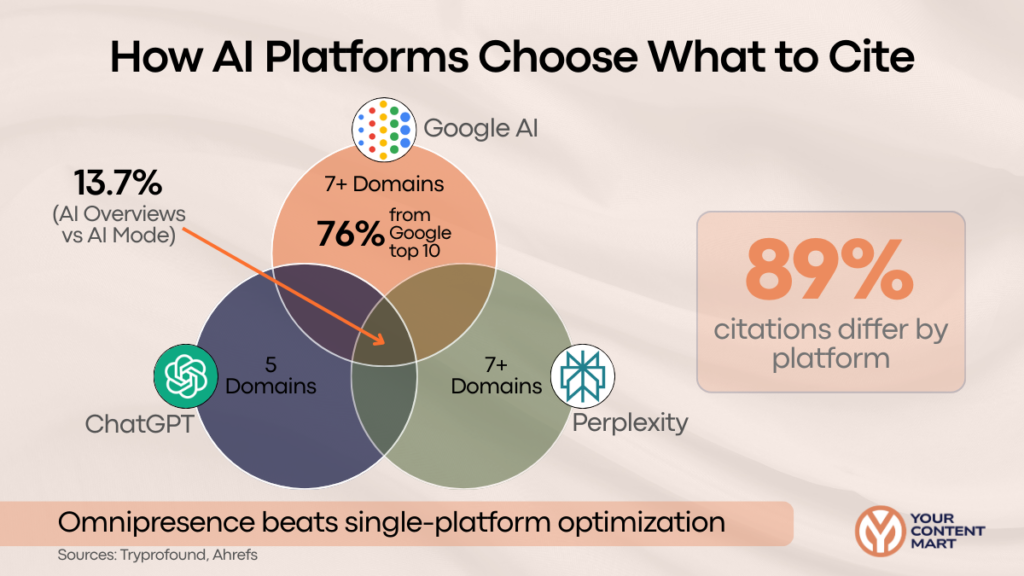
89% of AI citations come from completely different sources depending on which model users query. That means the page ChatGPT recommends for a question is almost never the same page Perplexity or Google AI Overviews will cite. The platforms aren’t pulling from a shared index. They’re making independent decisions based on different ranking logic.
This inconsistency exists even within Google’s own ecosystem. Google AI Overviews and AI Mode cited the same URLs only 13.7% of the time, despite reaching nearly identical semantic conclusions 86% of the time. Same company, same question, completely different sources.
But here’s where it gets interesting: 76% of AI Overview citations are pulled from pages ranking in Google’s top 10 organic results. While AI platforms behave unpredictably across the board, Google AI Overviews still strongly favor traditional SEO rankings. If you’re on page one of Google, you have a much better shot at being cited in an AI Overview.
Citation density varies, too. ChatGPT cites just 5 domains per response on average, while Google AI Overviews and Perplexity cite 7+ sources. ChatGPT is selective. Google and Perplexity cast a wider net.
What this means: AI citation logic isn’t figured out yet. There’s no official documentation from ChatGPT, Perplexity, or any other platform explaining their citation logic. The industry is still evolving, and what works on one platform won’t necessarily work on another. You can’t optimize for a single source and expect universal visibility.
Key Takeaway
You can’t predict which platform will cite which source, so your best strategy is to be omnipresent. You need to be present in multiple places: your own site, third-party reviews, industry publications, and community discussions. At the same time, traditional SEO still matters. 76% of Google AI Overview citations come from the top 10 organic results, so ranking well in traditional search directly improves your chances of being cited. Don’t abandon SEO for AEO. Do both.
Content Factors That Drive AI Citations
There’s no single factor that drives AI citations. But patterns are emerging.
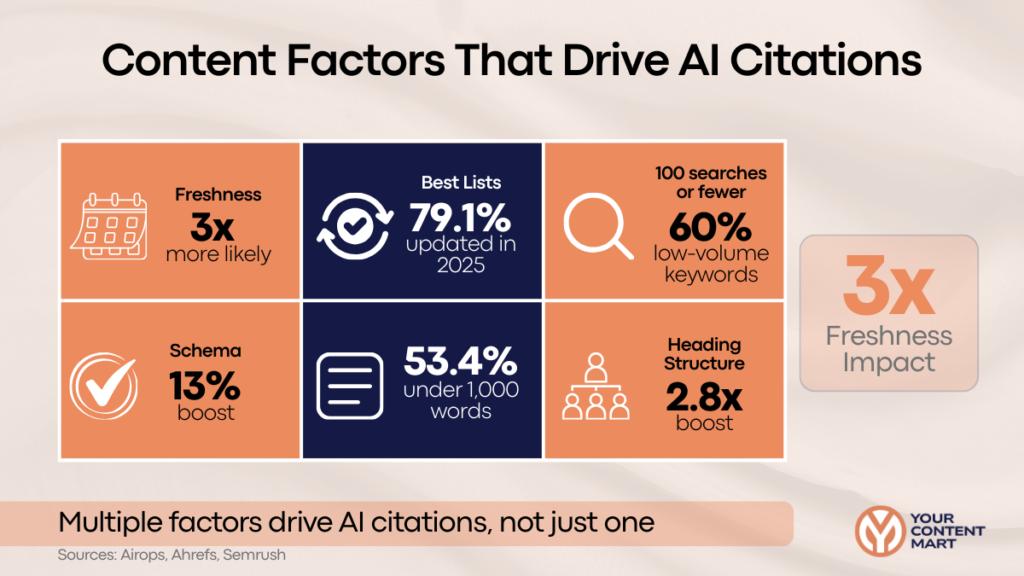
Start with freshness. Pages refreshed within 3 months are 3x more likely to be cited in AI answers. And when you look at what’s actually getting cited: 79.1% of ‘best’ blog lists cited in ChatGPT were last updated in 2025, with 26% updated in just the past two months. The message is clear: stale content doesn’t get picked.
Structure matters too. Pages with 3 or more schema types have a 13% higher likelihood of being cited. 61% of AI-cited pages already use multiple schema types. And sequential heading structures (clean H1, H2, H3 hierarchy) boost citation odds by 2.8x. AI platforms reward well-organized content.
Now for the counterintuitive part: 53.4% of pages cited by AI Overviews are under 1,000 words. Only 16% are over 2,000 words. This isn’t about cramming everything into shorter posts. It’s about specificity. AI platforms prefer focused answers to specific questions over comprehensive guides that try to cover everything.
If you’re writing “How to use [your software] for [specific use case],” you can cover that in 1,000 words. If you’re writing “The Ultimate Guide to [broad topic],” you probably can’t, and that’s fine for traditional SEO, but AI search works differently.
There’s a keyword dimension here too: keywords that trigger AI Overviews tend to be longer and more specific, with nearly 60% having 100 or fewer monthly searches. The sweet spot is 4- to 7-word queries. AI platforms show up for long-tail, high-intent searches, not broad head terms.
What this means: AI citations reward fresh, well-structured, specific content. You’re no longer optimizing for a single ranking factor. You’re optimizing for clarity, recency, and relevance.
Key Takeaway
Content refresh is not optional. If your content hasn’t been updated in 3+ months, it’s likely invisible to AI platforms. Build refresh cycles into your content calendar the same way you schedule new content. Ensure proper structure (schema and sequential headings), and target specific use cases rather than trying to create a single comprehensive guide for everything. Freshness is the recurring theme across all these stats.
Third-Party Content & Platform Source Preferences
Here’s the hard truth about AI citations: what you publish on your own website matters far less than what gets said about you everywhere else.
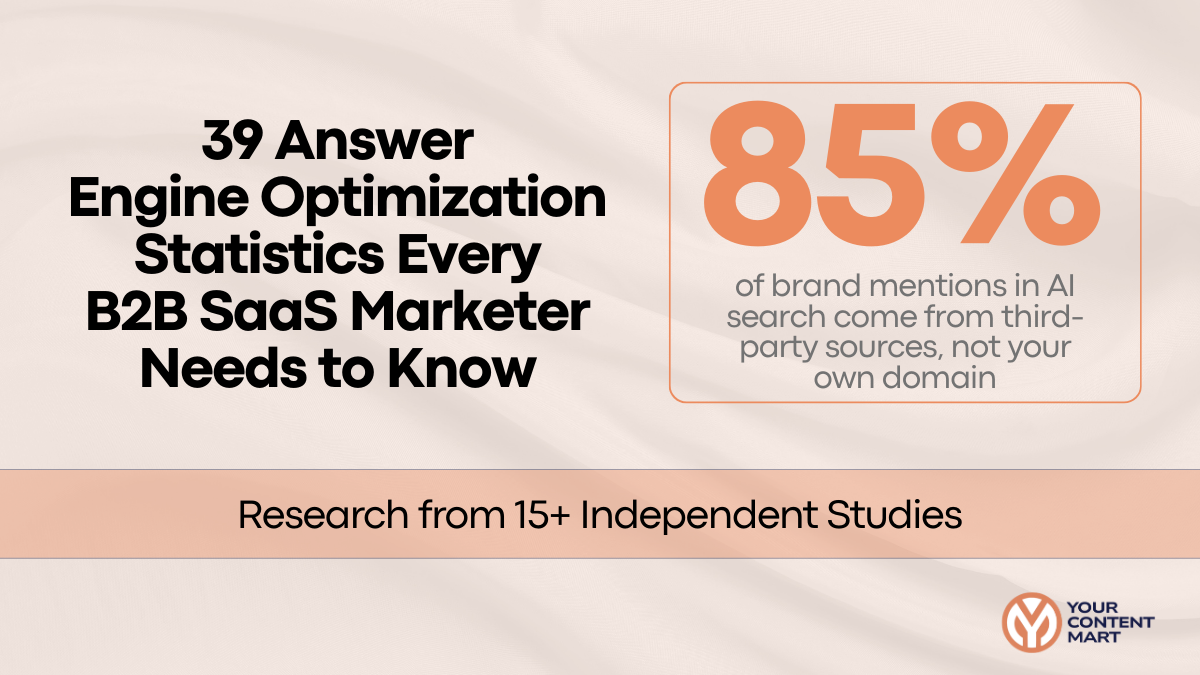
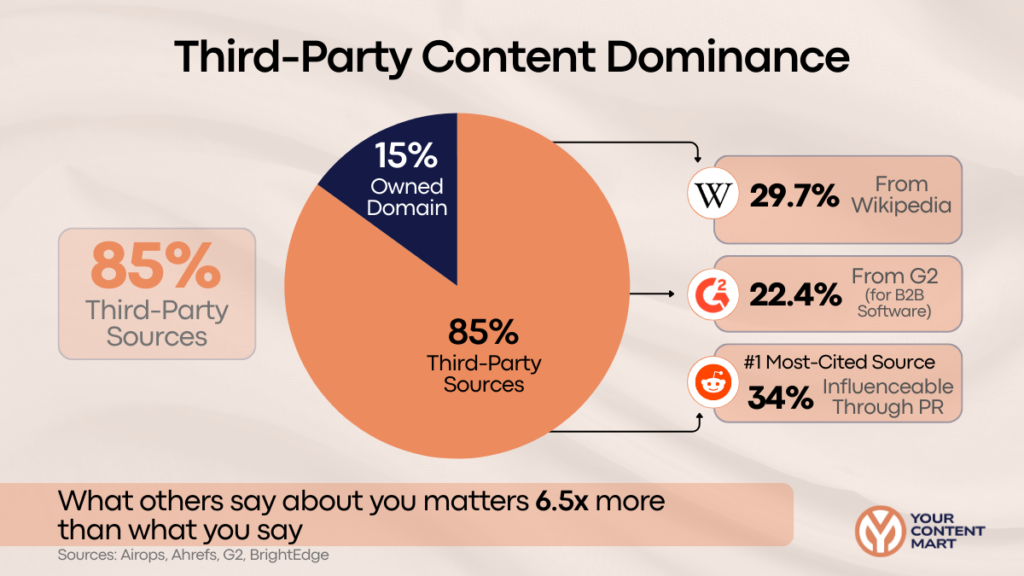
85% of brand mentions in AI answers originate from external or third-party domains. Only 13.2% come directly from the brand’s own site. That means AI platforms aren’t just crawling your blog and pulling content from it. They’re looking at the consensus. What are people saying about you on Reddit? What reviews exist on G2? What discussions mention your brand on LinkedIn, Slack, or industry forums?
The clearest example of this: Microsoft’s corporate blog generates fewer AI citations than Reddit threads about Microsoft products. Think about that. A Fortune 500 company with massive resources and a polished content operation gets cited less than unpaid community discussions. Why? Because Reddit has raw, unfiltered conversations. People share pros, cons, use cases, and real experiences. AI platforms value objectivity over corporate messaging.
Across 4+ billion tracked citations through late 2025, Reddit is the most-cited source across all major answer engines. If you’re a B2B SaaS company and you’re not active on Reddit, you’re missing one of the most important channels for AI visibility.
Wikipedia matters too. 29.7% of ChatGPT’s top 1,000 cited pages are Wikipedia pages. Getting your brand or category properly represented on Wikipedia isn’t vanity; it’s strategic.
For B2B software specifically, G2 accounts for 22.4% of citations for B2B software-related queries across ChatGPT, Perplexity, and Google AI Overviews. That’s the highest influence of any single platform in this category. Reviews aren’t just social proof anymore. They’re direct inputs into AI recommendations.
The opportunity: 34% of AI citations pull from sources that brands can influence through PR. That means being cited by industry publications, mentioned in third-party content, featured in community discussions, and covered by credible external sources.
What this means: You’re not just creating content anymore. You’re training AI models. And those models learn from what the entire internet says about you, not just what you say about yourself.
Key Takeaway
The strategic shift is from “publish more blog posts” to “train AI models through omnipresence.” After you publish content on your site, repost it on LinkedIn. Share insights in relevant Slack channels and Reddit threads. Actively participate in community discussions where your target audience gathers. Encourage and respond to reviews on G2, Capterra, and other platforms. Get cited by industry publications and third-party sites that write about your category. The more places your brand is mentioned authentically, the higher your probability of being cited.
Google AI Overviews & SERP Impact
AI Overviews are no longer an experiment. They’re reshaping how Google Search works.
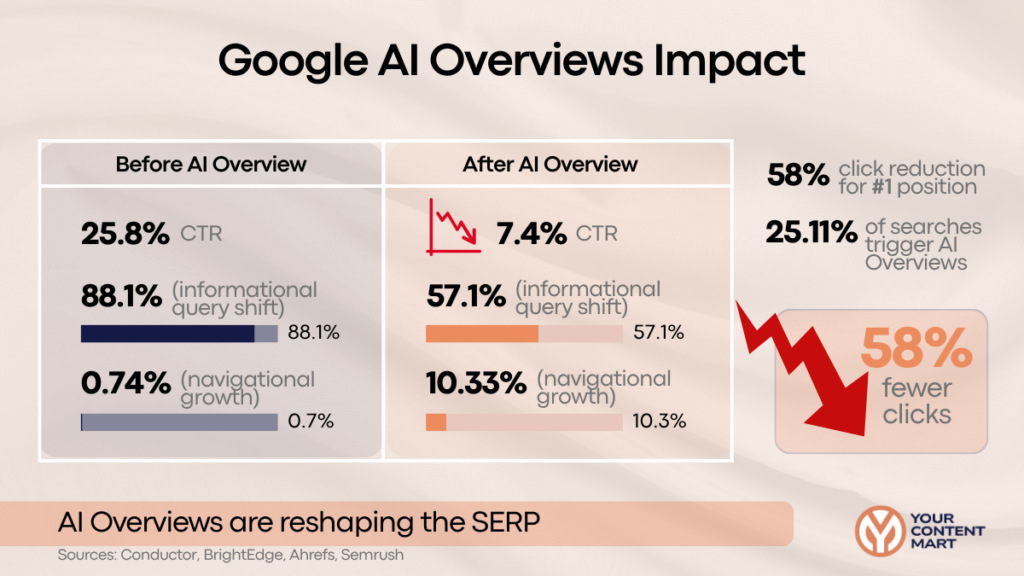
25.11% of Google searches now trigger an AI Overview. That’s one in four searches. Google is choosing to serve AI-generated answers instead of immediately showing the traditional ten blue links. And the impact on organic traffic is significant.
When an AI Overview appears, the click-through rate on the top organic listing drops from 25.8% to just 7.4%. That’s a 71% reduction in clicks. Even if you’re ranking in position one, AI Overviews reduce your organic CTR by 58% as of December 2025. When users see the answer they need in the AI Overview, they don’t click through to your site.
Here’s where it gets more concerning for B2B SaaS companies: 88.1% of AI Overview triggers were informational queries as of March 2025, but that share fell to 57.1% by October 2025, indicating that commercial and transactional queries now account for a much larger share. Google is rapidly expanding AI Overviews into commercial and transactional searches. The “it’s only for informational queries” defense no longer applies.
Navigational AI Overviews grew from 0.74% in January 2025 to 10.33% by October 2025, a more than 13x increase in under a year. Google is pushing AI deeper into every type of search, not just how-to questions.
One bright spot: being cited in an AI Overview correlates with 35% more organic clicks and 91% more paid clicks compared to not being cited at all. So while AI Overviews reduce overall clicks, if you’re one of the sources mentioned in the Overview, you still benefit relative to competitors who aren’t cited.
What this means: The game has changed. When someone searches for “best email marketing software for small businesses,” and the AI Overview lists five options, most users will research those five brands rather than scrolling down to see traditional organic results. Being mentioned in the AI Overview is now more valuable than ranking fourth or fifth on the page.
Key Takeaway
Google is building AI into everything: AI Overviews, AI Mode, Chrome, Gmail. AI Mode may eventually become the default search experience. This is the time to be strategic, not reactive. You can’t just focus on ranking in traditional results anymore. You need to optimize for AI Overviews, which means going beyond publishing on your blog. Get mentioned on third-party sites, build presence in communities, earn reviews on relevant platforms, and create content that AI platforms recognize as authoritative. SEO still matters (as we saw in Section 2, 76% of AI Overview citations come from Google’s top 10), but it’s no longer sufficient on its own.
AI Search Volatility, Citation Drift & Content Refresh
If you’re expecting AI search to behave like traditional SEO, where rankings stay relatively stable week to week, prepare to be frustrated.
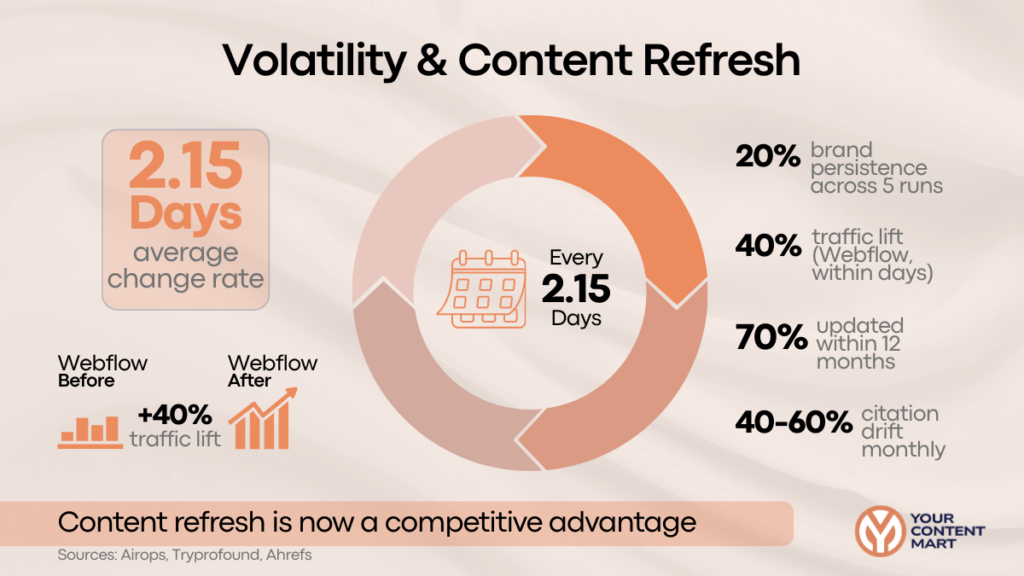
Only 20% of brands maintain visibility across five consecutive AI search runs. That means if you run the same query five times on ChatGPT or Perplexity, 80% of the brands cited in your first result won’t appear consistently across all five. Roughly 40 to 60% of the domains cited in AI responses will be completely different just one month later, even for identical questions.
Even Google’s AI Overviews aren’t stable. AI Overviews change their content every 2.15 days on average. The platforms aren’t locking in citations. They’re constantly reevaluating based on new data.
Why is it this volatile? The technology behind AI search, Retrieval-Augmented Generation (RAG), is designed to continuously update its knowledge. AI platforms don’t rely on a static index as traditional search engines do. They’re building consensus in real time by pulling from multiple sources, verifying information, and adjusting based on freshness and relevance. That creates instability, but it also creates opportunity.
Here’s proof it works: Webflow saw a 40% uplift in total organic traffic for refreshed articles within days of updating their content. That’s dramatically faster than traditional SEO, where it can take weeks or months to see the impact of content updates. The data supports why this works: more than 70% of pages cited by AI have been updated in the past 12 months.
What this means: AI search rewards recency and punishes staleness much more aggressively than Google ever did. If your content sits untouched for months, it’s not just underperforming. It’s disappearing.
Key Takeaway
AI search is still evolving, and the RAG framework that powers these platforms makes volatility inevitable. The upside: content updates show impact within days, not months. That means small, consistent refresh cycles compound quickly. So, you should treat content refresh as a core operational discipline, not a nice-to-have. The brands that win in AI search will be the ones that treat content as a living asset requiring constant attention.
What Doesn’t Work & Why Most Brands Have Zero Visibility
AI search doesn’t work the same way as SEO. Even with some overlap (creating content, earning mentions instead of backlinks), the underlying logic is fundamentally different.
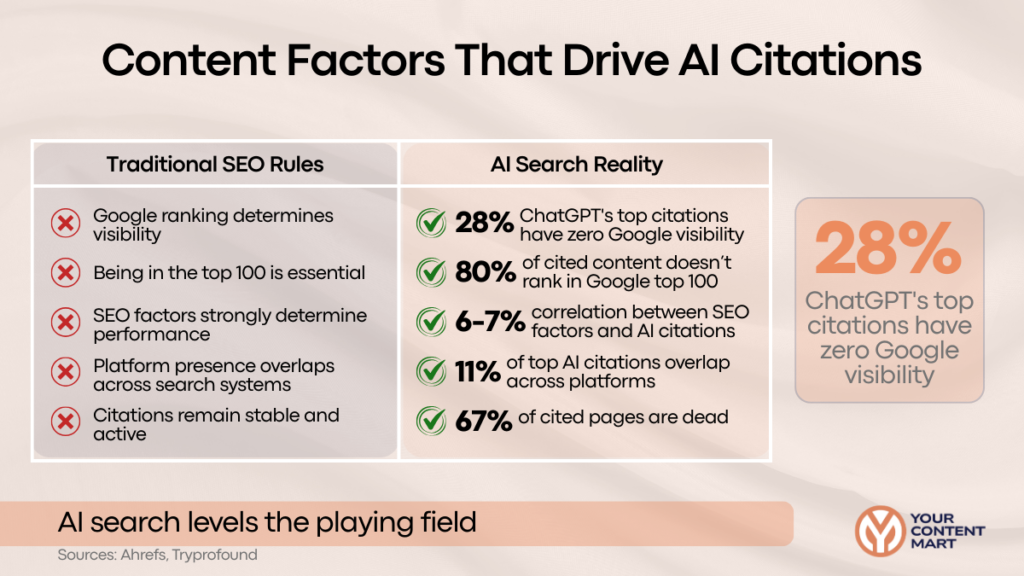
28% of ChatGPT’s most-cited pages have zero organic visibility in Google. Read that again. Nearly a third of the pages ChatGPT recommends don’t rank in Google at all. 80% of LLM citations don’t rank anywhere in Google’s top 100 results for the original query.
If you’ve been operating under the assumption that “if you don’t rank in Google, you don’t exist,” AI search breaks that rule completely. This creates a massive opportunity for smaller companies without the domain authority or backlink profile to compete in traditional SEO. If you create the right content and earn the right citations, you can be recommended by ChatGPT or Perplexity even if you’re nowhere near page one of Google.
Here’s why traditional SEO metrics don’t translate: standard SEO ranking factors like traffic and backlinks explain only 4 to 7% of AI citation behavior. The correlation is weak. AI platforms aren’t rewarding domain authority the same way Google does.
Platform fragmentation makes this even more complex. Only 11% of domains are cited by both ChatGPT and Perplexity. That means 89% of citations come from completely different sources across these two platforms alone. Winning on one doesn’t guarantee visibility on another.
The hard reality: 67% of ChatGPT’s top 1,000 cited pages are “dead citations” that brands can’t influence. Wikipedia articles, organizational homepages, app store pages, and reference sites you can’t reach through traditional outreach. But that leaves 33% you can influence: listicles, community discussions on Reddit, reviews on platforms like G2, third-party articles, and earned media.
And here’s one more number to sit with: brands are 6.5x more likely to be cited through third-party sources than through their own domains. Your website matters, but what everyone else says about you matters six times more.
What this means: You can’t just apply your existing SEO playbook to AI search and expect results. The rules are different. The opportunity is different, too.
Key Takeaway
AI search levels the playing field in ways traditional SEO never did. You don’t need to rank in Google to get cited by ChatGPT or Perplexity. You don’t need a massive backlink profile or years of domain authority. What you need is the right strategy: create valuable, fresh content; get mentioned in third-party sources (listicles, reviews, community discussions); show up in the places your audience already gathers (Reddit, Slack, industry forums); and build genuine consensus around your brand.
You’ve Seen the Data. Here’s What to Do With It.
You’ve seen the statistics. AI search is growing, traditional SEO metrics explain less than 7% of AI citations, and 85% of brand mentions come from third-party sources you don’t control. The shift is happening whether you’re ready or not.
The question isn’t whether to invest in Answer Engine Optimization. It’s about doing it strategically without wasting time and budget on tactics that don’t work.
We’ve helped companies like OneCal go from 8,000 monthly organic clicks to 31,300 in five months by building the kind of topical authority AI platforms actually reward. We helped Copysmith turn organic search into their #1 signup channel, growing monthly signups by 553% by targeting buyer-intent content that gets cited.
We understand how AI platforms decide what to cite and which content factors actually drive results. More importantly, we know how to build the kind of omnipresence across communities, review platforms, and third-party sources that trains AI models to recommend your product.
Book a call with us. We’ll look at where you are now, talk through what’s actually working in AI search for companies like yours, and figure out the most practical path forward. No pitch deck. Just a conversation about what makes sense for your business.

Shehu AbdulGaniy is the Founder of Your Content Mart. He helps B2B SaaS companies drive paying customers from SEO and AI search.